Category Archives: Thomas

About the Thomas Family

MY QUAKER HERITAGE

1966_0816_002

Like a bow wave pushing forward in front of a boat, competing religious denominations moved through 18th century North Carolina staying just ahead of the King’s reach. Baptists, Quakers, Moravians, Lutherans and others, held to their own tenants of faith, but were ultimately governed by laws set forth by the crown. Escaping the tyranny of European kingdoms and principalities, some came to this land as individuals while collective groups came in contract with and even funded by England’s need to populate this new land. Did these newcomers find satisfaction and security in the “church state?” From civic duties to faith, the King had power over all. Ultimately resolved in revolution, was it right for such power to be based solely on one man’s spiritual interpretations? Escaping oppression to this land with promises of so much hope, matters of faith really were complex. Over the next few posts, I’ll take a little time to explore my Quakers roots and share how their story sets the stage both for and in conflict with who I am today.

Quakers believed in the inner light. This was the notion that God was a spiritual presence within each individual and could speak to all humans through the words and actions of anyone. 

The Society of Friends known as Quakers spread across the open landscape of North Carolina along two primary paths of migration. Out of New Jersey, Pennsylvania and Maryland, Quakers brought over by William Penn moved with Moravians and others along the old Indian path usurped and is now known as the Great Wagon Road. These Quakers settled in the piedmont, particularly in areas surrounding present day Greensboro. But much earlier out of southeast Virginia, others opened meetings down east in Perquimans County and at places like Rich Square in present day North Hampton County. These Quakers migrated westward up the Neuse River to places like Contentnea Creek Meeting in old Dobbs, now Wayne County. Slavery and events of the mid-1700’s made it impossible for Quakers to morally justify efforts aimed at further growth in North Carolina. Guided by a strong peace ethic, the Quakers removed themselves in mass to places like Ohio and Indiana.

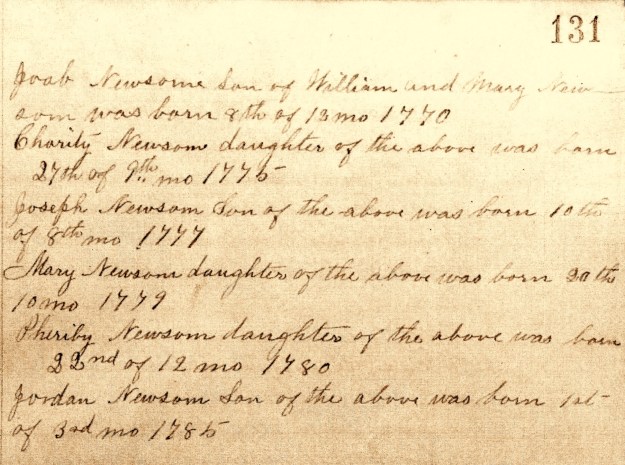
It’s in this environment that I begin to write about the life and family of Joseph Newsome. He was born in Wayne County, the third child of William and Mary  Jordan Newsome. He is my third great grandparent. And as written in the records of Nahunta Monthly Meeting (from the earlier Contentnea Creek Meeting), Joseph Newsome was born 10 Eighth 1777. Note that Quakers did not use the pagan naming for months as we do today:
2 001

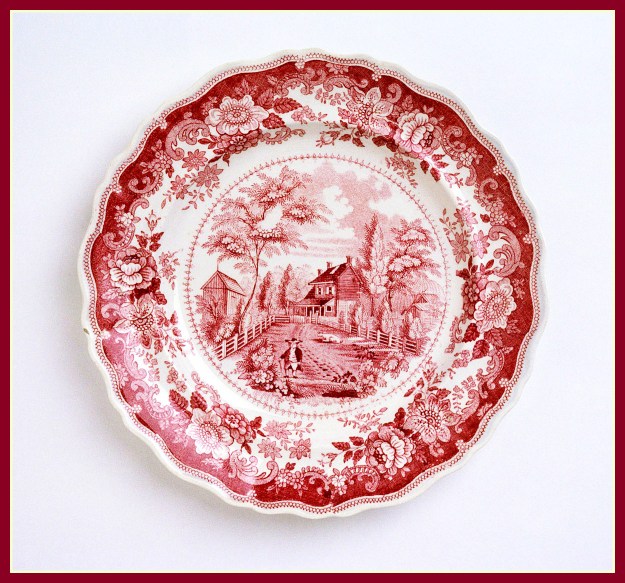
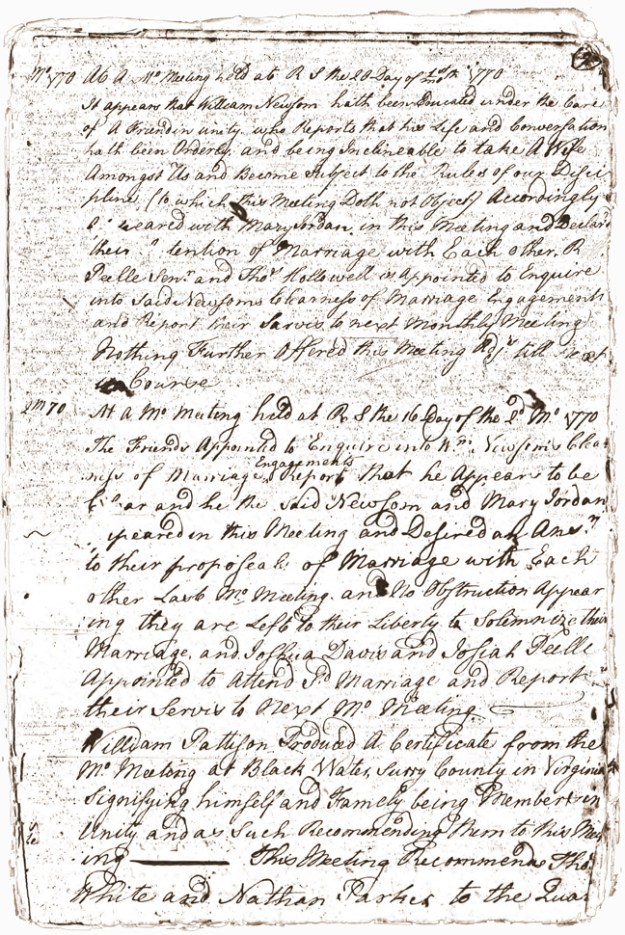
William Newsome was born about 1755 in Surry County VA, the son of Joel and Rebecca Dickenson Newsome. On 1770,1,20 William was received in membership to Rich Square Monthly Meeting in North Hampton County NC. There, he married Mary Jordan, the daughter of Joseph and Patience Ricks Jordan on 1770, 3,17. Joseph descended from Thomas Jordan, patriarch of what’s considered to be the most significant Quaker family in Virginia. And, closer to our immediate family, Mary Jordan’s brother Richard Jordan was a prominent Quaker Minister. He toured and preached throughout England and in his honor, a pattern of Staffordshire china was named for him. Richard lived out his latter life in New Jersey.  The image at the top of this post captures Richard’s home. ….and he is family!

My GGGG grandfather William Newsome’s request of marriage survives in Quaker Meeting records:
40642_301789-00033

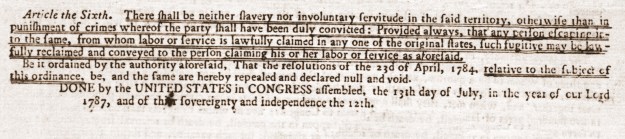
As a child, our Joseph Newsome witnessed the rapid increase in the acceptance of slavery as a profitable practice by farmers used to increase productivity. The trend was met by Quaker sentiment growing in its voice to abolish slavery. And then enacted 13 Jul 1787 by our newly formed United States Congress, the Freedom Ordinance (formally An Ordinance for the Government of the Territory of the United States, North-West of the River Ohio) created the Northwest Territory situated beyond the Ohio River. Item 6, the final item of this important act reads:
0002

Free from slavery, the newly opened land was an answer to Quaker prayers. Beginning in the late 1790’s, a migration to Ohio and Indiana escalated after 1811 when peace with the Indians was realized following the Battle of Tippacanoe. By 1820, most Quakers in North Carolina had either been disowned for holding slaves against church doctrine or had removed from the state in protest of slavery. In witness from a Nov 1911 Quaker church information bulliten in observance of the Quaker migration, the following was said about a person who had relocated to Indiana from the Contentnea Creek Meeting in Wayne County NC:

“. . .was visited by an aged Quaker Minister, who stayed the night. The next morning, the minister got up early, and took a walk over the farm. When he returned, he told his host he had an impression from the lord, that it would be right for him to sell the farm and move to the territory of Indiana.”

_________________________________

And now back to the Newsome family. William Newsome was likely disowned from the Quaker Church prior to 1790 as in that year he is listed in the Wayne County census as owning one slave. Dated 17 April 1795, the marriage bond for our Joseph Newsome and Christian Barnes appears in county records. Christian is the daughter of Simon and Mary Barnes. The 1800 Wayne County census enumerates Joseph and family as owning one slave. And following the mass exodus of Quakers to Indiana, Wayne County was likely not the place it once was.  Land records show that Joseph and family removed to Anson County NC ca. 1817.

Now living beyond his Quaker upbringings, Joseph Newsome lived out the remainder of his life on the banks of Gourdvine Creek in now Union County NC. Did his childhood amongst Quakers have an impact on his life? Built on his surviving bible, future posts will delve deeper into his family and into some of their lives in our changing antebellum south.


THE JOSEPH NEWSOME BIBLE

C - CopyJoseph Newsome was likely born in what’s now Wayne County NC in 1775 at the start of the American Revolution. His ancestry is clearly traceable by land deeds to early 1600’s Jamestown VA and possibly earlier to Robert Newsome from the 1550’s Newsome Chapel in Lancashire England. Like many others, Joseph and members of his family moved south and west, settling on the hills along Gourdvine Creek in present day Union County NC. It was there where his daughter Ally Newsome married my ancestor David Thomas, the son of Ananias Thomas.
In the late 1990’s I was overwhelmed with joy to learn that Joseph Newsome’s bible survived and was safe in the hands of the family matriarch whose life, at that time, was beginning to fade. Befriending her grandchild online through Genforum, I was graciously given the following photocopies. As you can see, the technology of the day was not very good though that’s okay as the record held important bits of information including the life record for my great-great grandmother Alla/Ally Newsome Thomas. And looking back to Joseph Newsome, it’s hard to imagine his legacy. It’s big; statistically, from 3,000-6,000 people have walked this earth because of the life he perpetuated.

Now many years later, I’m wanting to tell Joseph’s story, to show off the bible record and to share what I’ve learned from its pages. Putting my newfound love of photography to work, I recently sought to create and distribute a more perfect copy of the bible record. But time moves forward and the old matriarch has since passed. And, in process, the bible’s whereabouts is not at this moment known. Hopefully it’s in good hands. Likely, the present owner is unaware of its importance and hopefully will someday bring it forward.

Moving on, I’ve spent the last few weeks watching evening TV while working to digitally clean the old record. I don’t know how I feel about that as I’ve surely made mistakes and altered what was written many many years prior. But hopefully, the record will increase understanding and encourage conversation on this wonderful family story. Here is the cleansed copy along with a typed version found in a Carolinas Genealogical Society Journal.

And as a note of its provenance, my copy of the bible record was lost many years ago in a computer crash. And, the Newsome descendant who helped me loaned out their copy and its whereabouts are no longer known. So I recently reached out to Newsome family historian Dave Johnston who had received a copy of the record about the same time as myself. Of note, Dave as a descendant is not from North Carolina, though he lived near the old Newsome home place in Wayne County while serving at Seymour Johnson Airforce Base.

Our family story survives because of good people who have kept the stories safe. Good record keeping is important as is the generosity of those who understand the importance for shared distribution of family records. A sincere thanks to Dave and to all who have made this post possible.


A FUN LOOK BACK

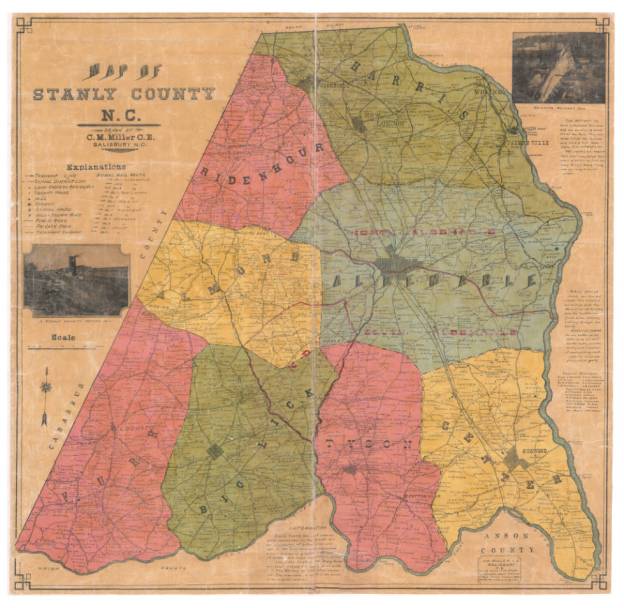
It’s a gray and dreary New Year’s day, so I’m kicked back, watching a bit of UNC Explorer TV and sharing memories with mom driven from the old 1905 map of Stanly County.  There’s a Smyrna and Lymra church located near where Love’s Grove UMC now stands.  And the Polk Ford road over to Love’s chapel crosses just above Chapel before passing by Clark’s Grove Baptist. And hey, in 1772 the route was likely the main highway from Charlotte to Elizabethtown!

I can also see my G-grandfather George Thomas’ home and store.  I’ve heard old folks talk about him journeying to Charlotte by wagon to load up on goods to sell.

Take a look and wonder around a bit.  Here’s the large searchable map of old Stanly County.

Can you find something you’ve always wondered about?  Where did YOUR grandparents or great-grandparents live?

A DAY WITH MS. ANNIE LEE

Nearly every visit to the farmlands of upper Union County includes a stop at the Fast Stop where I always honor the old ways with a 7 oz. Coke and pack of nabs or peanuts.

Fast Stop is one of those treasured country stores where local farmers and old timers congregate to share daily goings-on. Little did I know that advice offered on a certain less than fast stop would connect me to Annie Lee Traywick, a retiree who spent many years at the Lance plant making the Toastchee crackers I so love. …they really are the unbeatable compliment to a small bottle of Coke!

Annie Lee owned a picturesque farm near the intersection of Hwy 218 and Thanny Helms road where we spent hours talking about family history and plotting trips to old farms and graveyards. She knew her community, of the people, and of their past. With little access to hard records, Annie Lee passed down generations of family stories keeping alive the spirit of life. She was a tour guide of sorts; a caregiver always seeking to maintain memories while working to preserve old family cemeteries now falling to decay.

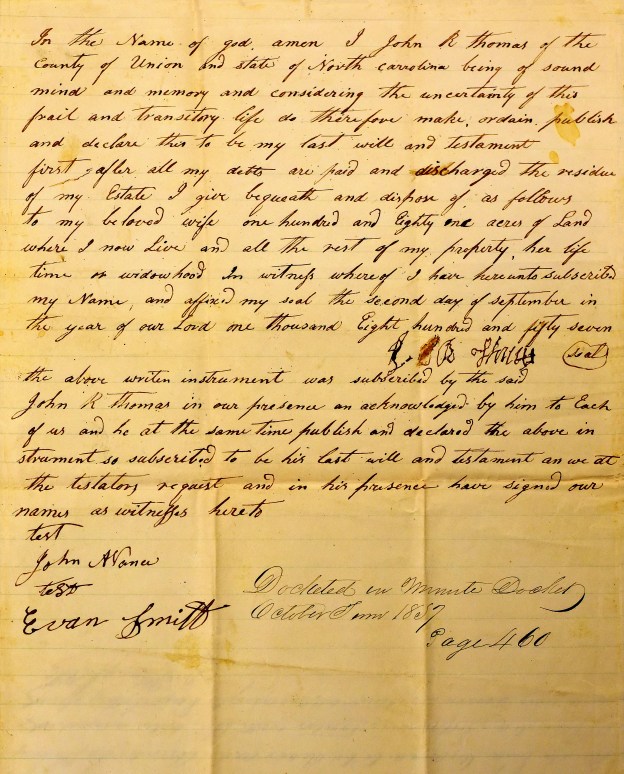
On one such visit we explored the life of John Robert Thomas, brother to my own ancestor David Thomas. Born in 1816, the son of Ananias Thomas, John married Annis Nance 2 Dec 1846. John’s life record is relatively short, with hints of legal troubles. He purchased land near Rocky River in the vicinity where Annis was raised. John wrote his last will and testament in 1857 and died prior to its probation a year later. Land and court records show that Annis continued to live in the area until or near her death. She’s buried at Oakwood cemetery in Concord near her son Clement Marshall Thomas. John and Annis Thomas also had a son John Calvin who’s buried at Big Lick Baptist not too far from my grandfather’s farm in Stanly County.

Seeking to satisfy my curiosity about his burial and the wanting to locate the lands of John R Thomas, Annie Lee Traywick led me to a Mr. Austin who raised African long horned cows on Pleasant Hill Church road. He knew bits and pieces and told us the homeplace was marked by a punch well on the old dirt road that once led from the fields of Austin’s Big Branch to Coble’s old mill on the river. He also spoke of an old Indian burial ground nearby. We found the punch well covered with briers at a point where two dirt roads converged near a large ravine. Annie and I spent an hour walking the old homesite. The burial ground Mr Austin spoke about was located on a small flat on the far side of the ravine. There were but a few small rounded stones and all were rough with no visible inscriptions. Some may be quick to identify them as old Indian stones, it’s my belief they mark the early generation of settlers.

Annie Lee Traywick had one more person she wanted me to see. Heading back up Pleasant Hill Church road, we turned off to pay a visit to Ms. Emma Austin. Upon arrival we had to wait a bit as Emma was busy on her tractor plowing the large field by her house. At roughly 94 years in age, Ms Emma was full of spirit. She showed us a black spot on her leg where she had recently been bitten by a brown recluse spider. Having been hospitalized with gangrene growing over much of her leg, she refused treatment, came home, and nursed herself back to health using a poultice of sulfur wrapped in bacon.

Ms Emma Austin had lots to tell. As a young child, she lived in the old home now identified only by a metal pipe protruding from the ground. She told of the good times and of hard times. She also knew of the old grave stones once marked with writing! From her testimony, we know Annis Thomas lived in the house when Emma was a baby and that the home place was always known as the Annis Thomas house.

112095247_1403469231

Annie Lee Traywick

It’s been more than ten years since Annie Lee led me through the rudes of Union. She’s now passed and I suspect Ms Emma has too. The backwood where the old place once stood has changed. It now sports several brand new brick homes and an improved roadbed. Today’s land owners likely know little of the past and of the people who once trod the land they now call home. The last few attempts to visit the little graveyard have been futile as I’ve yet been able to find it again. Someday! But hey, one of the homeowners is a THOMAS, so I’m looking forward to the new door that’s opened!


The New Year is upon us and while most are recovering from celebration, this Saturday I’ll be kicking leaves in search of family long lost.  It’s my thing.

MY THOMAS FAMILY


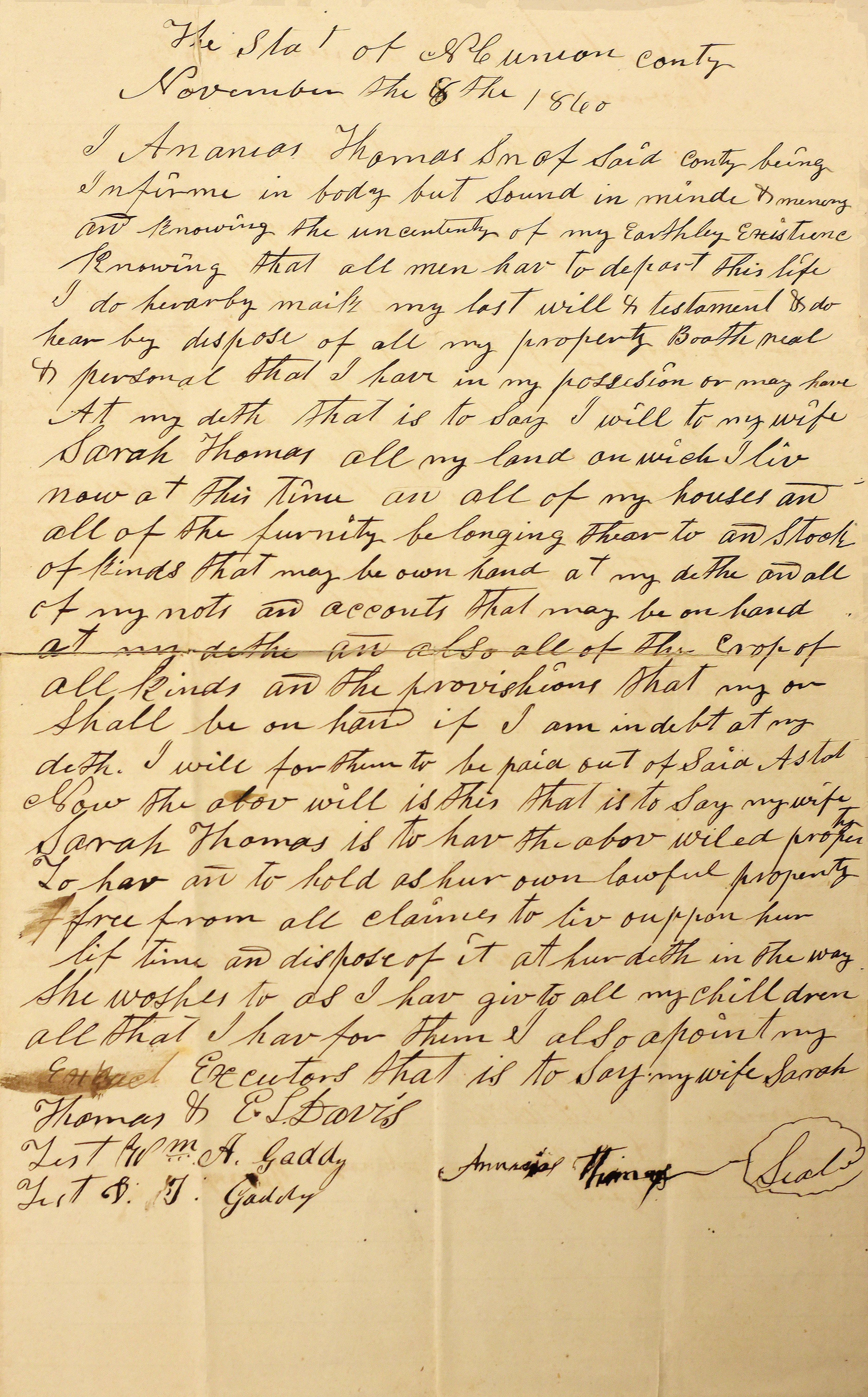
My GGG-Grandfather Ananias Thomas was born in 1779 and lived a long and prosperous life near the banks of Richardson Creek in upper Union County NC. He married a person named Sarah whose maiden escapes record. Both Ananias and his wife outlived most of their children.

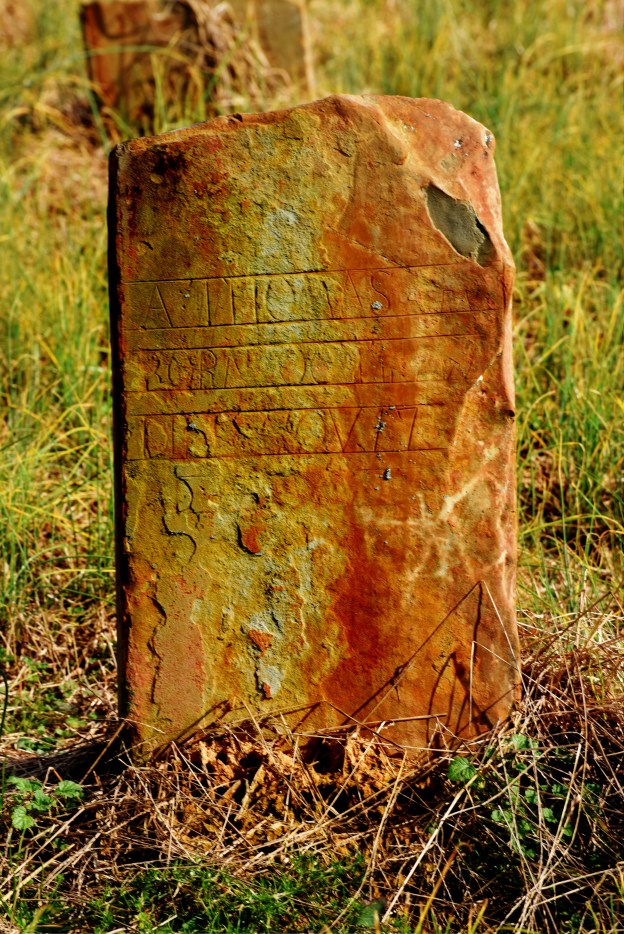
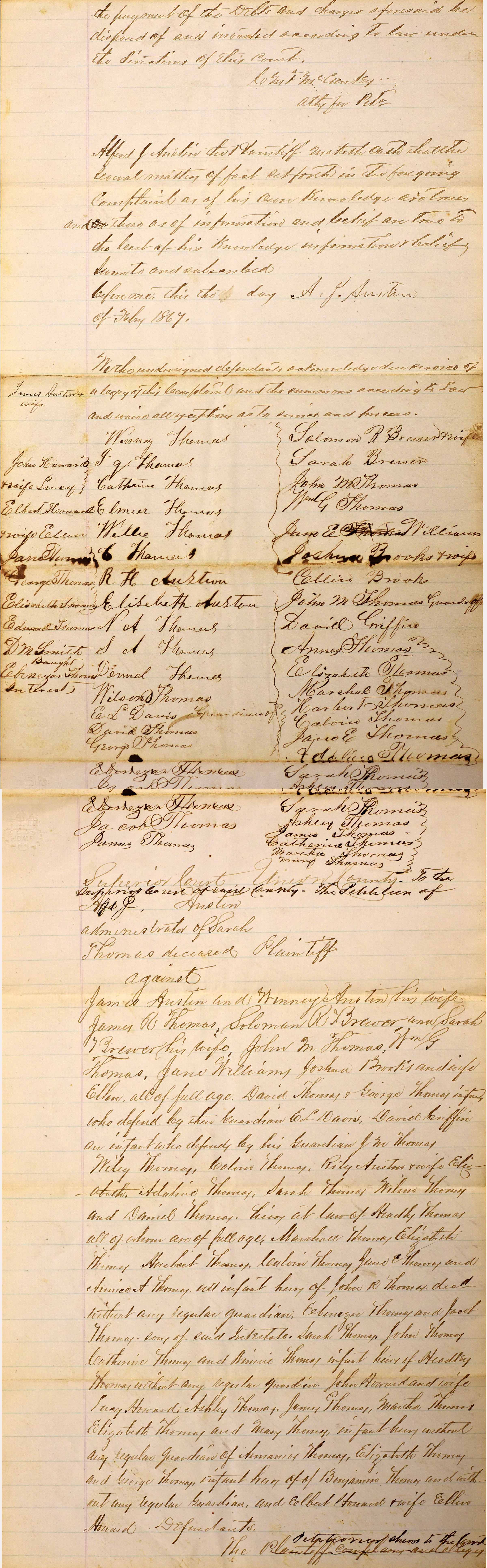
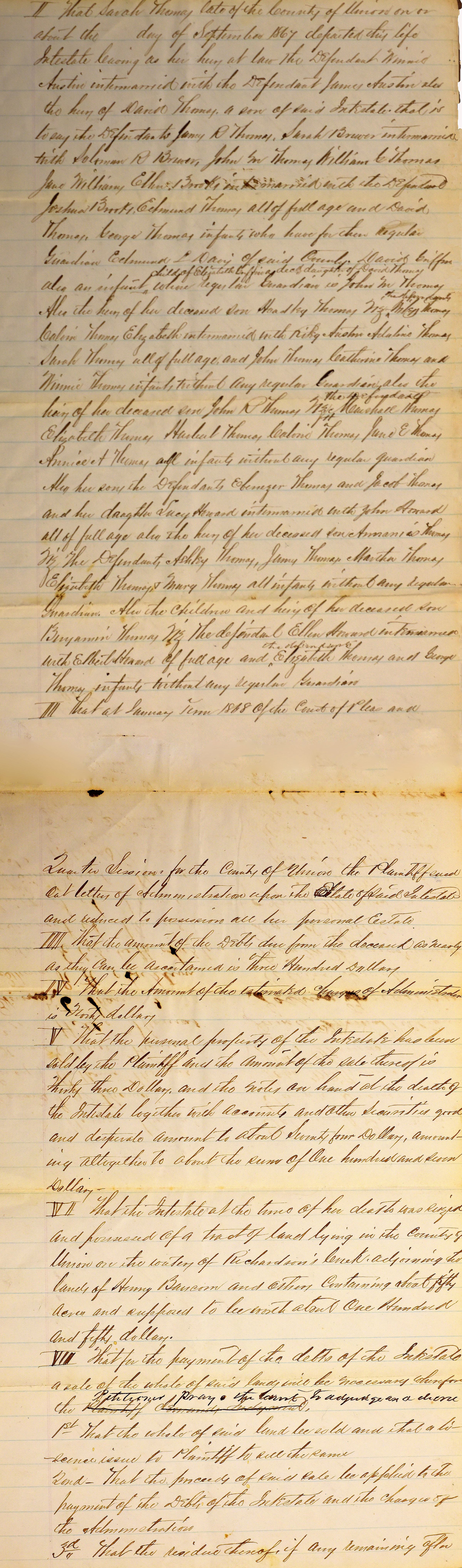
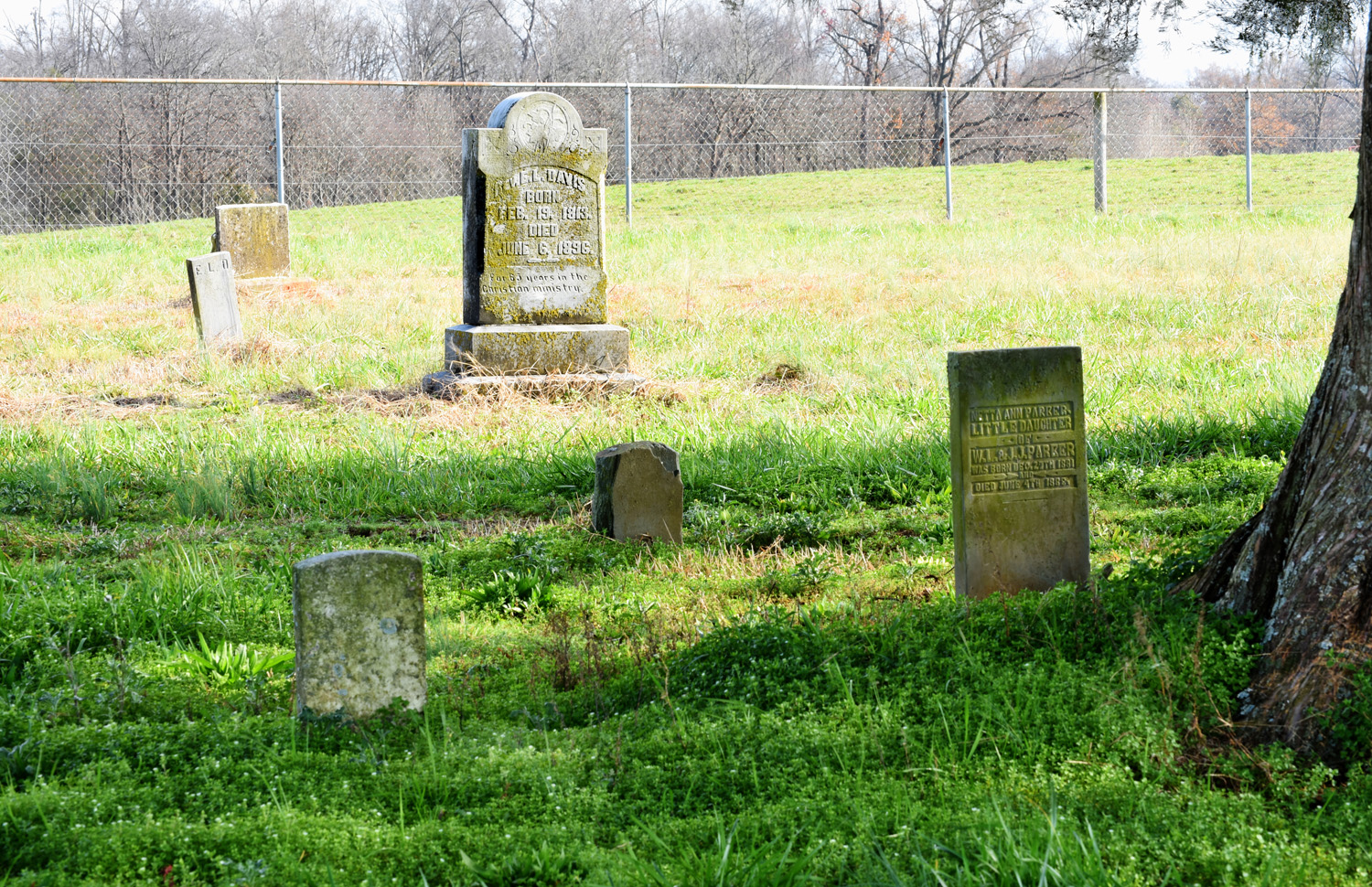
Living on the creek when the American Revolution swept through the region, Ananias wrote his will in 1860 and died 16 Feb 1861 at the start of the civil war. His grave stone (above) at the Edmond Davis Cemetery is barely readable today. Ananias’ wife Sarah died in 1867 and her estate papers list all the heirs including my own great grandfather George.

Rather than fill you with more computer generated font, below are images of Ananias’ last will and testament along with his wife Sarah’s estate papers. Take a look, imagine the shaky old hand using a quill pen to sign his last living directive. Read and imagine what kind of man he was. And look through Sarah’s papers and see if you can find your way back to Ananias and Sarah.

I want you to see the past like I do …it’s a puzzle full of mystery, written mysteriously in a language all but gone. Enjoy and may you look forward to a happy and blessed new year!

 
ananias will

DSC_4838

sarh estate

IF ONLY WE COULD TALK


David Thomas, son of Benjamin and brother of Ananias was born 1773 and married 1797 to Mary Presley, the daughter of Thomas and Sarah Lee Presley. This family moved from Anson County NC to Chester County SC around 1800. Mary died prior to 1830 and David married again to a person also named Mary. Some wrongly believe David’s second wife is the daughter of Thomas Satterwhite while it’s more plausible her maiden name is Brakefield. David died 1845 and his much younger second wife Mary was born ca. 1802 and died prior to the 1880 census.

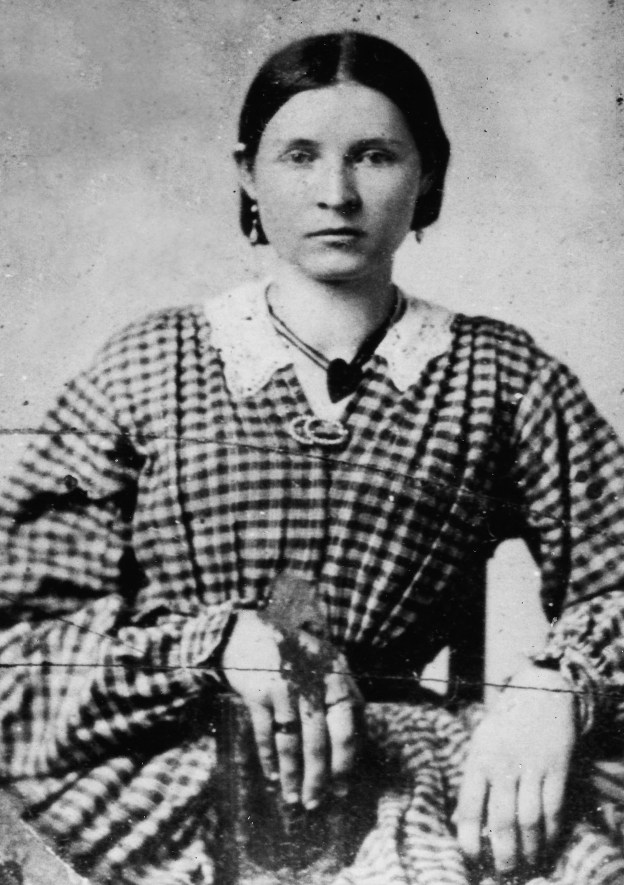
In the late 1990’s I was guided to speak with a lady in York SC who was known to be most knowledgeable on the family. Forgive me as I can’t remember her name. A very kind soul, she allowed me to copy a framed photograph traditionally believed to be the second wife of David. But for the life of me, it just seemed the person photographed was too young. I’ve recently learned more about the image and of family traits that make me question my early stance.

Using the collodion process, the original photograph of the above was a type of photographic image known as an ambrotype. Unique and unable to be copied as is accomplished with modern film processes, ambrotypes are projected and printed onto glass. Following the introduction of daguerreotypes in the 1840’s and predating tin-types of the 1860’s, ambrotypes such as this can be dated to the late 1840’s through the 1850’s.

Is the picture above that of Mary who is enumerated in the 1850 census as being 48 years old? Is it possible she padded her age a little to seem more respectful in age? Or, could this be a picture of another person that’s been misidentified for the many years?

Family lore holds strongly to the belief that the photo is in fact that of David’s second wife. And to their credit, the ladies in the family hold up well to the advances of time. This is certainly a wonderful photograph and an important record for the descendants of David Thomas of Chester County SC.

RELIGION ON GOURDVINE: PART 2

DSC_4372
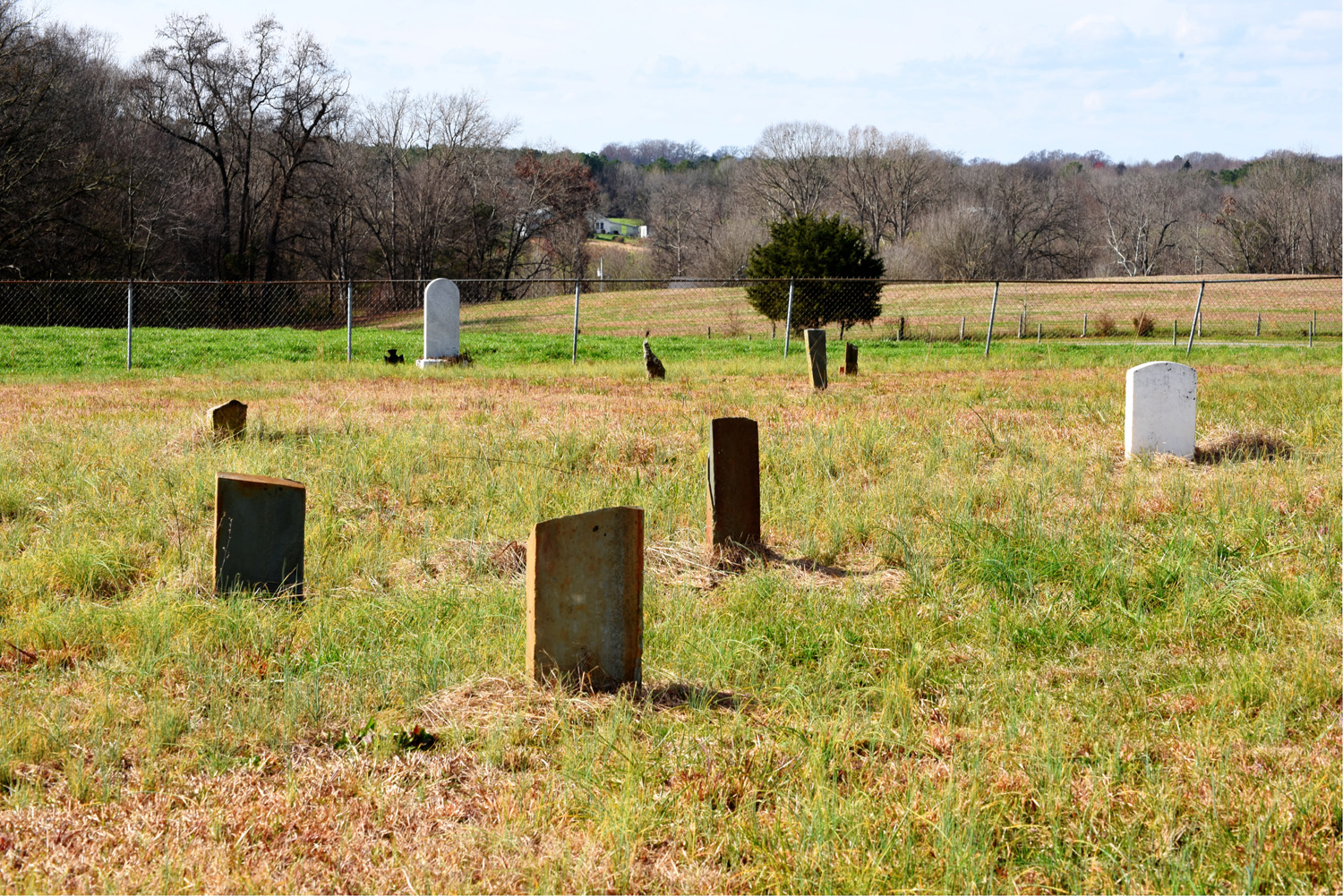
Staring across the grassy fields, I can imagine the goings on of early generations of settler. I’ve studied for years and feel in tune with their changing community and of the people who once lived near what is now the Edmond Davis cemetery. And realizing this was my ancestors’ final resting place, I know the story is not complete; there‘s more to be found and more story to be told.

Take a look at Edmond Davis cemetery … zoom in, zoom out and see the fields I see. The southeast corner of the cemetery is the place where my Thomas family is at rest. Edmond Davis and others are at rest under great cedars in the northern portion of the graveyard. And see the white spot midpoint of the west-most fence line?   That’s the resting place of Lorenzo Merriman Little, a member of Jesse James’ Gang who was on hand 13 Feb 1866 in Liberty Missouri for the first daylight bank robbery in the United States.  More on Edmond Davis cemetery can be found on Julie A. Hampton’ site.


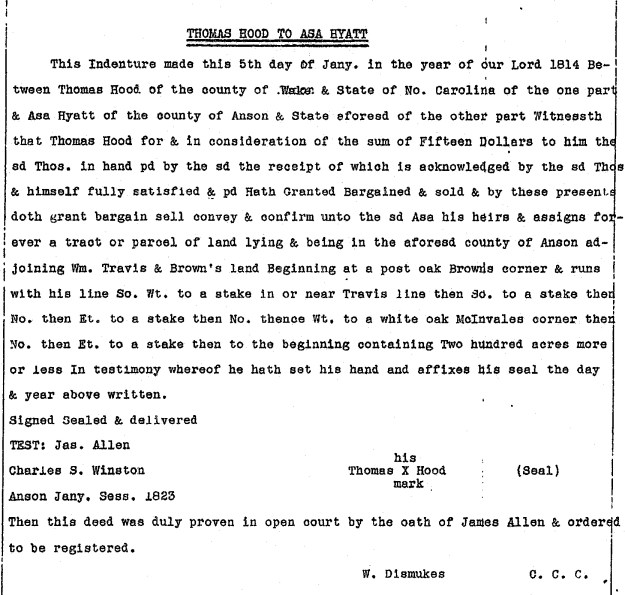
W__Websites_Anson_Tif_Deed_000V0415.tif_doc.tifWhile putting together the title history for lands around the cemetery, I happened across the following deed (left) dated 1821 in which James Baucom conveys 100 acres along Gourdvine Creek to William Holly. The tract originated as part of a land grant entered 1797 and issued 1811 to Frederick Taylor. Though my next post will delve deeper into the title history of the surrounding area, this one deed opens the possibility that Edmond Davis cemetery was more than a family graveyard. As highlighted in yellow, there must have been a “Meeting House Ford” on the waters of Gourdvine and I can only imagine there was also a meeting house nearby.

This is new and big as it does not relate to any known church histories. Well over 10 years before the founding of Jerusalem Baptist and more than 30 years before the founding of Olive Branch Baptist, we now know another church existed in 1821. It’s not Rocky River Baptist as it’s too far away. Let’s look back at the grant, neighboring lands and later conveyances to see where this all fits in today’s landscape.

gourdvineIn the illustration to the left, the Edmond Davis estate lands and cemetery are identified as a red shaded area. Frederick Taylor’s 1811 grant for 300 acres is lined in blue and adjoins the lands of Richard Lee as is written in the warrant for survey. You’ll also note another tract granted to Jacob Gurley. It’s in that tract where I believe the “Meeting House Ford” once crossed Gourdvine creek. Here’s a short title history of the land originating in the Frederick Taylor grant:

Grant # 5982 to Frederick Taylor, Anson NC, ent. 20 Dec 1797, iss. 18 Dec 1811. Being 300 acres on both sides of Gourdvine Creek.

  • Deed O-187 Anson NC, 6 Aug 1808, John Jennings Sheriff to Richard Williams for debt owed to Solomon Steagall being the entire 300 acres.
  • Deed S-274 Anson NC, 26 Jan 1818, Richard Williams to Willis Williams being all of the tract lying west of Gourdvine Creek containing 200 acres. Wit: Isaac Williams, Jacob Little.
  • T-304 Anson NC, 26 Nov 1819, Isaac Williams to Obediah Curlee being all of the tract on lying on the east side of Gourdvine containing 100 acres. Wit: Isaac Williams, Jacob Little.
  • T-313 Anson NC, 2 Jan 1821, Obediah Curlee to James Baucom being all of the northern half of the tract above the dashed line containing 216 acres. Wit: Lewis Baucom, Ransom Baucom.
  • V-415 Anson NC, 24 Sep 1821, James Baucom to William Holly being all of the northern half of the 300 acre tract lying west of Gourdvine containing 116 acres. In this deed the northern most east-west line is identified as being above the “Meeting House Ford.” Wit: C. B. Curlee, William Mullis.

DSC_4423_4_5_tonemapped… above the Meeting House Ford. Hmmmm, … as water runs downhill, the ford should cross the creek within the adjoining tract downstream from the land originating in Frederick Taylor’s grant. Entered 1797 and issued 5 Dec 1805, Jacob Gurley received 100 acres adjoining Michael Austin’s lands on both sides of Gourdvine at the mouth of “Buck Branch.” Nobody today knows anything about Buck Branch though a branch does rise just below the cemetery before making its way to Gourdvine below Olive Branch road. Here’s a look at the conveyances of this piece of Jacob Gurley’s land:

  • L-195 Anson NC, 4 Mar 1805, Jacob Gurley to Isaac Williams Senr, being the 100 acres granted to Jacob Gurley. Wit: Willis Gurley, Isaac Williams.
  • V-92 Anson NC, 3 Apr 1822, James Baucom to Solomon Mullis, being 25 acres of Jacob Gurley’s 100 acres lying on the west side of Gourdvine. The deed states the land was conveyed from said Gurley to Isaac Williams Senr, then to Obediah Curlee and then to James Baucom. Wit: Obed. Curlee.
Olive Branch road passing over Gourdvine creek

Olive Branch road passing over Gourdvine creek

Where was the Meeting House ford located?  There’s very little option other than it crossing at the same location  as today’s bridge or at least very close nearby. And knowing the location of Meeting House ford in 1821, exactly where was the Meeting House?

It’s my belief that at some point from 1800-1820, a Baptist church was organized and built on the hills above Gourdvine creek. In 1821, at the time James Baucom purchased land from Obediah Curlee, the church and graveyard (now Edmond Davis cemetery) must have already begun to serve numerous families in the community.

As Baptists are social in order, survival of the church was dependent upon the clout and leadership of a few families. Something happened to this dynamic causing change. What could have happened?

Edmond Davis grave

Rev. Edmond Davis grave

We’ll never know for sure though the 1830’s and 40’s were hard. Migrations west carried away many and there was also disease and death. It’s important that my own David Thomas’ lands at least adjoined the cemetery and that he and his wife both died in the early 1850’s. Baptist minister and uncle Edmond Davis oversaw both the estate and orphaned children. In 1857, he bought David Thomas’s land that adjoined the cemetery. And then in 1858, Edmond Davis and others provided notification that Olive Branch Baptist church was to be built on Henry Baucom’s nearby lands. See Julie A Hampton’s site.

The church grew strong and Olive Branch as a community was formally incorporated in 1875. Though Olive Branch Baptist church had its own cemetery, the old graveyard by Gourdvine creek continues its service through today. Why has it survived and why did they name the new church Olive Branch? A sign, a branch of peace, there must have been a very real reason. It’s my belief the name was a way of bringing together a community that had been divided by death, migration or social conflict. It’s only a guess; it’s not meant for us to know for sure.

foreground - grave of Ananias Thomas, background -gave of Merriman Little, distant landscape - location of bridge and likely site of Meeting House ford.

foreground – grave of Ananias Thomas, background by fence -grave of Merriman Little,  distant low land – location of bridge and likely site of Meeting House ford.


RELIGION ON GOURDVINE: PART 1

The Edmond L. Davis cemetery is located on a hilltop just east of the bridge where Olive Branch road crosses Gourdvine Creek in Union county NC.

The Edmond L. Davis cemetery is located on a hilltop just east of the bridge where Olive Branch road crosses Gourdvine Creek in Union county NC.

I remember Thanksgiving weekend 1996 and a visit to the Edmond L. Davis cemetery in Union county to photograph family lands I had only recently learned about. It was dreary, cold to the bone, and yet the frequent sounds of gunshot rang out as hunting season was in full swing. My father had passed less than a year prior and here I was alone in a cemetery seeking to lay witness to my GGG grandfather Ananias Thomas’ grave. I found his hand-carved stone which appeared to be grouped in a plot amongst other members of Thomas family. And just behind his grave were two unmarked stones that some have identified as mere foot markers. However, it’s always been my belief the stones mark the resting places of my GG grandparents David Thomas and his wife Alice Newsome Thomas. David is the son of Ananias.

Both David Thomas and his father-in-law Joseph Newsome owned land along Gourdvine creek in the vicinity of present day Edmond L. Davis cemetery. Prior to his death ca. 1843, Joseph Newsome sold some of his land to David Thomas. Per bible record, Joseph’s daughter Alice Thomas died 3 Dec 1852 and Union county probate records indicate David Thomas died prior to 1855.

Lot 1 of the estate of Edmond L. Davis

Lot 1 of the estate of Edmond L. Davis

Following the death of David and Alice Thomas, Edmond Davis was appointed estate administrator . He was also named guardian of the younger children including my namesake ancestor George Thomas. In the Fall Term 1856 of the Court of Equity for Union County, C. M. McCauley ordered the sale of 268 acres. Known as lot 1 of the “land upon which David Thomas lived at the time of his death”, this tract was situated on the south side of Gourdvine Creek. It adjoined David Thomas’s second tract and the lands of Elbert W. Caraway and Edmond Davis. On 30 Dec 1856, Edmond L. Davis purchased the land for $1,325.

Important! Following Edmond Davis’ eventual death on 6 Jan 1896,  lot 1 of his own estate takes in the cemetery that now bears his name (see plat above) . The tract matches and therefore can be accurately located using county GIS land records.

historyofrockyri00broo_0073Edmond Lilly Davis was a prominent Baptist minister in a region historically dominated by Baptists. His life and services are well documented in E. M. Brook’s 1928 History of Rocky River Baptist Church. Edmond Davis was also a friend and brother in-law to David Thomas as he married Mary Elizabeth Newsome, a sister of David Thomas’ wife Alice.

Note that David Thomas owned 660 acres per the 1852 Union county tax list at a time when Edmond Davis was listed with less. Following the death of David Thomas, the numbers reverse with David’s ownership of course going to zero.   From this I’ve always wondered if the cemetery was built on lands that once belonged to David Thomas and/or his father-in-law Joseph Newsome? The following plat locates the entire estate of Edmond Davis. Note the portion highlighted in purple identifies the one lot Edmond Davis purchased from the estate of David Thomas.

davis2

Estate of Edmond L Davis

At this point, after nearly 20 years of looking, I still cannot say with absolute certainty that the graveyard in question was first located on David Thomas’ home land. But we know his lands were oh so close as were his father-in-law’s. And knowing there are no graves marking the resting place of David and Alice Thomas, my mind goes back to something Ms. Annie Lee Traywyck once told me: “The cemetery once had many more stones that eventually went the way of cows”.  And then there are the two stones behind those of Ananias and his wife Sarah.  Stake-like in form and made of a much harder granite, was there ever even clear writing on the stones? Is it just my wishful thinking? And note that Olive Branch Baptist Church just up the road was formed by Edmond Davis and others in 1858 just as the estate of David Thomas was being settled?

Before Olive Branch Baptist, where did the folks along Gourdvine creek go to congregate and seek spiritual comfort? Where there’s more than two gathered, there would have been church. Where was it?


DECIPHERING A STORE LEDGER

melcher

______________________________

“When I was a little bitty boy, just up off a floor, We used to go down to Grandma’s house every month end or so. We’d have chicken pie and country ham, homemade butter on the bread. But the best darn thing about Grandma’s house was her great big feather bed. It was nine feet wide, and six feet high, soft as a downy chick It was made from the feathers of forty-eleven geese, took a whole bolt of cloth for the tick.” – John Denver

John Denver’s song “Grandma’s Feather Bed’ echoes a way of life dear to my mother’s memories of childhood. At a time before the modern conveniences of central heating and air conditioning, on cold winter nights, mom would warm by the fireplace before going to bed. Running as fast as her little legs would carry her, she’d jump up onto a feather tick piled high with soft warm quilts.

Not knowing the origin of the word “tick,” I’ve always imagined a mattress packed so full of soft down and feathers that it looked rather like a plump, well-fed deer tick. This viewpoint changed after reading the following store ledger written long ago.

IMG_20150626_170227926

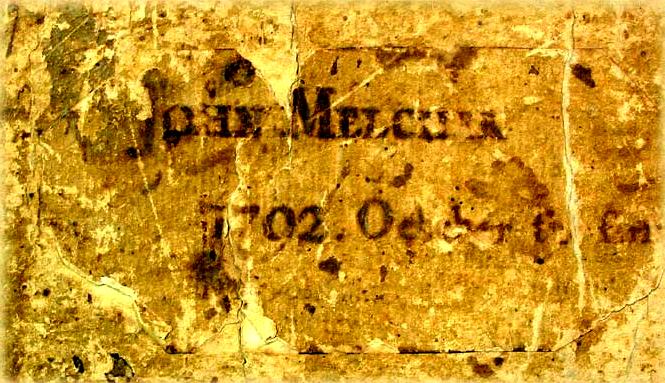
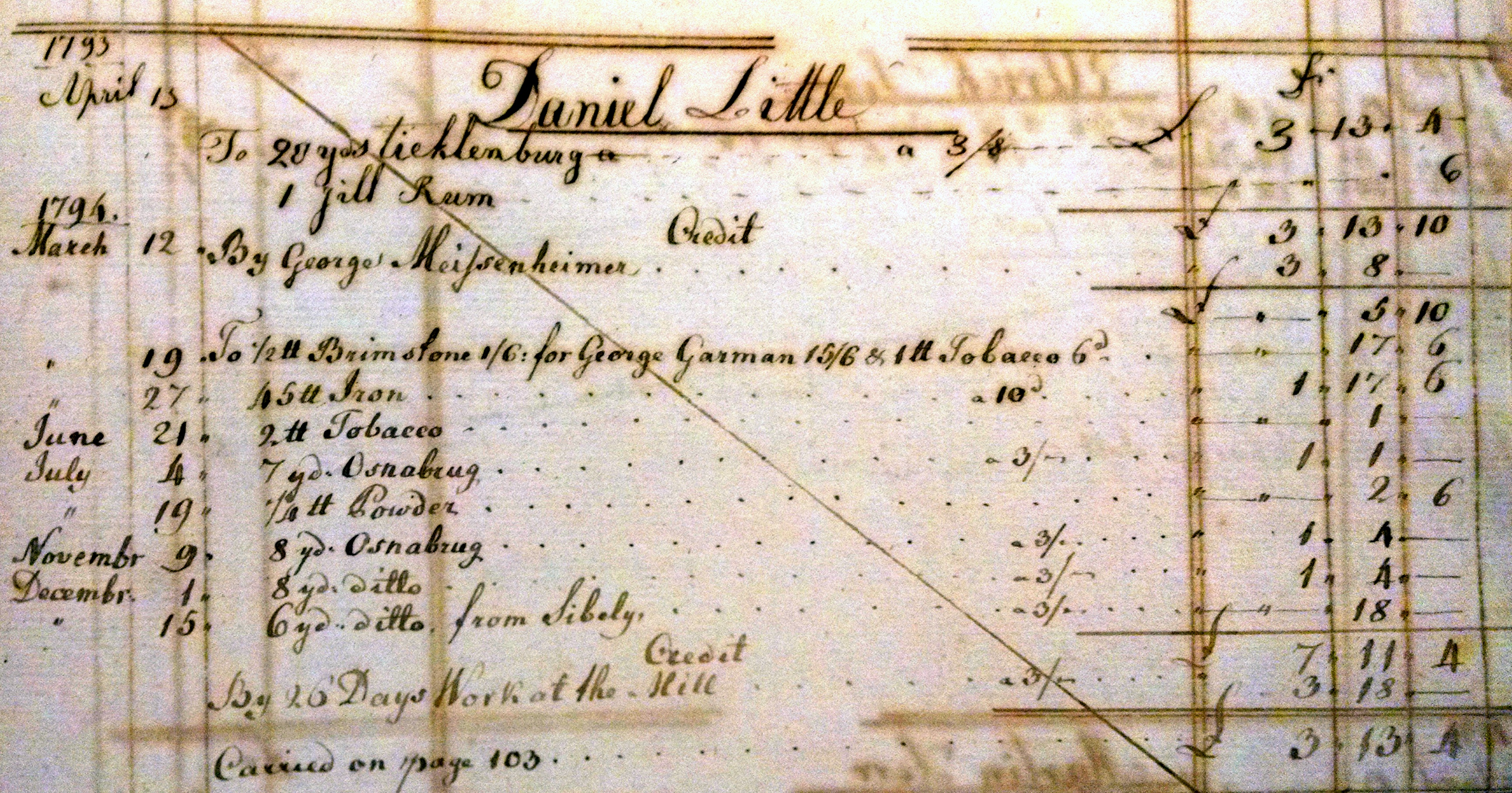
In 1793, almost ten years before moving from North Carolina to Kershaw South Carolina, Daniel Little (Junior) made the above purchases at John Melchior’s store in Cabarrus County. Such ledgers provide a wealth of information, offering clues and rare glimpses into the daily lives of our early ancestors. An account in this store ledger documents Daniel’s numerous puchases of Osnaburg along with 20 yards of ‘Ticklenburg’. Curious as to the Germanic sounding names of these items, I searched online to find out more; I am amazed at what I learned.

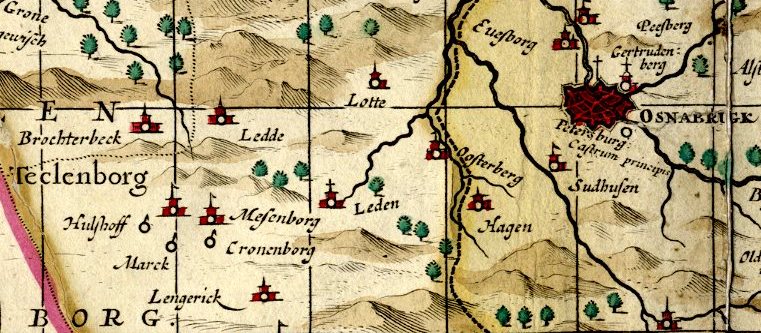
Located in the south of Lower Saxony, German was Prince-Bishopric of Osnabrück, a state of the Holy Roman Empire from 1225 to 1803. The fabric purchased by Daniel Little at Melchior’s store is rooted in this region, in the town of Osnaburg, known historically for quality woven cloth and fabrics. Originally made from flax yarns, the creamy white Osnaburg cloth has also been made from tow or jute yarns. A coarse imitation of the German fabric began to be woven in Scotland in the 1730’s and quickly became the most important variety in east-central Scotland. For bedding and clothing garments, Osnaburg was used in revolutionary war uniforms and was the fabric most often used to clothe slaves prior to the Civil War. It’s still commonly used today for window curtains.

ldy125

Happy to have found the origin of the Osnaburg fabric, I was then surprised to find that less than 15 miles to the southwest of the town of Osnabruck, was a district and town called Tecklenburg which was well-known for making another kind of cloth. Named after the town, Tecklenburg is a course blue and white striped industrial-type material often used for britches and bedding. Today we know it as “Ticking,” the blue and white fabric we’ve all seen made into mattress and pillow coverings. So now we know that it is this place in Germany where the naming of our fabled feather tick is rooted!

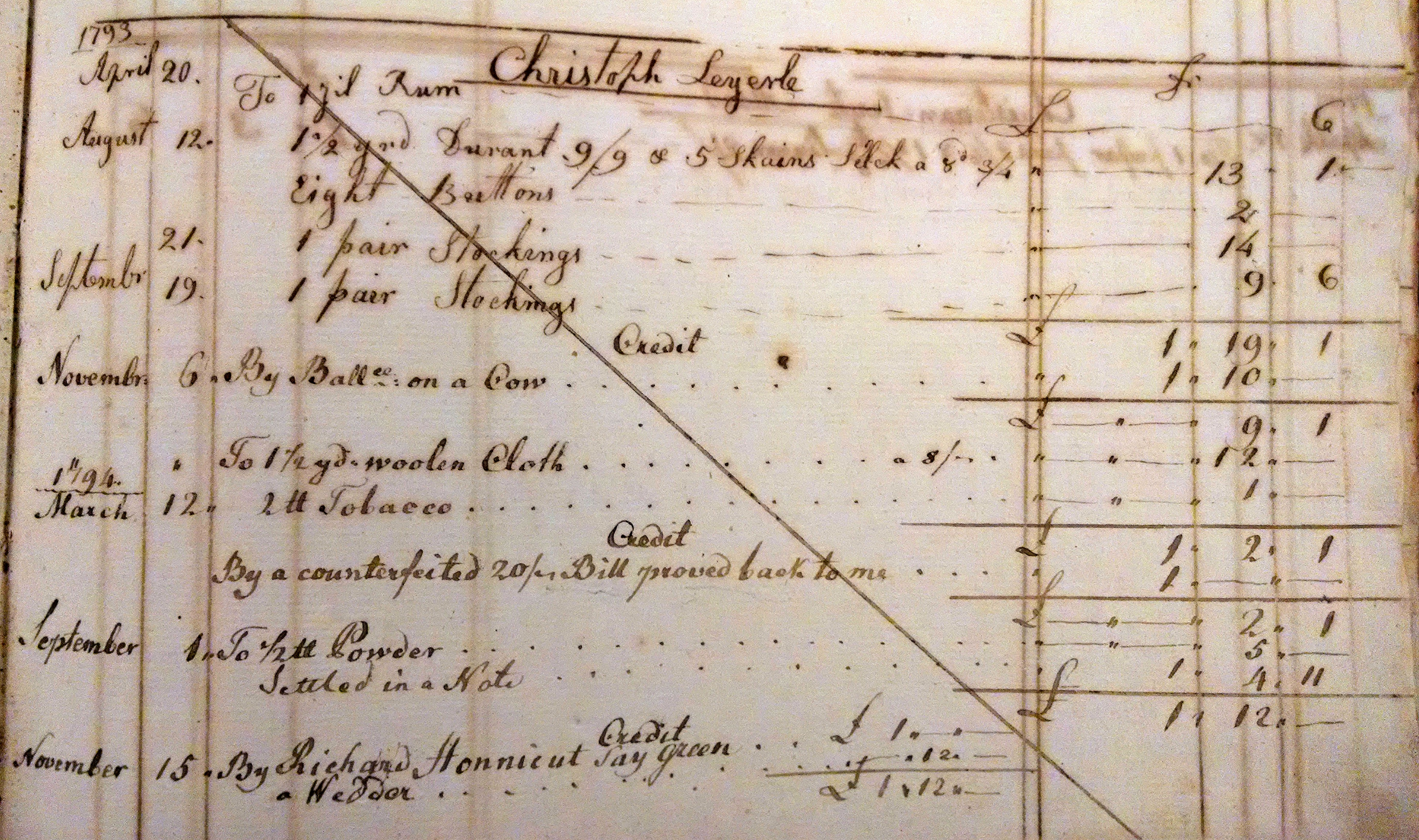
In another 1793 purchase by Christoph Lylerle (above), stockings, buttons, and Durant were purchased. Durant is of Norman origin being derived from an Old French word meaning “enduring.” I’ve not found the exact connection though the name of this cloth is likely attributable to John Durant, a wealthy wool merchant who died in 1297 Bedfordshire, England. The Columbia Cyclopedia identifies Durance as “A term applied to the leathrn dresses worn by the lower orders; a stout woolen stuff formerly made in imitation of buff leather, and used for garments, also called Durant and Tammy.”

IMG_20150626_165608134

And worth sharing in this post, I stumbled across the chance to learn from another word found in Christoph Lyerle’s acount. In the last entry, dated November 15, 1793, Christoph’s account was paid off by Richard Honnicut. At first reading this as “Green, a Widdow,” I thought maybe I had stumbled upon some genealogical clue. Excited, and in discussing this with a friend who just happened to be a retired NC State animal husbandry professor, I quickly learned that a “Wedder” is a castrated annd fattened sheep! Aparrently Richard paid for the bill with a fat sheep!

Note that one other purchase by Christoph Lylerle was paid for using counterfit money. This was a major issue after the Revolutionary War and was one met with harsh penalties ..more later.

Have fun reading those old docs!