OROPEAK (Pt 2)

drummond

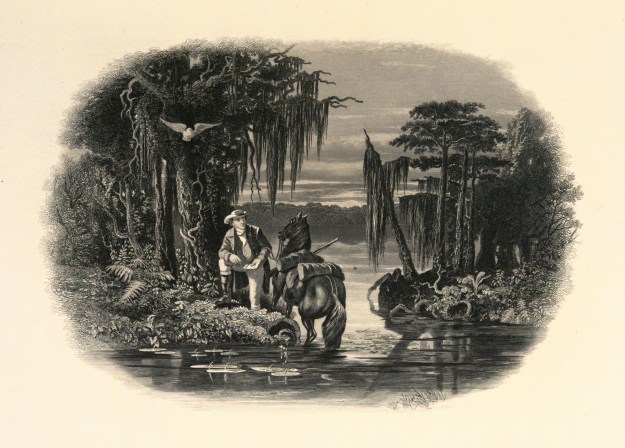
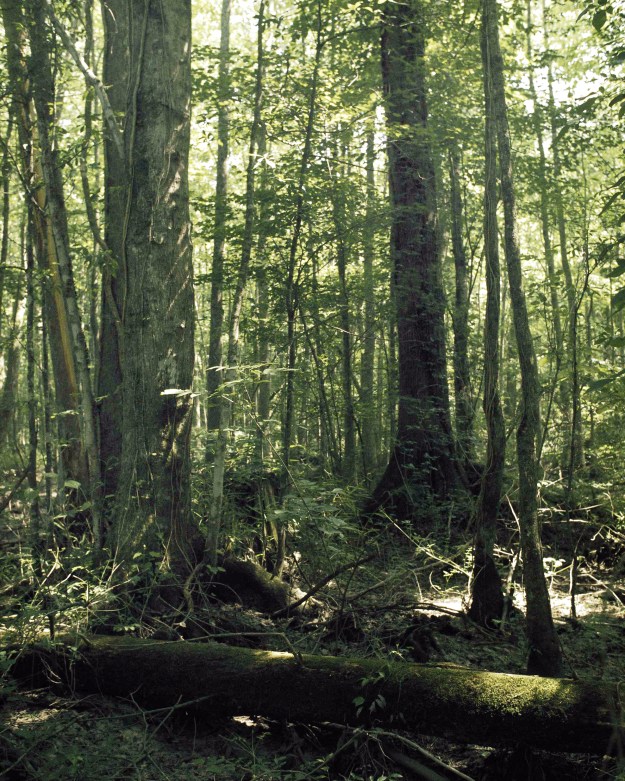
George Washington at Lake Drummond


Lawson1709It was just three years before Joseph Thomas was awarded his headright on Orapeake Swamp when John Lawson was captured and killed by Tuscarora Indians while on an expedition with Christoph von Graffenried. The two were seeking the source of the Neuse River. John Lawson had journeyed across the back country where by 1709 he wrote his fabulous book titled A New Voyage to Carolina which detailed all that he saw and encountered. And then, in 1710, John Lawson and Edward Mosley were named to a commission tasked with surveying the state line between North Carolina and Virginia. Unable to reach consensus, that effort failed.


Joseph Thomas received his headright in 1714 Virginia though the land was situated near the line in what’s now North Carolina. The state line was simply unknown.

_____________________________________________

William_ByrdAnother timely event. Can you imagine life on the farm when all of a sudden a group of men stepped out of the swamp with axes, chains and lots of talk of cutting the state line through or near your land? That actually happened in 1728 when William Byrd II led another attempt to survey the state line. From William Byrd’s diary we get a glimpse of early life on the Oropeake Swamp:

In these sad circumstances, the kindest thing we could do for our suffering friends was to give them a place in the Litany. Our chaplain, for his part, did his office, and rubbed us up with a seasonable sermon. This was quite a new thing to our brethren of North Carolina, who live in a climate where no clergyman can breathe, any more than spiders in Ireland.
One thing may be said for the inhabitants of that province, that they are not troubled with any religious fumes, and have the least superstition of any people living. They do not know Sunday from any other day, any more than Robinson Crusoe did, which would give them a great advantage were they given to be industrious. But they keep so many sabbaths every week, that their disregard of the seventh day has no manner of cruelty in it, either to servants or cattle. It was with some difficulty we could make our people quit the good cheer they met with at this house, so it was late before we took our departure; but to make us amends, our landlord was so good as to conduct us ten miles on our way, as far as the Cypress swamp, which drains itself into the Dismal. Eight miles beyond that we forded the waters of the Coropeak, which tend the same way as do many others on that side. In six miles more we reached the plantation of Mr. Thomas Spight, a grandee of North Carolina. We found the good man upon his crutches, being crippled with the gout in both his knees. Here we flattered ourselves we should by this time meet with good tidings of the surveyors, but had reckoned, alas! without our host: on the contrary, we were told the Dismal was at least thirty miles wide in that place. However, as nobody could say this on his own knowledge, we ordered guns to be fired and a drum to be beaten, but received no answer, unless it was from that prating nymph Echo, who, like a loquacious wife, will always have the last word, and sometimes return three for one. It was indeed no wonder our signal was not heard at that time, by the people in the Dismal, because, in truth, they had not then penetrated one third of their way. They had that morning fallen to work with great vigour; and, finding the ground better than ordinary, drove on the line two miles and thirty-eight poles. This was reckoned an Herculean day’s work, and yet they would not have stopped there, had not an impenetrable cedar thicket checked their industry. Our landlord had seated himself on the borders of this Dismal, for the advantage of the green food his cattle find there all winter, and for the rooting that supports his hogs. This, I own, is some convenience to his purse, for which his whole family pay dear in their persons, for they are devoured by mosquitoes all the summer, and have agues every spring and fall, which corrupt all the juices of their bodies, give them a cadaverous complexion, and besides a lazy, creeping habit, which they never get rid of.
…Care was taken to erect a post in every road that our line ran through, with Virginia carved on the north side of it, and Carolina on the south, that the bounds might everywhere appear. In the evening the surveyors took up their quarters at the house of one Mr. Parker, who, by the advantage of a better spot of land than ordinary, and a more industrious wife, lives comfortably, and has a very neat plantation.
…The line cut William Spight’s plantation in two, leaving little more than his dwelling house and orchard in Virginia. Sundry other plantations were split in the same unlucky manner, which made the owners accountable to both governments. Wherever we passed we constantly found the borderers laid it to heart if their land was taken into Virginia: they chose much rather to belong to Carolina, where they pay no tribute, either to God or to Cæsar.

Worries were much more sinister than the mere concerns over running the state line. A fox was surely loose in the hen house …you’d better keep an eye on that fellow lest your wife or children be “rogered.” (Note to self: look for DNA matches to William Byrd II).

_____________________________________________

Joseph Thomas sold his land near the Dismal Swamp less than a year after the survey. William Byrd had referred to the area as “a miserable morass where nothing can inhabit.” Removing to Bertie County, I can only imagine what drove Joseph Thomas away from the neighborhood. Looking creatively at a bad situation, Byrd had even proposed using slave labor to drain the swamp with a network of ditches and canals. But, there were problems with this idea as the Great Dismal Swamp sits on high ground. Instead of being a low place like most swamps, it is a source of water flowing outward away from the swamp …not a place where water naturally wants to pond.
Nearly 30 years after Joseph Thomas left the area, big money, politics and a bold scheme built upon the vision of William Byrd. In 1763, George Washington visited the Dismal Swamp and surrounding areas including Oropeak Swamp. From his diary, George Washington wrote:

Between Cyprus Swamp, and the last mentioned one, we went on horseback not less than ½ mile into the great swamp (Dismal) without any sort of difficulty, the horse not sinking over the fetlocks. The first quarter, however, avounding in pine and gallberry bushes, the soil being much intermixed with sand, but afterwards it grew blacker and richer with many young reeds and few pines, -and this, it may be observed here, is the nature of the swamp in general.
From Mossey Swamp to a branch, and a large one it is, of OROPEAK (Not less than 80 yards over) is reckoned 4 miles; two miles short of which is a large plantation belonging to one Brindle, near to which )on the south side) passes the Carolina line.
The Main Swamp of OROPEAK is about 1.2 mile onwards from this, where stands the Widow Norflets, Mi & Luke Sumner’s plantations. This swamp cannot be less than 200 yards across, but does not nevertheless discharge as much water as Cyprus Swamp.
At the mouth of this swamp is a very large meadow of 2 or 3000 acres, held by Sumner, Widow Norflet, Marmaduke Norflet, Powel and others, and valuable ground it is.
From OROPEAK Swamp to Loosing Swamp is about 2 miles, and this 70 yards across.
From hence again to Bassey Swamp the lower road may be allowed 2 miles more, but this swamp seems trifling.
And from Bassey Swamp to Horse Pool (which is he last, and including swamp running into the Dismal) is about 2 miles more and 35 yards across only.
The whole land from Pocosom Swamp to this place and indeed all the way to Pequemin Bridge, is a manner a dead level, wet and cold in some place sandy in others, and generally poor.

Looking back at Joseph Thomas’ land, what happened to it after he left for Bertie. And, is there any connection at all to Washington’s visit? Let’s take a quick look at two deeds:

• Deed Book W1, 375-376 Chowan, 10 Feb 1737. Lemuel (LB) Bass to Edwd. Skeeter being two tracts, one of 175 acres and one of 14 acres. Witness John Sumner, Henry Hunter, Wm Speight.
• Deed Book G1-5-8, Chowan, 16 Jan 1753. Edward (ES) Skeetor to Edward Arnell for 175 acres on the southwest side of the Oropeak swamp joining Edward Arnell, Thomas Hinton, Patrick Woods, and Batttles being the land purchased of Joseph Thomas to whom the sd lands was granted by Alexander Spotwood late Gov of VA. Also another tract of 14 acres. Wit: Demsey Sumner, Elisha Parker.
• Headright, 25 April 1701, Nansemond VA. Edward Arnold, being 89 acres on the South westward side of Oropeak swamp beg. on the S.W side ye aforesd. Oropeake swamp near Battles corner tree.
• Headright, 28 Oct 1702, Nansemond VA. Richard Sumner, being 330 acs. in Upper Par., Nansemond Co., on the northwest side of the Mossy Sw., beg in the 2nd branch of Oropeak in the Round Trees Line; along the Desert; on the Brinkley’s Land.

From my last post, Joseph Thomas acquired a small 14 acre tract in the fork of Oropeak and Elm Swamps. John Battles owned land to the west of the tract followed by Joseph Thomas’s 175 acres to the west of said John Battles. Samuel Bass [Basse] purchased Joseph Thomas’ land and then sold it to Edward Skeetor in 1737. Witness to that deed was Wm. Speight whose land was cut into per the diary of Wm Byrd II. In 1763, George Washington mentions Bassey Swamp …could this be named for the Bass family?

OLYMPUS DIGITAL CAMERAOther names also appearing in the above records include members of the Sumner family. In 1763, Fielding Lewis, George Washington’s brother in law, purchased nearly 40,000 acres total with over 1,000 being from the Sumner family. Forming the Dismal Swamp Company, Washington, Byrd. and others worked to reroute the swamp’s source of water. Efforts expanded to included canals connecting Virginia and North Carolina wateways. But by the late 1700’s, George Washington became frustrated with the project and sought to sell out his share. Henry (Light Horse) Lee, the father of General Robert E. Lee, was approached but did not have the funding necessary to secure the transaction.

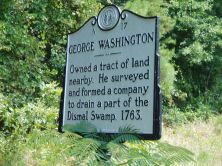
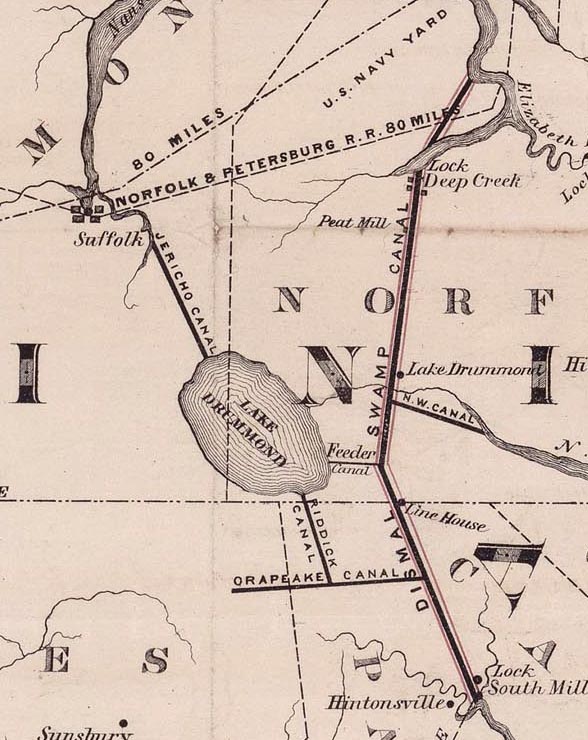
There are old maps of the project and today the area is known as Corapeake. There is a State of North Carolina Historical Marker south of the town of Corapeake marking Washington’s visit and purchase. Today Coropeak and the Great Dismal Swamp are crisscrossed with ditches and canals began during the times of our early 1700’s ancestors. The greatest of the canals , the Dismal Swamp Canal, is a great recreational spot and is worth visiting.


drummond2

Map of Dismal Swamp Canal drawn by D. S. Walton – 1867


OROPEAK (Pt 1)

Great_dismal_swamp

Dated 16 Jun 1714, Joseph Thomas received a headright for N.L. (new land) located in the Upper Parish of Nansemond County Virginia. Situated on the south side of the Orapeake Swamp, the land adjoined that owned by Edward Arnold, Thomas Milner, Patrick Wood and a Mr. Battle. Joseph Thomas received the 175 acres as reward for importing from England the following 4 persons: Joseph Thompson, Elizabeth Thompson, Michael Thomas & his wife (Cavaliers and Pioneers Vol 3 –page 140, by Nugent).

The headright for Joseph Thomas raises several questions that I’ve never clearly seen answered. First, was the name “Thompson” used in the grant a mistake and did it instead refer to the family of “Joseph Thomas” who actually received the land grant? And second, it is believed that Joseph Thomas was born in Virginia from a long line of Thomas family going back to the early 1600’s. In lieu of this record, can that be so and does this record imply that Joseph Thomas also made a trip from England? And, exactly how does the named Michael Thomas and wife play into our family story?

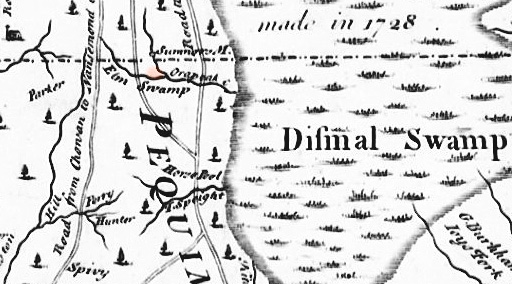
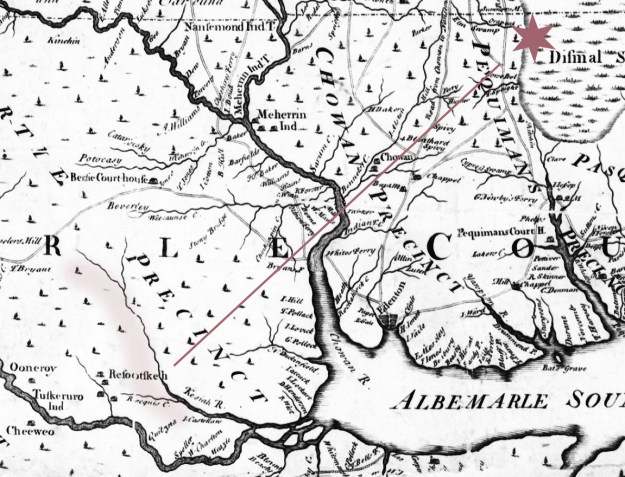
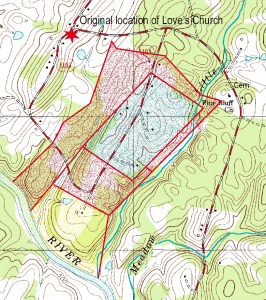
Though granted by the State of Virginia, this land belonging to Joseph Thomas may actually be located on the Oropeak Swamp near the state line in present day Gates County, North Carolina …not Virginia. Later conveyances of the granted tract indicate the land must also be close to the Elm Swamp. From Edward Mosley’s 1733 New and Correct Map of the Province of North Carolina, both the Orapeak and its southern branch, Elm Swamp, are seen as sources to the Great Dismal Swamp lying to the east:

oropeak

To the west of the above, early Chowan Precinct became Chowan County when in 1720 Edenton was designated as the county seat. And from early Perquimans Precinct (taking up most of this map), the county of Perquimans was officially formed in 1739. It wasn’t until 1779 until Gates County was created in honor of Horatio Gates who would later lead the Maryland Continental line at the failed battle of Camden. The earliest known lands of Joseph Thomas are located near the Virginia state line in present day Gates County. Any ownership in Virginia is yet proven.

Within two years of acquiring his land on Oropeak Swamp, Joseph Thomas is mentioned in the 5 Sep 1716 last will and testament of Peter Parker. Among bequeaths including land on Deep Run and Wishacone Creek, Peter also orders “Joseph Thomas to pay 1200 pds of tobacco for my land at Elm Swamp”. Looking at the above map, you’ll see the name “Parker” located in the upper left corner not far from Orapeak Swamp.

________________________________________

Dated 23 Mar 1729, Joseph Thomas sold his land to Samuel Bass. Recorded in Bertie County, the deed identifies both the buyer and seller as farmers “both of the Govern of North Carolina” …no mention of county. The first tract below is certainly Joseph Thomas’ original headright. The metes and bounds along with Peter Parker’s last will and testament can be used to identify the second smaller tract as lying in the fork of Oropeak and Elm Swamps (located on the map above):

First Tract being 175 acres on the southwest side of Oropeak Swamp – beginning at a maple a corner tree of Edward Arnold’s land standing by the swamp and runs thence along the said Arnold’s line south westerly 14d 119p to a white oak thence south westerly 52d 139p to a pine, thence south westerly 12d 75 ½ p to a pine in Thomas Milner’s line, thence on sd Milner’s line south westerly 35d 38 p tp a pine thence north westerly 60__163 p to a pine, then north easterly 27d 68 ½ o to a gum in Patrick Wood’s line thence on Wood’s north easterly 71 ½ p to red oak thence northeasterly 7d –54p to a pine in Battle’s line, thence north easterly 58d on sd line 201 p to the first station.

• Second Tract being 14 acres which sd Thomas purchased of Elizabeth Parker & John Parker her son – known as “Little Neck” beginning at a marked gum on the side of Orapeak swamp in the mouth of a small branch thence running up the sd branch along a line of marked trees to a poplar, it being a line tree of John Battle’s, thence running down the said line to a marked white oak standing on the west side of the Orapeak Swamp, it being a corner tree of the said John Battles, thence running up the swamp to the first station.

The deed from Joseph Thomas to Samuel Bass was witnessed by John Perry and Anderson Sugg and was registered much later on 2 May 1755. What happened in 1755 to warrant a need to record the deed at that time? Joseph Thomas Senior [I] died around 1732 and we know his son Joseph Thomas [II] dies sometime between 1752 and 1755. Maybe there was a need to record and clear the title prior to the settlement of estate for Joseph Thomas [II]. Of importance, Joseph Thomas [I] signed the above deed with a mark that appears in form to be a capitol I with mark through the middle. The original does not exist and this deed book copy was surely from a later transcription as it’s written on lined paper. Even so, Joseph Thomas who left his last will and testament in 1732 Bertie County signed with a similar mark.

1732 - CopyBeyond the comparison of signature marks, there’s one other bit of evidence that links Joseph Thomas of Oropeak with Joseph Thomas who died ca. 1732-5 in Bertie. On the very same date as the sale from Joseph Thomas to Samuel Bass, Samuel Bass returned the favor by selling a tract of 200 acres to Joseph Thomas. Lying on the south side of the Kashie Swamp, metes and bounds for that transaction reads:

..beginning at a pine in the woods by William Williams plantation then n5de 320p standing in the Kesia Swamp, then according to the meandering of the swamp to the mouth of a great branch, then the various courses of the said branch to a pine in the head line, then along the head line to the first station.
Witnesses were again Anderson Sugg and Jno Perry.

kashie

In summary, Joseph Thomas received a Virginia headright in 1714 on land in present day North Carolina. Joseph sold the land in 1729 to Samuel Bass who in turn sold Joseph a tract in Bertie where Joseph wrote a last will and testament in 1732. The land on Oropeak Swamp was situated in an area rich in American history. In the next post I’ll look at later conveyances and of business ventures among the rich and famous.

One Violin, One Tomahawk, and a Side Saddle


1732After working the records in Wake, Chatham and Moore counties to near exhaustion, it’s time to move in earnest towards the task of proving the Thomas family lineage another generation back to Bertie County. We know of Joseph Thomas who came to Wake in 1772. It’s he who died ca. 1819 in Chatham County. But, where did Joseph come from prior to living in Wake? Research coalesces around the idea that Joseph Thomas who died in Chatham is the son of a Joseph Thomas who died per last will and testament drawn up in Bertie County on 12 Dec 1752 (probated on 5 Jan 1758). And looking back a generation further, all online histories indicate that the Joseph who died ca. 1752-58 is the son of yet another Joseph who drew up a last will and testament in 1732 Bertie Precinct.

In revisiting all the deeds, estates, court and any other legal records pertinent to the study of our Thomas ancestry, it quickly hit me that what I was seeing cannot support the storyline so often seen online and found in the writings of prominent researchers of the past. Is it me or is there a real problem? In this post I’ll express my concern through scrutiny of the 1732 last will and testament of Joseph Thomas as it relates to those of his believed sons Joseph and James. By way of comments (so we can all learn), I ask for your thoughts and rationale whether or not you believe I’m right or wrong on this matter.

___________________________________________

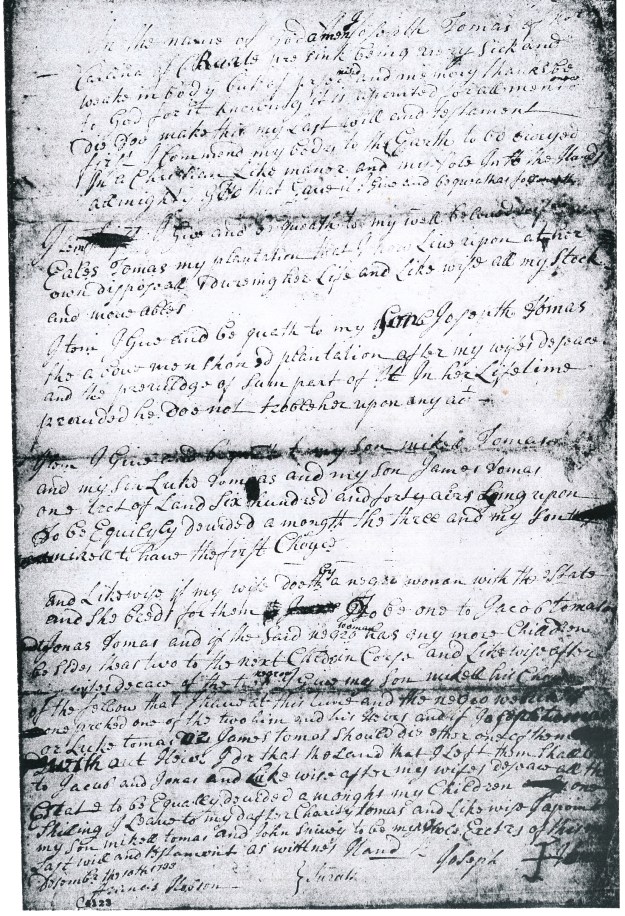
At the top of this page is the 1732 last will and testament of Joseph Thomas . For closer scrutiny, Joseph’s will and those of others are transcribed at the bottom of this post. Much can be gleaned from the wills, but keep in mind, I’ll go no further into findings than what is necessary to raise my concern. Much more will be rolled out later.

From the above last will and testament, we see that in 1732 Joseph Thomas names his wife Eales (Alice) and children Michel, Joseph, Luke, James, Jacob, Jonas and Charity.
From the Thomas and Bridges Story 1540-1840 written in 1972, author Edison H. Thomas indicates that Joseph’s and Alice’s son James died ca. 1780 after writing his will in Bertie County. What’s important for my concern is the 1780 date of this James Thomas’s will. See James’ will at bottom for details and please keep this point in the back of your mind as we go forward.

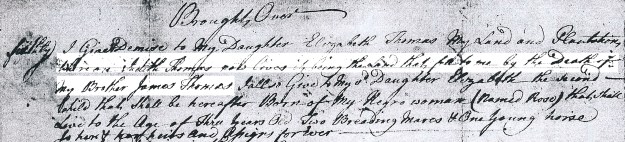
Now, let’s look at James’ brother Joseph as identified in the 1732 last will and testament at the top of this post. This younger Joseph II is believed the same person who wrote a last will and testament on 26 April 1752 in which is named wife Ann along with children Michael, Josiah, Joseph, Mary and Elizabeth. In item “sixthly” of the will, Joseph bequeaths to daughter Elizabeth:
joseph 1757 2 - Copy

The important part of the item reads: “Whereon Judith Thomas now lives it being the land that passed to me by the death of my brother James Thomas.” So, if Joseph II and James are brothers [sons of Joseph and Eales (Alice) Thomas], and James died prior to the writing of Joseph’s will, then it’s simply impossible for James to have penned a will in the 1770’s. In case you’re having difficulty following the logic of my concern, take a look at the following:

familytree

Seeking further information on a James Thomas who died prior to Joseph II’s 1752 last will and testament, I found the following:

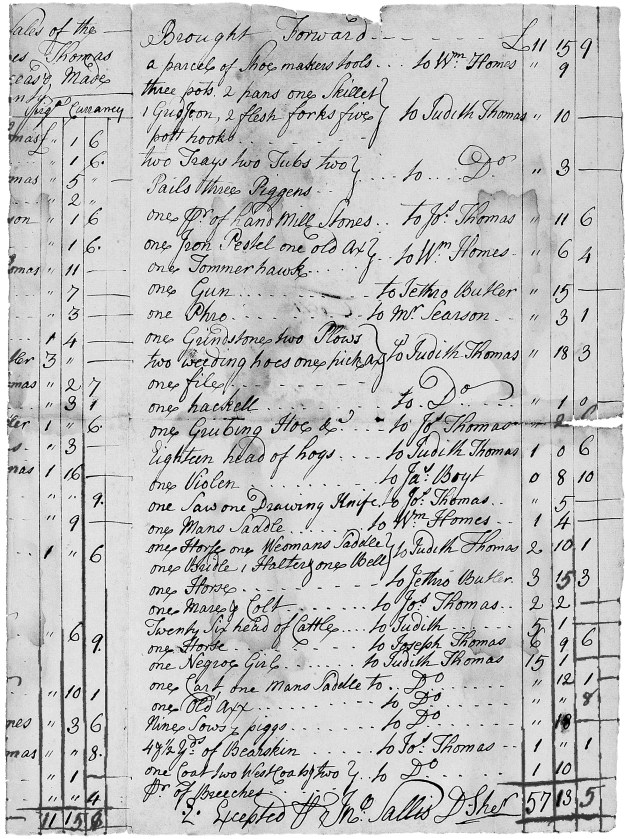
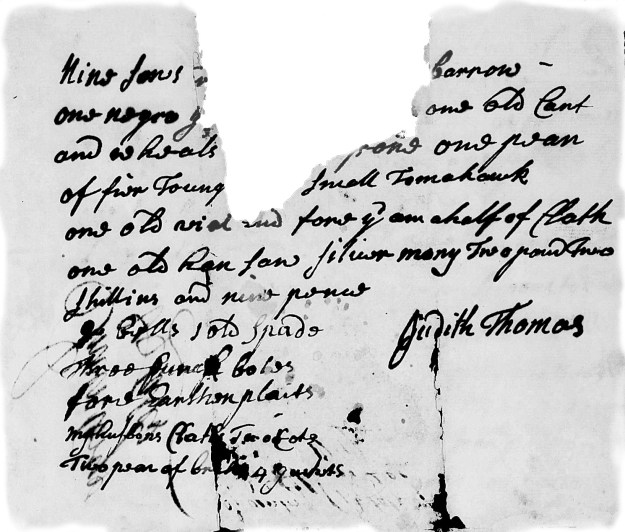
Estates (653) Bertie – James Thomas. Account of sale 1750 by John Sallis, Deputy Sheriff. Buyers were Judith Thomas, Joseph Thomas, John Jameson, Jethro Butler, William Holmes, Mr. Searson, and James Boyt. Also, among the loose estate papers of Bertie County is the following account of sale for James Thomas’ estate. The name of Judith Thomas appears on the backside indicating it was her who either made the sale or at least had it recorded.”
james thomas estate1

Implications: It appears that Joseph Thomas I who died in 1735 had a son named James who died ca. 1750. James may have married a person named Judith. James likely died intestate and left no last will and testament. James and Judith likely had no children as any land passed to James’ oldest living brother Joseph. Judith would have been given a widow’s allowance to live on the land for her lifetime or until her remarriage.

How much longer did Judith live and is there anything else we can glean from her life record? Dated 20 April 1762, Thomas Pennington drew his last will and testament naming Judith Thomas though not specifying that she is his daughter. I’m not sure at this time whether or not Thomas Pennigton’s last will and testament refers to James Thomas’ wife Judith. Requiring a little research, more information on this will be forthcoming.
It simply is not true that James Thomas (who married Sarah Barnes) is the son of Joseph Thomas I who left a will in 1735. James Thomas whose will appears in 1780 Bertie must be the son of another person other than Joseph I. So, who is James’ father and who are James’s siblings if any? How does he relate to Joseph Thomas who died ca. 1735? How will this change the story?

Though to me this is all a cool find, I can’t help but think more about the timeframe and where this all happened. James Thomas’ estate sale included icons of two worlds …both a violin and tomahawk. I can envision James sitting peacefully by the fire admiring the sounds of melodies wafting through the forests pine. And this was a time when the Tuscarora Wars were only thirty years in the past (actually fifteen at the time of Joseph Thomas I’s last will and testament). Was the tomahawk a useful tool used by James or was it a trophy or keepsake from the Tuscarora Wars? James was born just prior to the wars and the Thomas family lived near present day Windsor NC. He lived amongst “friendly Indians” who remained and had been allowed to live on a reservation known as Indian Woods. I know you can tell a story through music but I bet the tomahawk also spoke proudly in its own way. And, then I wonder of Judith’s side saddle and where it carried her and who she traveled to see. I have to wonder about my Thomas family, and of any blood connections to the Indian culture they lived amongst.
james thomas 2

Last Will and Testament of Joseph Tomas
10 Dec 1733, pro. Feb 1735 in Bertie County NC

I the name of god Amen I Joseph Tomas of North Carolina of Bertie Precinct being very sick and weak in body but of perfect mind & memory thanks be to god for it knowing it is appointed for all men once to die do make this my last will and testament first I command my body to the earth to be buried in a Christian like manner and my sole in the hands of almighty God that gave it I give and bequeath as ______________

Item I give and bequeath to my well beloved wife Eales Thomas my plantation that I now live upon at her own disposal during her life and likewise all my stock and ___________
Item I give and bequeath to my son Joseph Tomas the above mentioned plantation after my wife’s decease and the privileges of ____ part of it in her lifetime provided he does not __________ her upon any_____________

Item I give and bequeath to my son Michel Tomas and my son Luke Tomas and my son James Tomas one tract of land six hundred and forty acres lying upon to be equally divided among the three and my son Michel to have the first choice and likewise if my wife doth buy a negro woman with the estate and she breeds for them to be and to Jacob Thomas and Jonas Tomas and if the sd negro woman has any more children their two to the next children ________ and likewise after my wifes decease of the two negros I giving son Michel his choice of the follow that I have at this time and the negro wench _______ one of the two him and his heirs and if Joseph Tomas, Luke Tomas or James Tomas should die either one of them or without.

Item I do that the land that I left them shall be to Jacob & Jonas and Luke and likewise after my wife’s decease al the estate to be equally divided amongst my children one shilling I leave to my daughter Charity Tomas and likewise appoint my son Michel Tomas and John Spivey to be my whole executors of this my last will and testament as written hand.
December the 10th 1733
Francis Hobson
William (x) Simmons                                                                  Joseph (I) Tomas

Bertie Precinct
Febry Court 1735 The written will of Joseph Thomas was proved by the oaths of Francis Hobson & William Simmons the two subscribing witnesses thereto and the Michael Thomas one of the exe’r therein named took the oath of an Ex’tr by law required.
Test: Jno Wynn


Last Will and Testament of Joseph Thomas
26 April 1752, pro. April 1758 in Bertie County NC

North Carolina
In the name of God amen. I Joseph Thomas of Bertie County Planter being sick of body but of perfect manner & judgement first recommending my soul to God that gave it and my body to be buried at the discretion of my Executors hereafter mentioned do make this my Last Will and Testament this 26 day of April anno Dem 1752;

Imprimus I bequeath to my loving wife Ann Thomas the use or the plantation whereon I now live during her natural life and all the land thereunto belonging except what land lies on the south & southeast side of the plantation called the Spring Branch & also give to my sd. wife six cows and calves six sows & their pigs two breeding mares and as to my household furniture I lend the use of all to my sd. Wife during her natural life and after her decease my will is that all of my sd. household goods be equally divided among my children share & share alike. I also lend to my sd. wife the use & labor of my negroes she using them as they might to be used Viz; Rose, Jack, Boson until my children who I shall in this will give them to arrive to the age of twenty one years or the day of marriage or are capable to choose their guardians towards the raising my sd. children to her heirs or assignees.

2nd I give and demise unto my son Michael Thomas six hundred & forty acres of land now the occupation of Griffin Summerell it being the land I purchased of Thomas Kearney I also give to my son all my stocks cattle hoggs that is in possession of the sd. Summerell on his land one negro woman named Rose and all her increase thereafter except the first two children the sd negro woman shall bare thereafter that shall live to the age of three years old which children I reserve for my daughters hereafter mentioned. I also give to my sd. son two breeding mares and one young horse by the name of Blaze and my servant melato boy named Jacob till he shall be lawfully free to him his heirs & assignees forever.

3dly I give and devise unto my son Josiah Thomas my land and plantation whereon Nathaniel Keel now lives, it being bounded and joining the land I gave to my son Michael and Thomas Blounts land and all my stock of cattle on the sd land that is in possession of Nathaniel Keel six sows & piggs two breeding mares one young horse by the name of Ball & one negro boy named Jack to him his heirs & assignees forever

4th I give to my son Joseph Thomas my land & plantation whereon I now live and all my stock of mare cattle that belongs to the sd. plantation except what cattle I have given to my wife and two three year old horses two breeding mares one young horse six sows and piggs one negro boy named Bason and Liberty if he sees proper to make a plantation on the south east side of the spring branch in case his mother is living when he is at age to him and assignees forever.

5th I give and demise unto my daughter Mary Thomas my land that now belongs John Spivey a minor my said land I now give to my said daughter Mary is now in the occupation of Hardy Keel I give also to my said daughter the first child that shall be born of my negro woman named Rose that shall also live to the age of three years old viz; the first child that is born after this date and two breeding mares & one young horse to her and her assignees forever
6thly I give and demise to my daughter Elizabeth Thomas my land and plantation whereon Judeth Thomas now lives it being the land that fell to me by the death of my brother James Thomas. I also give to my daughter Elizabeth the second child that shall hereafter be born of my negro woman (named Rose) that shall live to the age of three years old two breeding mares one young horse to hers and her heirs and assignees forever

7thly My will and desire is that all the remaining part of my estate after my just debts funeral charges & legacies are paid/ be equally divided amongst my five children before mentioned share & share alike to them their heirs & assignees forever

Lastly I constitute ordain & appoint my loving wife Ann Thomas my Executrix and my loving friends Thomas Whitmell & Arthur Williams my executors of this my last will and testament hereby declaring this to be my only will in being. In witness whereof I have unto set my hand & seal the date above written.
Signed sealed declared & published
in the presence of }
Jos. Collins jurat
Nathaniel (x) Keel                                                                                   Jos. Thomas
Joseph (III) Keel
Richard (R) Sparkman


Last Will and Testament of James Thomas
22 Oct 1780, pro. November 1780 in Bertie County NC

In the name of God amen I James Thomas of Bertie County of the state of North Carolina, being very sick and weak in body but of perfect mind & memory Thanks be given unto God, calling unto mind the mortality of my body and knowing that is appointed for all men once to die do make and ordain this my last will and testament that is to say principally and first of all I give and recommend my soul into the hand of almighty God that gave it and my body I recommend to the earth to be buried in descent Christian like manner at the discretion of my Executors nothing doubting but at the General Resurrection I shall receive the same again, by the almighty power of God and as touching the worldly estate wherewith it has pleased God to bless me in this life, I give, demise and dispose of the same in the following manner and form (to wit)

Item first of all I leand unto my beloved wife Sarah Thomas during her life or widowhood once third part of my land and plantation whereon I live one feather bed and furniture that belong to it one mare bridle and saddle one lining wheale, one iron pot & hooks & two puter plats, one puter dish one puter bason one cow & one calf.
Item I give and bequeath unto my beloving son Ezekiel Thomas one feather bed and what belongs to it one puter dish & two puter plats one Noohothed Heffer to him and his heirs forever.

Item I give and bequeath unto my loving son Luke Thomas five shillings sterling to him and his heirs forever.

Item I give and bequeath unto my loving son James Thomas all my land and plantation after his mothers death ad two parts of my land from the time that the will is proved one feather bed & what belongs to it one horse bridle & saddle to him and his heirs forever except my son James Thomas should die without heirs the land to be equally divided between my two eldest sons Ezekiel Thomas & Luke Thomas.

Item I give and bequeath unto my beloved daughter Selah Dement wife of Charles Dement one small chist one eow and lamb to her and her heirs forever.

Item I give and bequeath unto my loving daughter Luridill Thomas one feather bed and what belongings to it one linning wheel one puter dish and two puter plates one cow & calf one eows & lamb one chis to her & her heirs forever.

Item I give and bequeath unto my loving daughter Sarah Thomas one heffer yearling about three years old to her and her heirs forever.

Item I give and bequeath unto my loving daughter Lidda Thomas the feather bed lent to my loving wife to her and her heirs forever.

All the remainder part of estate of what nature or kinds soever I leave to be equally divided between my son James & Liddy Thomas at my son James coming two age of twenty one years and the said Liddy part to be continued in the hands of sd James Thomas during the discretion of the Executors hereafter nominated or arrives at the age of eighteen years of marriage but in case that either of the sd James Thomas or Liddy Thomas should die without lawful heir then my will & desire is that his or her part of the dividend be and remain to the said James or Liddy Thomas to them and their heirs forever.

Lastly I nominate constitute and ordain David Outlaw & my son Ezekiel Thomas my whole and sole Executors of this my Last Will & Testament to see the same compiled with and I do hereby utterly dislow and revoke all other wills and testaments by me heretofore made ratifying and confirming this and no other to be my Last Will Testament in witness whereof I the sd James Thomas I have hereunto set my hand and seal this 22nd day of October in the year of our lord Christ one thousand seven hundred and eighty.
Signed Sealed Published Pronounced & declared by the sd James Thomas as his last will and testament in the presence of us:
Abner Eason Snr
Joseph Eason Jur                                                                               James (J) Thomas
Mary Pritchard

Bertie County November Court 1780: proved by Abner Eason Esqr & Joseph Eason
Test : Stevens Gray CC.


ALL IN A NAME (Pt 3) – (Correcting a Mistake)

William Morris – Grant 3518 entered 24 May 1773, issued 23 July 1774.


morris

William Morris – Grant #3518 entered 23 May 1773, issued 24 July 1774.  CC: Wm. Legget, Henery Taylor.

In preparing for the next post I’ve just now discovered a big mistake in my last post. Looking through research going back to the 1990’s, an assumption was made by me in the interpretation of supporting documentation on my page dedicated to life of Benjamin Thomas Junior. The same information has been folded into the last post in this series on William Morris.

bair


In the 1760’s through 1772, William Morris moved from old Dobbs County to Anson (now Richmond) where he lived upon land on Hitchcock Creek. Then, in 1774, the fact that William Morris received the above land grant on “Bair Branch near the Catfish Road. ” Like anyone else with knowledge of upper Anson County, it was clear as a bell to me that this was land in upper Anson County The implications were that the William Morris living upon Hitchcock on the east side of the Pee Dee had moved to land on Bear Branch on the north side of Richardson Creek. Looking at the present day topography maps, you’ll see that Bear Branch takes off to the north of Richardson Creek and is trailed and crossed by a road now called “Fish Road.”!!! Catfish road and fish road on Bear Creek more than 200 years apart!

roberdel

Looking further at surrounding deeds for Bear Creek, I noticed that neighbors like Jonathan Lewellen and Nathaniel Williams maintained land holdings near both William Morris and Bear Creek. Appearing with William Morris in Edward Morgan’s writings on the Baptist church at Hitchcock Creek, I had assumed that they too eventually migrated to upper Anson to live upon Cribbs and Lanes Creeks. Believing it verified the records as I had interpreted on William Morris, it’s true that Nathaniel Williams and members of other families including that of Jonathan Lewellen made the move to upper Anson. However, the Bair Branch in William Morris’ 1774 grant IS NOT a branch of Richardson Creek and is not located in Upper Anson County! Instead, I’ve just learned that Bear Creek is a branch of Hitchcock Creek (below) and is located in the present day community of Roberdell in Richmond County. It’s this location where William Morris received and land grant in 1774.

At this point I’ll move on with the story of William Airley Morris. We’ll look at other the beliefs written by others and of further chapters of this story I believe to be written in error. You’d think it’s not a big deal, but every little thing we get wrong has exponential impact reaching out beyond family in ways unimagined.


ALL IN A NAME (Pt. 2)

euseWhen Morgan Edwards made his tour of North Carolina in 1772/3 to gather material for his Notes on North Carolina Baptists, he visited Edgecombe County and said of Toisnot Church and of John Thomas and his family:
They originated from the general Baptist. The names of them who first declared for the particular scheme are Rev. John Thomas and his wife, Moses Baker and wife, Jonathan Thomas and wife, Sarah Hickman, Obedience Thomas; the 14 were constituded on the particular plan Sep. 7, 1758. The first minister is the present John Thomas, a native of Virginia; bred a churchman. Embraced the sentiments pf the Baptist in 1748 & had the ordinance administered by Rev. Josiah Hart. Ordained by Rev. mess. George Graham and John Moore, at which time he took on the care of the church.

At this time in history, there was really only one church, the Church or England. Other non-conforming “societies” or churches were either barred or were at least required to be licensed. Found in the book John Thomas of Toisnot Baptist Church, the following entries appear in early Edgecombe County Court Minutes:

Sep 1759 – A petition of John Thomas & others of the profession of Anna Baptist for lycencing the Meeting House built by the Society on the said Thomas land near Jonathan Thomas’s. – Ordered that the same be lycenced.
Sep 1761 – Jonathan Thomas a non-conformist preacher produced an Ordination in writing signed by George Graham and John Moore the Pastures of the Baptists ordaining and appointing him to preach according to the Tenants of that church.

It’s really cool for me to be able to connect my family and story on William Airley Morris with this early line of Thomas. Though it’s very likely we are all distant cousins, this post has little to do with John Thomas of Toisnot Creek. It’s more about those who were with him in the late 1750’s founding of his church. The Rev. George Graham who ordained John Thomas moved around the state and eventually settled in the area of Hitchcock Creek near the old Piney Grove Quaker Meeting in present day Richmond County NC. And, back around 2001, as luck would have it, I had the opportunity to work with a fellow named Bob Walls from Illinois on this line of Graham whose descendants followed the Quaker’s move to Lick Creek in Orange County Indiana. Let’s look at some of the records for George Graham and others and how they connect to the ancestry of William Airley Morris.

In 1739, George Graham received several land grants in Craven County across from present day Newbern. The land was situated on the north side of the Neuse River and on the east side of the Broad Creek known as Elizabeth’s Choice. In a biography for Joseph Parker written by George Stevenson at NCpedia , we know that George Graham was ordained in 1739 by Paul Palmer who is considered to be the founding father of Baptists in the upper south. Graham moved a bit inland where he pastored congregations at Stoney Creek Original Free Will Baptist Church just north of Goldsboro. He also served at Bear Creek Baptist in nearby Lenoir County. It is on Contentnea Creek where our William Morris enters the scene. In the later 1760’s William Morris received three land grants in Dobbs County situated on Contentnea Creek in present day Wayne or Green Counties. The 1769 Dobbs County Tax List lists the following:

MORRIS William William Curlee & John Curlee 3

All I can say is wow, how about that! …twenty years later William Morris, John Curlee, and William Curlee are living next to each other on the waters of Bare and Cribbs Creeks in Anson County more than 100 miles away in Anson County.

(Note that Johnston County grew from Craven in 1746, and then Dobbs grew from Johnston in 1759, and Wayne grew from the western portion of the defunct Dobbs in 1779 and then Glasgow County was formed from eastern Dobbs which later became Greene County, and the southern portion of Dobbs became Lenoir County.  Whew …much of the above occurred on the Bear, Stoney, and Contentnea Creeks near the junction of the present day Wayne/Green/Lenoir County lines.) It’s also important to know that State and Granville Grants along with a deed index are all that survives in terms of early land records for Dobbs County which for a time covered the above area. From the grants we know that William Morris lived near the families of Tindal, Johnston, Jones, Simpson, and Meares. William Morris is indexed as making conveyance to William Ormond and Lewis Williams. William Ormond founded Rainbow Methodist Church and Ormond’s Chapel in Greene County.

Starting in the late 1760’s, William Morris and others from old Dobbs County began moving south. By 1775 many were living on the east side of the Pee Dee River in what’s now Richmond County (then Anson). Capturing both the move and an undeniable connection to church, in 1772, Rev. Morgan Edwards M. A.  journaled the following about a regular Baptist church situated on Hitchcock’s Creek:

(REGULAR) HITCHCOCK,(1772)
In the county of Anson, 200 miles from Newburn and — miles from Phila. No meeting house. Const. March 28, 1772, at the house of William Morris. Families 8, Memb. 14, Minister

REV. HENRY EASTERLING
Born May 24, 1733, at the mouth of Nuse river. Bred a churchman. Embraced the principles of the Baptists in 1760 in Dobbs County by Rev. George Graham. Called to the ministry in 1762. Ordained March 29, 1772, when he took care of the church. He married Eliz. Bennett by whom he had children Sherdock, Henry, Bennett, John, James, Elizabeth, William, Mary, Martha, Joel. Came here in 1764, and preached in 1770. Baptized the following persons: Jonathan Lewelin, Wm. Moody, Thomas Summerlin, Wm. Leggate, Wm. Smith, Nathaniel Williams. Mary Smith, Fanny Williams. Constituted March 28, 1772 by Mess. Edwards and Brown.

It appears the Rev. Henry Easterling’s journey followed a similar path as that of George Graham and William Morris. Easterling owned several tracts on Nahunta Creek in old Dobbs County. He was ordained in 1772 at Hitchcock Creek. However, Henry Easterling is not ever recorded as actually owning land in Anson County. From a family history, we learn that Henry Easterling may have returned to and remained in the area of old Dobbs County on Nahunta Creek until at some point in the 1780’s he again moved south where he apparently founded a church. From a history of Marlboro County South Carolina, Beaverdam (now McColl) was formed into a church in the year 1771 by Henry Easterling at or near what is known as Beauty Spot Bridge, and was called Beauty Spot. It’s interesting that Robert Thomas, the son of Stephen from this area in North Carolina/South Carolina was also a Baptist firebrand …growing churches in the area at the same time as Easterling. As a matter of fact, Robert Thomas’ bay lake known then as “The Ocean” was sold to Easterling.

Beauty Spot must have been much more than a location important to Baptists. Today, a historical marker at that locale reads:

Here stood the first Methodist church of Marlboro County, a single log cabin built in 1783. Here Bishop Francis Asbury presided over and preached at an early Quarterly Conference, held on February 23, 1788. Camp meetings were held here 1810-1842. In 1883, the church was moved to another site, also called Beauty Spot, two miles eastward.

Just north of present day McColl South Carolina was a small preparatory Quaker Meeting known as Piney Grove. Located on the state line, the church faltered mainly due to the pressures of slavery and the religious peace ethics followed by the believers. Around 1815, the congregation splintered with some pulling away from the church while others moved to Orange County Indiana to escape the intolerable realities of slavery. Interestingly, Robert Thomas’ brothers John, Lewis, and James were not Baptists but instead were Quakers and made the trip to Indiana. And, of interest, John’s son Stephen lived for a while in Wayne County NC where as a Quaker he met and married while a member at Contentnea Creek Meeting. John’s son Stephen is recognized as the father of the Indiana Annual Meeting.

And back to this story, what happened to Piney Grove? information about Beaverdam and Piney Grove from the bio on Henry Easterling  provides some answers:

By 1785, Rev Henry pastors Beaverdam (Creek) Baptist Church at, or near what is known as Beauty Spot Bridge, in an area of Marlboro County called Beauty Spot. After a number of years, this church moved to Pine Grove (near modern McColl, SC), where they worshipped in common with other denominations in a house built by the Quakers or Society of Friends. The Pine (or Piney) Grove site ultimately fell into the hands of the Methodists, and the site is the home of Pine Grove United Methodist Church in McColl, SC today.

_________________________________________________

It appears that the Baptist congregation on Hitchcock Creek in present day Richmond County did not meet long at the home of William Morris as by 1774 he, or a person of same name moved to the area of Lanes Creek and Bare Branch in upper Anson County. It must be the same person, or someone of same name in his family as others in the congregation on Hitchcock Creek also made the move. But, tracing the family from here will not be as easy as you may hope. There are members in the Morris family whose names confuse the story. There are also records of a William Morris in Montgomery County that also confuse the story.  Please see the next post for detailed information on a mistaken interpretation of related records. 

It appears that the Baptist church meeting in William Morris’ home did not survive long as such. In 1774 William Morris sold his land to Neighbor Nathaniel Williams.   Nathaniel Williams later sold land on Hitchcock Creek to Lewis Thomas.  A Quaker and son of Stephen Thomas of Maryland, Lewis later moved to Orange County Indiana where neighbors there had interacted with Joseph Thomas of Chatham County.  All likely unrelated. 

The records for William Morris in Anson (now Richmond County) names sons and others including  a possible son named William Morris Junior.” The records from 1774-1779 indicate that William  (or another person of same name) may have spent a short time in Montgomery County NC before settling in the area of Lanes and Cribb’s Creek in upper Anson County (more later).

Next week I hope to zero in and offer a close look at Richmond County and the move to Anson. I’ll need a little time to wrestle with some of the issues I’ve never been able to resolve. Was William Airley Morris the son of William who was buying land in 1740 Craven County NC?  Will the bonds among family and  neighbors remain tight and will this spreading of the Baptist migration continue?


ALL IN A NAME (PT 1)

IMG_20170801_0002

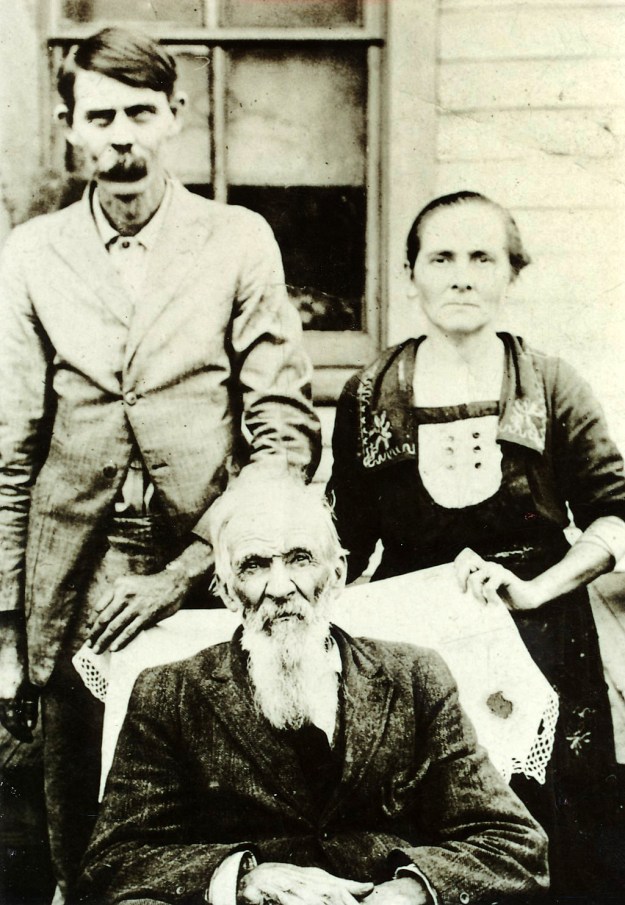
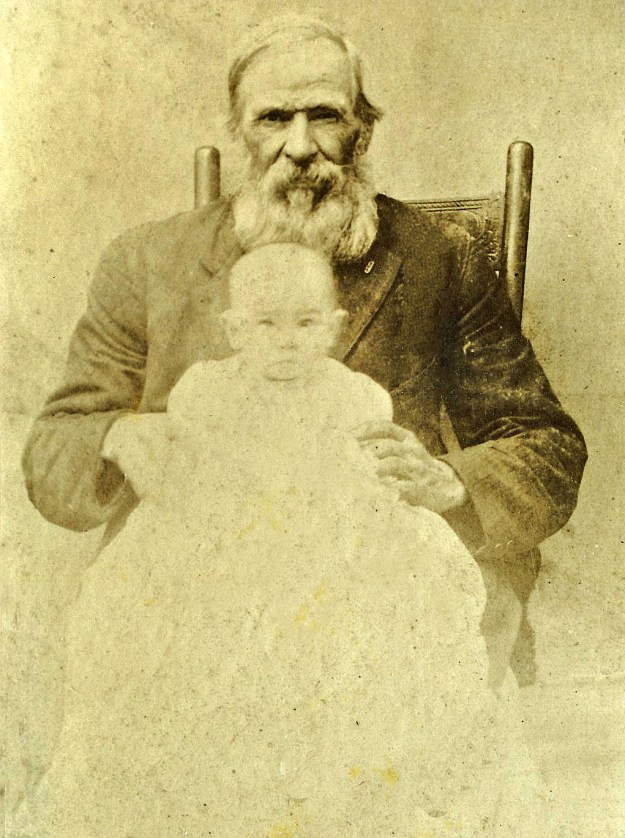
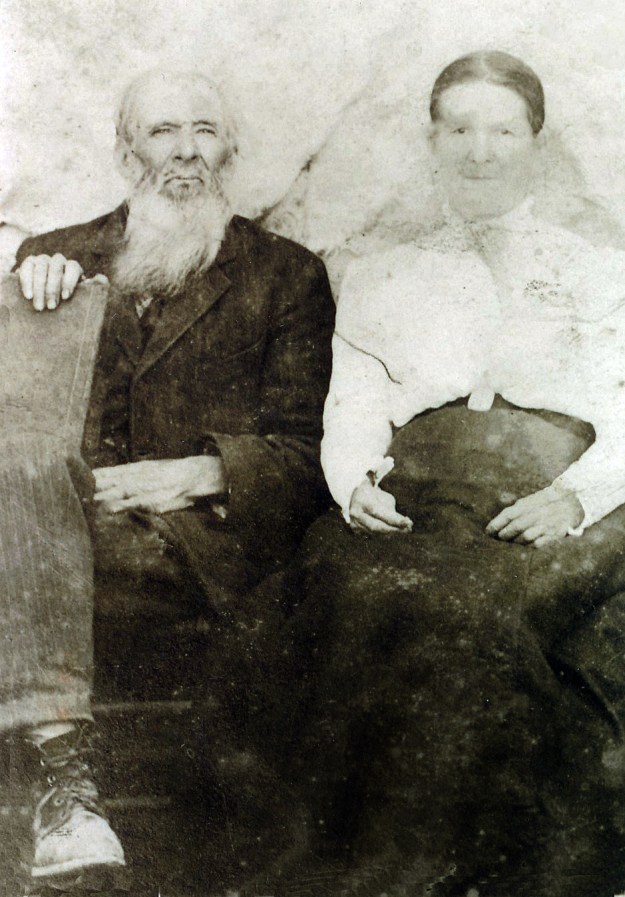
I really love old photos like the one above of William Early Thomas and wife Nancy Caroline Hogg. William is the son of Jonathan Thomas who is in turn the son of Ezekiel Thomas from Anson County NC. Jonathan moved to now Blanche, Cherokee County Alabama around 1838 where in 2001 I had the opportunity to meet his granddaughter Ms Abbie Gail Sharp Goss. Serving as my guide, Abbie shared family lore and allowed me to copy the above photo. Since this visit, and just as with her ancestors, Abbie Gail has now passed and her words and spirit are left to us in memory only. Little did I know back then of how the photo and the naming of Abbie’s great grandfather would lead to some pretty deep questioning of her complex family history.


abbie

Abbie Gail Goss is the daughter of Wriley Sharp and Caroline Thomas.

The above photo captures William Early Thomas with his most prized treasure, a worn and well-loved family bible. Maybe the bible once belonged to his father or grandfather and maybe it made the trip all the way from North Carolina to Alabama. It may have held the written memory of his grandmother, the first wife of Ezekiel Thomas whose name is unknown. There’s a hint of Ezekiel Thomas’ first marriage revealed in his last will and testament probated in 1839 Anson County. In the writing, Ezekiel’s oldest son Jonathan is separated from the other children as follows: “…divided Equally Between Milly, Ozbourn, Lewis, Edmond Thomas also I leave my son Jonathan Thomas one dollar.” As Jonathan was older in age and had likely already received all that was due him, the customary bequeath of a dollar was not hurtful but was instead fair and correct.


Photographs tell us the story of time and place. You not only see the wrinkles of background, clothing and landscape, you also get to glean information from facial features as another form or roadmap of our earthly existence. We can see in the photo that William Early Thomas had lived a long and likely hard life. Knowing he served in the Civil War, you can imagine this old man once in the prime of his youth taking up the arms of war. William appears worn, but equally proud. But even more so than the stories portrayed in photography, the name William Early Thomas in itself just may tell its own story.

___________________________________________

The given name William is used very little in the Thomas family of Anson County. Our traditions follow more closely to Old Testament biblical naming patterns. And, the middle name “Early” offers a unique set of naming possibilities leading back to a family of that name in northeast North Carolina. So how was it that Jonathan decided to name his son William Early Thomas? Back in North Carolina, around 1800 Ezekiel Thomas was deeded part of his father Benjamin Thomas Senior’s land situated a short distance from and on the north side of Richardson Creek. Ezekiel’s son Jonathan also acquired land in the same area before moving to Alabama. And just to the east of the Thomas lands in Anson County, on the waters of Bare Branch, there once lived William Morris. William’s story is quite twisted and I have reservations whether today it’s remembered the way it should be. Anyhow, it’s important to know that William had a son named William Airley Morris who was a well beloved Baptist minister. It’s this person for whom I believe William Early Thomas was named.

From a bio in the History of Rocky River Baptist Church:

Bro. [William A.] Morris served as pastor from 1842-1844, the year of his death. He was spoken of in the tenderest terms in a Memorial paper offered by the church on the occasion of his death. He lived on a farm midway between the church and the present town of Polkton. His grave is in sight of the present Lane’s Creek bridge on the (highway now in use). He was a man of fair intelligence and held some good pastorates. His family is extinct so far as known. Though there are grand-children, none bear the name of Morris.

And, in 1838, the highly revered Baptist preacher Rev. John Culpepper mentioned William A Morris in a letter to Rev. James Yarborough of Marengo County Alabama:

They are really like Pharoah’s [sic] lean kine, and come “thin and blasted with the East wind.” — All the old preachers you know in the country and most of the young intelligent young ones, are on the Missionary or effort side, and your brother, William A. Morris, is amongst them. He and myself have a Temperance meeting yesterday at Brown Creek Meeting House; we had ninety members before, and seven joined yesterday, and I hope the cause of God and good morals are gaining though iniquity abounds, and the love of some is waxing cold.

Relevant to any possible Thomas-Morris connection, Benjamin Thomas Jr (being Ezekiel’s brother and son of Benjamin Thomas Sr) sold on 11 Oct 1818 to William Morris 130 acres situated on Bare Creek. The land adjoined that of Drury Austin. This was surely William Airley Morris as his father William Morris had already died at the time of the deed. And the tract of land was originally granted to William Gurley and split between Drury Austin and Benjamin Thomas by way of the said William Gurley’s 1815 estate. And, it is traditionally believed by some that the elder William Morris married Pherabee, a daughter or William Gurley. And furthermore, that William Morris may be the son of John and Rebecca Early Morris from earlier in Bertie County NC. As a matter of fact, living very close to William Morris were also members of the Bush and Curlee families who had close ties to the Early Family back in Bertie County. So, it’s somehow through this line and this pile of people where the impetus for the naming of William Early Thomas in Cherokee County Alabama must be found.

In follow-up posts I’ll attempt to look at the lineages collectively and from a differing viewpoint …at times throwing all he balls in the air at once in order to get a glimpse of all possibilities. In truth, many times fact is mixed upon myth and a truth we believe is so. We have to look at it all. As Donald Rumsfeld once said:

There are known knowns. These are things we know that we know. There are known unknowns. That is to say, there are things that we know we don’t know. But there are also unknown unknowns. There are things we don’t know we don’t know.

I ask you to take a seat and get your mind ready as it’s going to be a hard read. There is so very much already out there that’s just not clearly founded and I’d like to devote a little time illuminating my concerns. So, let’s look further back in time. Let’s look back to northeast North Carolina where the ancestors of some of these players in Anson County were interacting in an earlier day and time. Other family names will be brought into the discussion such as Graham, Leggett, Bond, and Sanders. And just as with the life of Willaim Airley Morris and his likely namesake William Early Thomas, religion has always been at the center of our collective family story.


IMG_20170801_0003

Abbie Goss’ Aunt Margaret and her husband Lee A Crower with William Early Thomas


abbie2

Abbie Gail Sharp Goss in the arms of her grandfather William Early Thomas


The Goldsmiths of Maryland

It’s clear that in America, the first discovery of gold occurred in 1799 Cabarrus County North Carolina when young Conrad Reed came across the precious metal whilst playing in Little Meadow Creek. That’s the way the story goes and though there’s nothing to contradict it, surviving records do make you wonder.
As early as the 1740’s Granville grants and the like of Governor Arthur Dobb’s conveyances within the Great Tracts included clauses protecting any profits from mining operations:

“Except and always reserved out of this present grant unto the kings most Excellent majesty his heirs and successors one fourth part of all the gold & silver mines to be found in or upon the premises and also except and reserve thereat unto the said John Earl Granville his heirs and assigns, one moiety or half part of all other mines or minerals whatsoever, and all white pine trees now growing or hereafter to be found growing thereon.”

And, as late as 1793-4, Obadiah Fuqua received grants for 26 one thousand acres tracts in Randolph County, North Carolina. He did not hold on the land long as by the end of the year 1794, goldsmiths from out of state purchased the large tracts as follows:

Deed 6-9 Randolph NC, 3 Jan 1794, 19 Jan 1795, Obadiah Fuqua “farmer” of Randolph County NC to Nathaniel Morton and William Bedford both of Baltimore, town and county in the state of Maryland “Goldsmiths” of the other part being 26 tracts of land lying in Randolph County.”

Deed 6-16 Randolph NC, 29 Feb 1795, 17 May 1795, Obadiah Fuqua or Roan County NC” farmer” & John Adare of Baltimore to Nathaniel Morton and William Bedford both of Baltimore & State of Maryland “goldsmiths” of the other part, whereas Obadiah Fuqua did sell to John Adanill?? one undivided equal third part of 26 tracts. Obadiah Fuqua did also sell unto the said Nathaniel Morton and William Bedford one other undivided third of the 26 tracts. The said Obadiah Fuqua agreed to sell unto the said John Adanil & the said Nathaniel Morton and William Bedford the remaining 2/6th’s or one equal undivided third of the 26 tracts.
So, five years prior to discovery of gold in Cabarrus County, goldsmiths from Maryland were buying up land in Randolph County. Located in what’s today known as the “Gold Crescent.” were the buyers merely speculating in hopes the land would increase in value or had they somehow been tipped off of the possibility of gold? And, not being but a few years in advance of the discovery in Cabarrus, are there ties to the Reed mine and later developments in that area? Let’s take a look.

USGS GeoTIFF DRG 1:24000 Quad of Locust. Product:615851(YELLOW TRACT TO LEFT) Dated 5 Feb 1771, Abner Nash and Justina his wife sold to Samuel Crowell 48 acres lying in tract #2 on the north bank of the Rocky River with the southeast corner located at the mouth of Meadow Creek (Deed 6-51, Mecklenburg NC). In Deed 6-140, Mecklenburg NC, a year later, Samuel Crowell and wife sold the same tract to Thomas Dove. Thomas Dove soon after moved to the hills of Surry County NC before relocating south to near present day Bryson City. Thomas Dove eventually removed to Warren County Georgia where a well written biography can be found on “find-a-grave.”
Removing from his land at the mouth of Meadow Creek, Thomas Dove and wife sold their 48 acre tract to George Garmon (Deed 9-245, Mecklenburg NC, 3 Jan 1778). Witnesses were George Kiser and Archibald White. Of interest, George Kiser married Mary Dove and their son Thomas Dove Keizur was one of the wagon masters on the first crossing of the Oregon Trial.
On 10 Mary 1795, the same 48 acres was sold by Ebenezer Marsh to James Little (Deed 2-143, Cabarrus NC, 10 Mar 1795) Witnesses were John Stucker and William Carriger.
(BLUE TRACT ABOVE) Grant # 3290, Mecklenburg NC, was issued to George Garmon on 2 Nov 1784. The warrant was for “40 acres on Meadow Creek above the wagon road that goes to Kiser’s mills” and adjoined his own to the south and Meadow Creek to the southeast. This tract nests under the overhanging portion of James Little’s grant # 234. CC: John Corsire, Thomas Ingram. (Note that James Love married Mary Ingram and had a brother Thomas. Is it possible this Thomas Ingram is the brother-in-law of James Love?
James Little received two grants for land nested among the acquisitions of Thomas Dove and George Garmon. (RED SMALLER TRACT ABOVE) Grant #104, Cabarrus NC, issued 7 Dec 1797 to James Little, being 32 acres lying on both sides of Meadow Creek adjoining his old line and Isham Clay lands. CC: John Tucker, Jacob Nees. The second tract was (RED BACKWARD 7 SHAPED TRACT ABOVE) Grant #234, Cabarrus NC, being 70 acres. The land adjoined George Garmon to the west, John Reed to the north and Isham Clay to the east. The land crosses Flat Branch and Little Meadow Creek above its mouth. AT the time of its survey, the tract ran from a water oak (on bank of river at mouth of deep gut running thence four conditional lines between him and George Garmon) north 35 east 100 to p. o., north 45 east 50 to hic., north 55 east 38 to s. g., north 25 east 86 (up the Flat Branch) to to p.o. (James Love’s corner), south 58 east 16 to p. o. grub (John Reed’s corner), (with his line) south 20 east 42 to hic (Reed’s corner), south 45 east 64 to p. o., east (crossing Meadow Creek) 32 poles to pine, Reed’s other corner), (with Clay’s line) south 30 west 94 to pine, south 22 west 28 to stake (in Clay’s line), north 11 west 24 to pine (his own corner), north 47 east 80 to p. o. (his old corner), north 43 west 70 (crossing Meadow Creek) to pine, south 47 west 112 to p. o. (his old corner), (with his old line again) south 46 west 75 to b. o., south 41 west64 to w,. o. (on bank of river) (his old corner), then to begin. CC: ________________.

 
Hopefully you’ve made it through the above and are curious as to where this is heading. Basically, James Little ended up with all that land within and south of the backward seven shape in the above. And then on 25 Jan 1805, James Little sold it all to William Bedford and Nathaniel Morton of the County and City of Baltimore in the State of Maryland:

Deed 6-14, Cabarrus NC being 77 acres. Wit: Hu. Campbell, Js. Beard.
Deed 6-15, Cabarrus NC being 32 acres. Wit: Hu. Campbell, Js. Beard.
Deed 6-16, Cabarrus NC being 48 acres. Wit: Hu. Campbell, Js. Beard.

Confirming the sale and intent, THE EVENIG FIRESIDE published in Philadelphia PA the following dated 14 Dec 1805:

RALEIGH (N. C.) By the Representatives in the present General Assembly for Cabarrus county, we learn that the Proprietors of the Gold Mine in that county, continue to collect that precious metal, though in smaller quantities than heretofore. We learn also, that the gentleman from Maryland, who purchased a quantity of land last year at a high price, with the expectation of finding gold in it, is about to establish works upon the land, and is likely to succeed. Small pieces of Gold we are informed, have been found several miles from this place where it was first discovered.

Acquiring Little’s grant # 234 and the two other tracts between it and the river, there are no further records for Bedford and Morton until
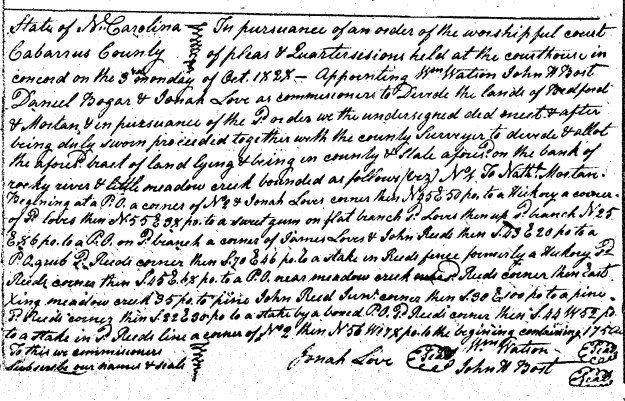
And then in Oct 1828, the court ordered the division of Morton and Bedford’s land. Wm. Watson, John H. Bost, Daniel Bogar, and Jonah Love were appointed as commissioners to divide the lands (11-176, Cabarrus NC). Daniel Boger was the father of my GGGrandfather Peter Pless’s wife Elizabeth Boger. Daniel Boger once owned a mill upstream from Hagler’s Ford that later fell into the hands of John H Bost. Also, Jonah Love is the ancestor of my mother’s parents as both were Love.

CONTENT


There must have been a split or parting of ways as Nathaniel Morton received 175 acres known as tract 1. At this time, what was the northern half of James Little’s lands now adjoined Jonah Love to the west running then up Flat Branch to James Love and John Reed’s corner. The line then runs south along now Jon Reed Junior’s line and then back west to the beginning. William Bedford received the southern half of land lying against the River and then adjoining Jonah Love’s land to the west, Morton lands to the north and John Reed Junior’s land to the east. It appears Morton and Bedford went bankrupt as their names appear together in a list of bankruptcies appearing in records from New York.

Nathaniel Morton’s (tract 1) was further conveyed as follows:

Deed 11-401, Cabarrus NC, 9 Aug 1831, prv’d Sep 1838. Sarah Williams, David Stewart, M. A. Stewart, Geo. C. Morton, and M. A. Morton of Maryland to Geo. Tucker.

Deed _____, Cabarrus NC, _______. George Tucker to John Reed Jr. Being tract #1.

William Bedford’s (Tract 2) was further conveyed as follows:

Grant 667, Cabarrus NC, ent. 14 Dec 1836, sur. 4 Apr 1837, iss. 22 Apr 1836. Issued to Nancy Linker, in a rare move, William Bedford’s tract # 2 was somehow escheated to the state and reissued as a Secretary of State Land grant. The survey was for lands adjoining Jonah Love to west, George Tucker to the north, and John Reed Junior lands to the east. CC: Isaac Linker, John C. Reed. Of interest, Nancy Linker was married to David Linker and her maiden name is Shore. Is she a child or otherwise kin to James Love’s daughter Elizabeth who married Henry Shore in Stokes County?

Deed 13-255, Cabarrus NC, 1 Dec 1838, prv’d Oct 1839. George Garmon and Nancy Linker to George Garmon Sen., being 115 acres on the mouth of Meadow Creek. Wit: Culpepper Howell, George Garmon.

Deed 14-286, Cabarrus NC, 29 Oct 1839, Prv’d Oct 1840. Henry W. Linker to George Garmon. Wit: Culpepper Howell, Isaac Linker. Being Tract #2.

Deed 14-318, Cabarrus NC, 18 Jan 1841, prv’d _____. Lewis B. Krimminger Esq., High Sheriff, to Robert Motley & Samuel Klutts. By virtue of an execution issuing from 1839 Cabarrus P & Q session against the property of Nancy Linker. Whereas Darling Love recovered a sum of $45.48 ½ and 125 acres were ordered to be sold. Wit: H. S. Love.


THE STORY OF WILLIAM, CATHERINE …and HENRY?

Born ca. 1747, Joseph Thomas died in Chatham County NC prior to the inventory and sale of his estate dated 3 Dec 1819. We have learned much about Joseph’s family from land grants, conveyances, court entries, and the names of those who purchased from his estate. But, do such records capture the entire family as indicated in so many online genealogies? And what ever happened to Joseph’s children Micajah, Catherine and William who we know so little about? I’ve been assured that the early generations of Joseph’s descendants all remained in the area of Moore and Chatham Counties NC, but, is that the truth? I’ve also come to believe otherwise and new research will begin to bridge family gaps extending well beyond the state of North Carolina.

About Micajah Thomas, he appears in numerous land records in Wake before buying and selling land among family prior to receiving a land grant in Moore County. By 1805 it appears he disappears from record other than his listing in the 1810 Moore County Census. And after that point his whereabouts appears to be unknown. Beyond Micajah, what do we know of Joseph’s children William and Catherine?

From Joseph Thomas’ 1819 estate sale listed in part below, both William and Catherine are listed as purchasers. And with that bit of information, I decided to trace available records for neighbors and others listed in the last and important Thomas family document. Joseph Thomas Estate Page 3

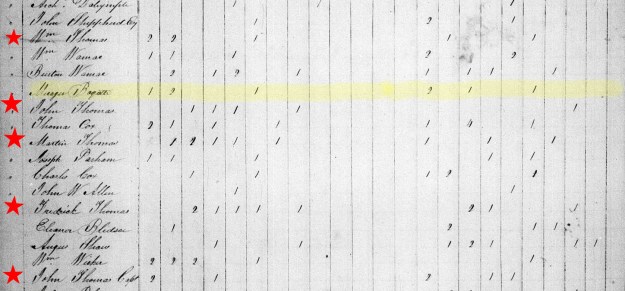
From the above estate sale you’ll see Catherine and William Thomas buying alongside a person named Micajah Baggett who was likely born in Wayne County NC. And in the 1820 Moore County census, Micajah Baggett is enumerated among the families of John, Joseph and Frederick Thomas.   By 1830, he is still enumerated (in yellow below) in Moore County alongside Wm Thomas, John Thomas, Martin Thomas, Frederick Thomas and Capt John Thomas. Other neighbors include John Shephard, Wm Womack and Wm Yarborough.  t

Believing the name Micajah Baggett to be uniquely different and therefor easy to locate, it didn’t take long to discover the next move. In 1840, young William Thomas is enumerated in Marion County Georgia next to William Wommack. Also living in Marion County are Micajah Baggett, John Shephard, and Andrew M Shephard.

Apparently Micajah Baggett and Joseph Thomas’ daughter Catherine met and married in either Moore or Chatham County NC around 1820. John Shephard above is likely the son of Andrew Shephard who sold land in Moore County to Philip Johnston who then sold it to Joseph Thomas. And remember that Voluntine Braswell’s tract on Bush Creek in Chatham County passed through the hands of John Shephard before being owned by the Thomas family and later Ishmael Roberts.

In Marion County GA, the 1842 last will and testament of John Sheppard names daughter Mary Thomas. In 1850, the 65 year-old Mary Thomas is enumerated in Buena Vista, Marion County in the home of Osborne and Mary Blair. Mary Blair is Mary Thomas’s daughter. The 1850 Marion County census also enumerates 54 year-old William B Thomas with wife Sarah and children Moore, Asa, John, and Laurel. In 1854, Chattahoochee County was created from western Marion and it’s there where Wm. Thomas and M. Baggett are found:ttt

andrew

It seems the Thomas family in Marion and Chattahoochee Counties begin to disappear in the 1850’s and beyond. What happened to William Thomas’ children?

Going back to the first probate record (on page one) found in the earliest Marion County record online it the estate of Henry Thomas. Please take a look below and notice who purchased from his estate and likewise who did not:henry

This post is pretty mangled and for that I apologize. However, in the roundabout way, it’s clear that at least two of Joseph’s children moved to Georgia. And for our THOMAS family Facebook Usergroup, an important challenge lies in connecting several lines in Alabama linked presently by DNA only. One of the families is that of Henry J. Thomas who died in Elmore County Alabama. Henry’s father is Andrew Thomas who married the widow Jane Wood Daily in 1854. The young family appears in 1860 Montgomery County as:

1860

Born 1822 in North Carolina, Andrew Thomas’ given name is a clue I’ve thought would eventually reveal his story. Is it possible Andrew is the son of William in Marion County? And, of all the luck, who is Henry Thomas who died in early Marion County? And, note that one of the buyers of the estate happens to be Micajah Bagget, husband of Joseph Thomas’ daughter Catherine! Could Henry be a member of our family? And, what do you see in the name Andrew? Andrew Shepherd was a large figure in the area along the early Chatham/Moore County line. If his son’s daughter Mary married into the family of Joseph Thomas, would it not make sense for them to have a son Andrew Thomas? The age is right and just maybe Andrew Thomas in Montgomery County Alabama is the son of Henry. And did Henry marry Mary Shephard?

There’s still very much to learn if we are so blessed. Someone with better ties to Marion County GA needs to plow ground there in hopes of further connecting the dots. Note that John Shephard is interred at County Line Primitive Baptist Cemetery, Marion County GA.

THOMAS LANDS ON THE MOORE/CHATHAM LINE (PT. 2)

In my last post, conveyances by Joseph Thomas in Wake County indicated that ca. 1798 his family was in process of moving the short distance across the Cape Fear into Chatham County. And now, we’re about to go there, to plow new lands thick with our Thomas heritage. In what’s now Lee County NC, the largest family file at the county library is that of the Thomas family.   The family is huge and still going strong today. But before moving forward, let’s take a quick look at Joseph Thomas Senior and what most researchers believe to be his immediate family. Also so as not to confuse, the Joseph I refer is identified in records as literate (able to sign his own documents) and goes by title senior in order to distinguish himself from a son of same name. Note that it’s strongly believed that Joseph Senior is himself the son of a man named Joseph Thomas.

In no particular order, the children of Joseph Thomas Senior are believed to be:

  1. John Thomas b. 1770-1775
  2. Frederick Thomas b. 1770-1780
  3. Micajah Thomas b. 1770-1784*
  4. Martin Thomas b. 1770-1800
  5. Catherine Ann Thomas b. 1770-1800*
  6. Joseph Thomas b. 1771-1772
  7. Benjamin Thomas b. 1775-1776
  8. William Thomas b. 1790-1800*
  9. Allen Thomas b. 1796-1800

We’ve already been introduced to Joseph Senior, John, Micajah, and Joseph Junior in the records of Wake County. And now in Chatham and Moore counties, we’re about to learn of Frederick, Martin, Benjamin, and Allen Thomas. And later, we’ll learn of Catherine and William. Of all these kids, little info has been provided for three (in red asterisks). What happened to them and what’s their story? The storyline is about to get much more interesting; but for now, let’s look at the family’s initial land acquisitions as they move beyond Wake County:

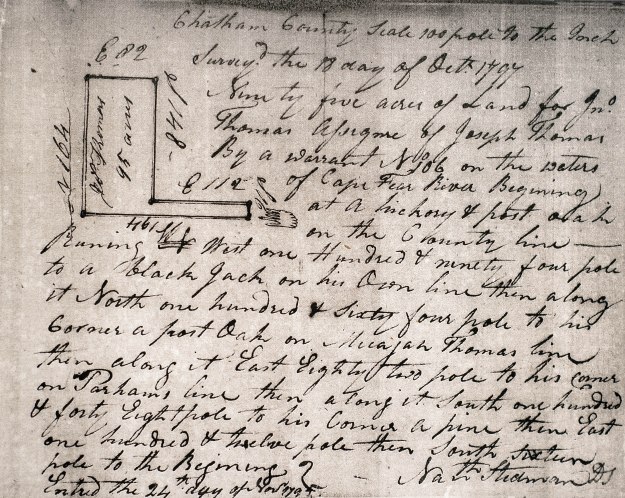
DSC_9123Grant #1511 Chatham NC, ent – – -, surv 18 Oct 1797, iss 13 Dec 1798. Issued to Jno. Thomas, assignee of Joseph Thomas, being 95 acres on the Moore County line adjoining his own and the lands of Micajah Thomas and — Parham.

DSC_9121Grant # 1514 Chatham NC, ent —, surv 19 Oct 1797, iss 13 Dec 1798. Issued to Joseph Thomas being 275 acres on the Moore County line adjoining his own, Micajah Thomas’ and Thomas Partridges’ lands.

micajahGrant # 1035 Moore NC, ent 29 1798, surv 3 Jul 1798, iss 13 Dec 1798. Issued to Joseph Thomas, being 70 acres on both sides of Bush Creek and the Chatham County line adjoining the lands of Jno Cameron and a hill on the SW side of Wm Parham’s. Chainbearers: Micager Thomas, Elisha R. Yarborough.
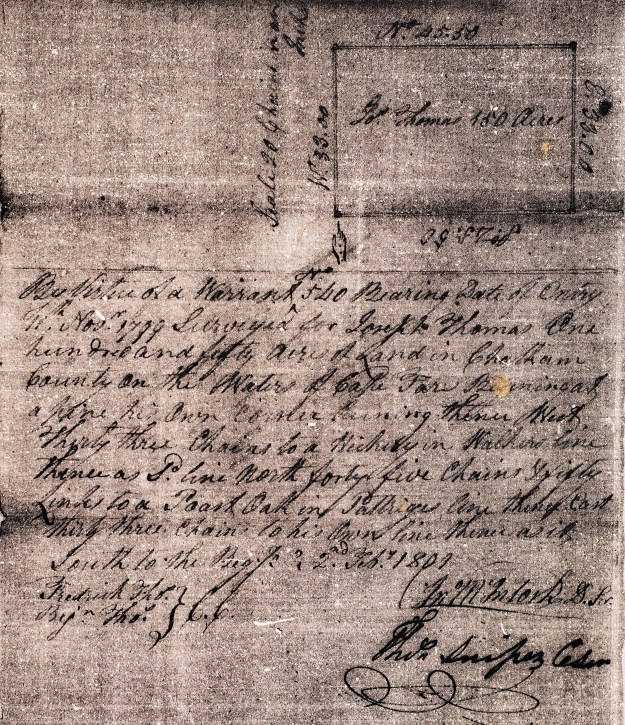
DSC_9119Grant # 1691 Chatham NC, ent 11 Nov 1799, surv 2 Feb 1801, iss 14 Nov 1801. Issued to Joseph Thomas, being 150 acres on the waters of the Cape Fear adjoining his own, Walker’s, and Partridge’s lands. Chainbearers: Frederick Thos, Bejn Thos.

I love to draw on paper the physical shapes of old land grants and conveyances. Using a scale of 1 pole (16 ½’) equals a millimeter, I draw my ancestral lands and even the lands of their neighbors as far out as I can stand. Once in hand, the paper “plats” are like pieces in a child’s puzzle and can be joined together in map form. But, it’s not so easy. These puzzles offer the clever beauty of a chameleon lizard as the look of each piece (and entire puzzle) changes appearance over time. Each new conveyance offers the opportunity for mutation by way of the ever-changing interpretation of preceding records. At first a plat map made of original grants is pretty simple. Most of the pieces fit together nicely and the resulting display is somewhat predictable. But sometimes there are lost records or mistakes and grants that are issued wrongly or something legally happens requiring the land to be reissued in a new form. Sometimes reissued or later conveyances of grants are similar in appearance but are not exactly the same as the original. Also, conveyance by way of deeds and estate distributions infuses an enormous opportunity for change. People acquire multiple tracts of land only to someday die and have it all uniquely divided by committee to satisfy the numbers and demands of their heirs …a totally different shape matrix is introduced!

So, with the help of my little deck of playing cards, let me show you the lands along the Moore /Chatham County line. The videos below are about our Thomas family and also about the community where they lived. I want you to see it all the way I do, to understand how the changing landscape evolved with our history. I want you to understand how I come to my conclusions. So please, it’s important that you start with video one and work your way through them all. Please hit reply at the bottom of this post and let me know if you have any questions, concerns or additions. This is an initial reading of the puzzle and I’m sure there are mistakes. More can be gleaned through the collective eyes of others. Also, note that hopefully by later this year, and presented online, I’ll have all the lands within this area platted out to include original legal descriptions along with their later conveyances.

THOMAS LANDS ON THE MOORE/CHATHAM LINE (PT. 1)

It’s time to turn attention back to research here in North Carolina …to the family of Joseph Thomas and of their move from Wake County to land along the Moore/Chatham County line. Arriving in Wake County around 1772, by the 1790’s, court minutes chronical the coming of age of Joseph’s children. Listed in crews working the road to Braswell’s Ferry in Chatham County, by the late 1790’s, members of the family are also documented as being insolvent. Such records foretell of change and of the family’s move across the river.

-June 1790. Ordered that the following hands be added to the Road where William Hays Esq. is overseer of towit: Joseph Thomas, Micajah Thomas, John Thomas, Joseph Thomas Jun. and Nathan Allen.

-December 1794. Ordered that the following jury, to wit, Andrew Peddy, Elijah Watson, John Burt, Joseph Thomas, Joseph Thomas Junr., Micajah Thomas, John Thomas, Daniel Oaks, Stewart Hamiliton, Carnaby Stephens, and Richard Hucaby turn the road leading from James Gaines’ esqr. to Braswell’s ferry and report theron to the next Court.

-INSOLVENTS allowed James Huckabie Collecr. Of the Taxes in Capt. Farrers District for the year 1795: Elkin Jones one poll, Joseph Green 1 poll, Andrew Hambleton one poll, Hardy Lil one poll, Jesse Jent one poll Jesse Lewis one poll, Henry Powel one poll, Hugh Mills one poll, Nathan Powell one pol, Asa Thomas one poll, Ezekiel Smith one poll, Jasper Turner one poll,

Also in Capt. Peddy’s District for the year 1795: Jos. Thomas one poll, John Thomas one poll, Hillery Thomas one poll, Thomas Berney one poll, William Cook one poll, Thomas Hays two poll, Stewart Hambleton one poll, John Lett one poll, Stephen Matthews one poll, Edwin Stephens one poll, William Spivey one poll.

-September 1797. In Capt. Peddy’s District: Revil Coleburn one poll, John Cook one poll, William Cook one poll, Micajah Thomas two poll, Simpson Wood one poll, George Williams two polls, Amey Gross one poll, William Smith one poll.

We have a clear record of Joseph’s land entries and of the various tracts he acquired through grants issued by the Secretary of State. He and other players in his life likely bought and sold an even larger amount of land though such possibilities go unknown as a court house fire in Wake County destroyed a few of the early deed books. Also, as Joseph and family moved piecemeal to neighboring Chatham County, the selling off of their holdings in Wake County does not fully account for all the land that had originally been granted them. With that in mind, here’s the only three surviving deeds recording the family’s divestment of land in Wake County.

Deed R-35 Wake County NC, 31 Dec 1800, recorded Aug 1808. Joseph Thomas of Chatham County NC to William Hayes of Wake. Being 366 acres on the waters of Buckhorn Creek adjoining the lands of Hayes (formerly Sellers), Wommack, Peddy, Daniel Oaks, Phillip Smith’s (now William Hayes). Witnesses: Elleck (x) Howard, Willia (x) Sugg.

Deed R-320 Wake County NC, 20 Feb 1800, recorded Feb 1803. Joseph Thomas of Chatham County to James Huckabee of Wake. Being an unidentified amount of acreage on both sides of Little White Oak Creek. Witnesses: Jesse Winbourn, James Parker.

Deed U-277 Wake County NC, 1 Jan 1802, registered Feb 1808. Joseph Thomas, David Mimms, & Jacob Leven to William Ragland of Chatham County. Being 169 acres on the east side of the Great White Oak Creek adjoining the county line and Moses Hicks and Woodard’s lands. Witnesses” Thomas (L) Ash, David (x) Waldon, Richard Adams.

At this point it’s time to focus beyond Wake County to Chatham and Moore and to the dynamics of life there. Rather than inundating you with a huge amount of land conveyance data, in this series of posts, I’m trying a new approach in rolling out future chapters of this family story. Please take a look at the following short video. I cannot begin to imagine how to communicate the broken trail of land records in a clear and succinct manner. This video, and others following, will illustrate the move, the changing times as well as my thoughts on how all the loose parts come together. I believe that how we come to learn something is as important as the intended lesson itself. So, please click on the following link and enjoy …I hope this works!