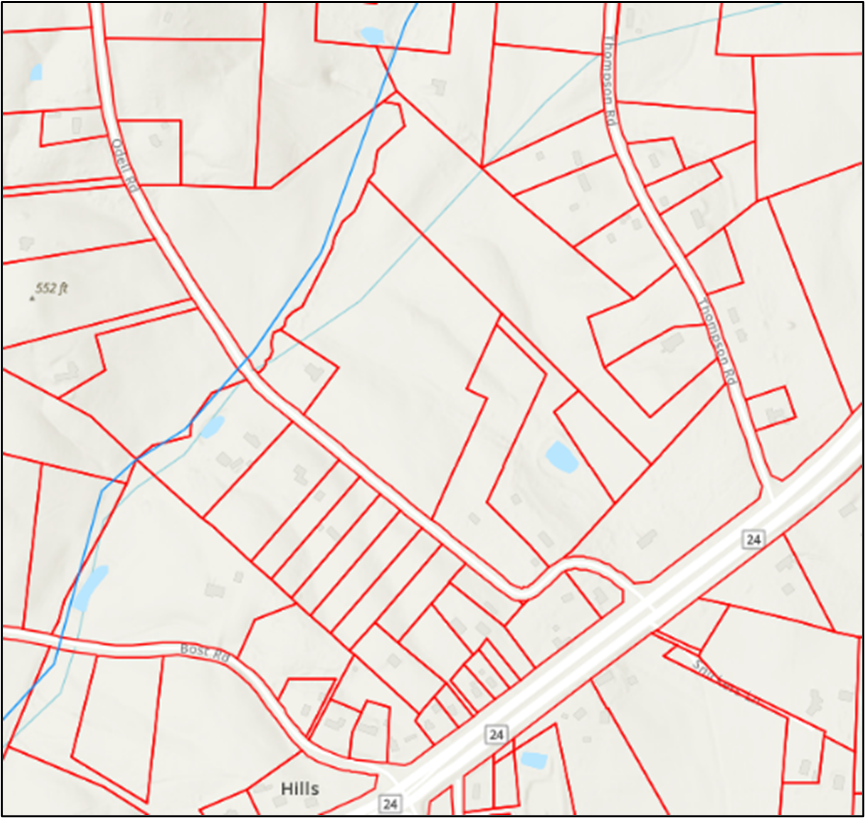
 North of 24/27 and nested between today’s Thompson Road and Bost Road in Stanly County lies a diamond-shaped visual echo of our distant past, see it? Going back to 1780, a person by the name of Thomas Durham entered 100 acres “on both sides of Little Bear Creek, including some improvements.” As can be clearly seen on the image, passing through the northern end of the tract is a stream most people today call the Little Branch of Little Bear Creek. However, from the original survey, which occurred 12 years after the entry, we learn of that time, the tract was described as located on “both sides of a Little Creek or a branch call’d Daniel’s Branch.” Creeks often go by different names and that seems to be the case with this stream.
Regimental records show that Thomas Durham served in the Revolutionary War. From a pension request filed by William Boyd of Washington County, Arkansas: “The service I rendered was against the Cherokee Indians and Tories, I was under the command of Captain Daniel Bankson while a private James Allen, a Captain who died of the smallpox was in my company as a private. I served as an Ensign under the command of Captain Thomas Durham, who resigned and Captain James Crump took the command, and in a few months took command of another company on the East side of the Yadkin River.” As it turns out, James Crump owned land nearby where he patented numerous properties along the waters of Long Creek. Most significant might be a small 50-acre square that later became known as the Efird Mill tract.
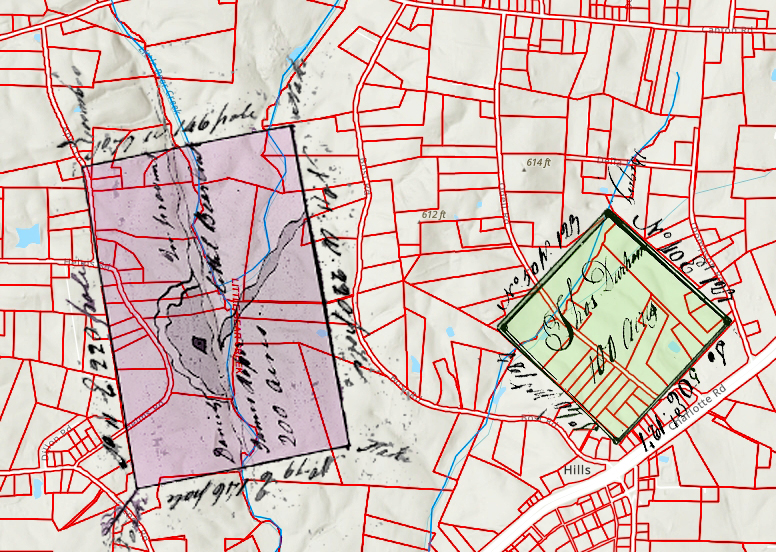
But what about Daniels’ Branch and what do we know of the stream? It so happens that a person named James Roper patented 200 acres in 1778 Anson County located at that time “in the fork of Little Bear Creek, including Jeremiah Daniels’ improvement.” A survey of the property made that year shows Daniel’s house in what looks to be an island formed where a secondary branch empties from the east into Little Bear. The lines are a bit turned around in the survey, but deeds prove the property to be but a few hundred yards downstream from Thomas Durham’s patent on the little branch of Little Bear, also called Daniels’ Branch. Now we have a better idea of why the stream was named Daniels. The following illustrates that these two surveys, overlaid atop today’s GIS map, may be helpful in locating other early properties.
The American Civil War which, for many, is seen as less of a community-based civil riot or war and was about issues dividing the North and South. However, and especially for North Carolina, the American Revolutionary War often divided local communities and even families. I could write about William Thomas of now Richmond County (no relation to me) who taunted and rode a loyalist neighbor around unclothed on the back of a horse. Tory militia led by David Fanning whipped up loyalist sentiment throughout today’s Carolina Piedmont. And there so happens to be an interesting story about Joab Durham, who was Thomas Durham’s brother.
Thomas and Joab came from Orange County, North Carolina, where I feel the brothers relate to the naming of Durham County and city that grew from Orange County. There, in 1779, Joab entered a land grant for 150 acres on Little Cain Creek. A bit unusual, the wording mentions the property’s joining with “Melchi McDaniel deceased, including the improvement and claim of land where Thomas Durham, deceased did live.” So, now we can be certain that the father of Joab and Thomas Durham is also named Thomas Durham.
And here’s where it gets really interesting. Found on a Durham family genealogical site, and as appears in a book From Kitty Hawk to the Moon by W. O. Durham, the author of that book tells the story of James Allen Durham who passed in Winn Parish, Louisiana, in 1899.
“He called two of his grandsons to his room and told them to write down the following story about the patriotic exploits of Joab Lindsey Durham, his paternal grandfather, during the Revolutionary War.”
Following their grandfather’s wishes, the story has been passed down as follows:
“My grandfather, Joab Durham, was a leader of a band of patriots in North Carolina during the Revolutionary War. He had a brother-in-law named Mack Arrington, who was a leader of a band of Tories. The Patriots got news that the Tories were going to destroy or damage a watermill nearby. Joab and his rangers secured themselves inside the mill. And, when the Tories reached there, one of the patriots said to Joab, the leader, “Joab, Mack Arrington is leading the Tories and I’m going to kill him. Joab said, “Go ahead and kill him.” and then, he turned his head so as not to witness the killing. The bullet plowed through the lower chin of Arrington and broke his neck. All the rest of that band of Tories was either killed or taken prisoner. Joab and his men later joined Marion and his band in several battles, one of which was the Battle of Kings Mountain, on 7 Oct 1780; also, the Battle of Gillford’s [sic] Courthouse in North Carolina in March of 1781. He also had part in the Battle of Hobkirk’s Hill, North Carolina [sic], and the one at Fort Ninety-six.”
I have read lots of things, mostly words from court cases and land conveyances. And somewhere in it all I do recollect the name Mack Arrington in the county of Stanly, or old Montgomery County. Someday I hope to come across the name again and I hope to learn more about this family member killed by another. But from this report and the genealogical site, I learned that one of the scribing grandsons was named Thomas Bozeman Durham. I believe Mack Arrington is closely related to Whitmel and Charles Harringtom who lived on Big Bear Creek in Booger Hollow but a few miles west of Thomas Durham’s patent on Little Bear Creek. And but a short distance upstream, and per a patent to James Pickett and William Coleman, Charles Harrington did once live nearby. James Pickett happened to be the Representative of Anson County who attended the 4th Provencial Congress at Halifax, North Carolina, giving our state the right to be known for its role as First in Freedom. But of this Harrington family, Whitmell’s daughter Sarah married Boseman Adair. There is that Bozeman name again and like the Durham family, the Adair family also moved to Georgia. There are knowns, unknowns, and known unknowns.

