ONE THING LEADS TO ANOTHER

115About this time last year, I had the chance to attend the 300th Anniversary Celebration of Indian Woods which is located in Bertie County, North Carolina. The three day conference at historic Hope Plantation focused on the lives of the Tuscarora Indians and their unfortunate demise over time as a result of war, social divisions, and finally the forced collapse of their Indian Woods homeland by external pressures. Participants in the conference had the opportunity to learn from many of the remaining descendants. We were immersed in Native American history, as well as being introduced to the realities of growing up as tri-racial Indians. The conference was led by Dr. Larry Tise, an East Carolina University distinguished professor of history, who is also well known for his knowledge of the Wright Brothers including a recent research initiative into their first secretive flights:  https://player.pbs.org/viralplayer/1839215537/

________________________________________

Following the conclusion of the Tuscarora Wars, a number of these great people remained in the area of Bertie County where their descendants folded into the fabric of today’s down-east North Carolina. The rest, those who fought against and fell to the advances of early English settlement, were forced to remove north to a reservation located near Niagara Falls, New York. The most heartwarming aspect of this conference was in witnessing the coming together of these two distant bands of people and being a part of their sharing of heritage.

Some of what I learned about Tuscaroran history was built upon gleanings from an unusual source, the notes and journal of a Mr. August Gottlieb Spangenburg. In the 1740’s, Spangenburg toured Bertie County in search of a 100,000 acre tract of clear land suitable for establishing a settlement of Moravians. Eventually the Moravians chose an area they called Wachovia in present day Stokes County. Now known by the settlement’s early towns of Bethabara, Bethania, and Winston-Salem, it was in this same area that yet another group of people chose to settle in the late 1700’s. These were Methodists spreading west and then south out of Virginia. They first broke bread in town taverns, in contrast to the local Moravians who attended morning worship in their own properly constructed churches. These Methodists were plotting their own expansion, as had Spangenburg and the Moravians. It was in this mix that my ancestor James Love founded a Methodist church on the waters of Muddy Creek. As occurred for the Moravians in the writings of Spangenburg, Methodist Bishop Francis Asbury introduces us to early Methodism in western North Carolina. In 1799 Love’s Church was visited by Bishop Francis Asbury who wrote in his diary:

We rode through Stokes County, and attended meeting at Love’s Church, which has glass windows and a yard fenced in. After Jesse Lee, I added a few words on Hebrews ii, 1. We then came to William Jeans near the Moravian old town.

Turning our attention back to the conference at Hope plantation, we had a great time in both study and fellowship. For me, it was a wonderful opportunity and marked my “jumping off point” into a more devoted study of history following my recent retirement from the Crafts Center at NC State University. The conference gave us all the opportunity to break bread daily around tables at the Conference/Welcome Center. We even joined in the traditional task of shucking Indian corn! It was in this setting that I had the opportunity to share some of my own stories with Dr. Tise.

love2

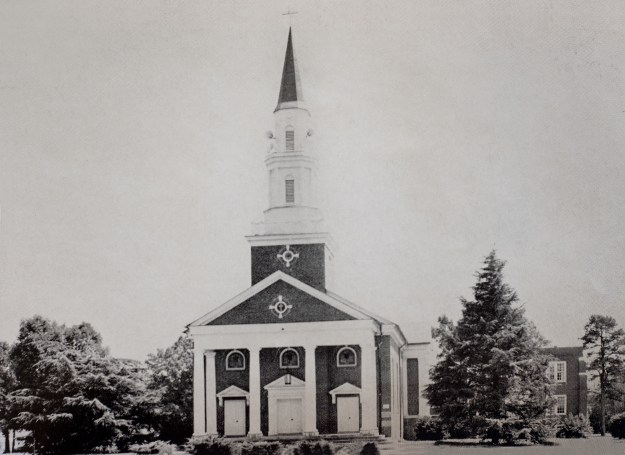
ca. 1966 – Love UMC, Walkertown NC

We live in a small world, truly, because, as it turns out, Dr. Tise is a native of Winston-Salem with his spiritual life beginning at Mt. Tabor United Methodist Church. He became a local preacher while studying at Duke University and upon completion of an undergraduate degree in history, and prior to his graduate studies, Dr. Tise was asked to research and prepare an authoritative history of Love’s Church. Wow, is this the Love’s Methodist Church that I’ve read about?!! Is this the church founded by my ancestor James Love? Yes, indeed it is!

love's methodist
The history of Love’s Church, A House Not Made With Hands, was published in 1966 in observance of the 175th Anniversary of Love’s Church. It was during his research and stay at Love’s Methodist Church that Dr. Tise realized history was his true passion and calling. Without his Methodist roots, and without this wonderful initial experience, Dr. Tise may not have ended up to be the person he is today. Without any or all of the above, I would likely have not attended the conference on the early North Carolina Indians. It simply may not have happened at all.

________________________________________

From Chapter II: Seed Time and the First Harvest, 1791-1807:

When one seeks for the founding date of a church such as Love’s, one speaks of a parcel of historical data which perhaps can never be pinpointed. …Churches simply are not and were not established at a particular point in time. They grow out of small, unpretentious beginnings and out of informal gatherings. They occur because there is a local personal need for religious experience.

The above acknowledges the “seeding” and germination time wherein the most important challenges facing a church lie. It’s during this time that greatness seemingly sprouts from out of nowhere. As for my family, James Love is in many ways our “seed.” Before him we know very little. And without him, there would be no Love’s Church. I would not be here and neither would many others.

I’m very appreciative of Dr. Tise and of what his writings have taught me. In 1966, he was limited by the availability of records and little was known at that time about the founding families of Love’s Church. Today, we know much more about James Love who first came to the Stokes County settlement now known as Walkertown. We know of his beginning and of his descendants who carried on the family traditions in the Methodist church.

Just as actions in early Bertie County spun off and impacted the future we now live in, Love’s Methodist Church in Stokes County, NC was a seed from which other churches have taken root. The following are offshoot churches bearing our family name of Love:

Love’s Chapel Methodist – founded by James Love, son of John Love who is the son of the above James Love. This church is no longer standing though the cemetery survives in Loogootee, Martin County, Indiana

Loves Church – for this one, I’m not even sure exactly where, though I’ve heard there is a Love Methodist Church in Missouri which sprang from the family who moved from Stokes County, NC to Indiana

Love’s (or Mount Moriah) Methodist – founded by James Love Junior, the son of James Love Senior who founded Love Methodist in Stokes County NC. Struck by lightning and burned in the 1860’s, this church was once located within stone’s throw from Reed gold mine near the intersection of Hartsell and Reed Mine Roads in Cabarrus County. The only thing surviving is the church cemetery with but a few marked graves

Love’s Chapel United Methodist – founded by Jonah Love, the son of the above James Love Junior. This church is located in Stanfield, Stanly County

Love’s Grove United Methodist – founded by Phoebe Love, daughter of Thomas love, son of the above James Love Junior. This church is located in Stanly County on Rene Ford Road.

TROUBLES IN THE NEIGHBORHOOD

In this post I’m finally powering up in preparation of working an area of Anson County that I’ve dreaded. It’s a place where land disputes gave rise to one of the most impactful Supreme Court Cases I’ve seen. I become exhausted reading through the more than 75 pages of deposition. That, and there’s the accompanying survey plat that’s one of the most extensive I’ve ever viewed. Already hesitant to wrap my mind around the aforementioned case, again this week I stumbled across yet another legal action, further expanding the scope of this story.

Early on, Anson and Mecklenburg Counties joined in what is now eastern Union County. And, in the western edge of old Anson flowed a stream by name of Negrohead branch. It emptied into Richardson Creek from the south.

Recently changed to Salem Branch, local lore says the stream may have been named for a slave whose head was piked as warning to others. However, a more plausible origin can be found in the large blackish rocks lining the creek banks. The rocks may be the same type as those my dad always referred to as “bullhead rocks.” In all of this, and for sake of civility, I’m simply glad that the stream name has recently been changed to Salem Branch. Please note that I’ll continue to use the term Negrohead in this post as it’s the name used officially in historic documentation. I mean no disrespect.

Looking first at the case I found this week, I hope you will take time to study the survey plat along with the legal land descriptions that follow. And while in your studies I ask that you put yourself in my place. Knowing that it’s my goal to reconstruct the land records of early Upper Anson County, imagine the effort it’s going to take to rejoin and make sense of such convoluted title history. My concerns are rooted in the effort needed to make sense of all this while realizing some mistakes were legally dealt with while others were resolved simply with the passing of a buck or shake of the hand. I’m not alone in my troubles as I am only walking the path of mistakes made by others in the distant past. Whether based in greed or some simple mathematical error, ancient mistakes in calculating or recording land have a way of wreaking havoc on our understanding of the past.

The below is found in the Union County civil action papers relating to issues of land. In this case John E. Austin who was born in Wake County, the son of Charles and Phereby Bunch Austin, intended to sell several granted and otherwise deeded lands. The buyer was Simeon D. Pembleton who on 6 May 1851 married nearby Mary A. Treadway, daughter of John Treadway. I’d never bring up this extraneous information though a Google search of Simeon netted an interesting story titled “Counterfeiters for the Good.” From a newspaper article concerning runaway slaves Simeon D. Pembleton is mentioned thusly:

“No doubt now remains but Simeon D. Pemberton, of Anson County, is the rascal who procured these passes for my negroes. It may be that the counterfeiter, Geasling, of Rockingham County, who was whipped and imprisoned at Wadesborough, wrote one of the passes.”

Now, let’s get back to the land transaction between the above John E. Austin and Simeon D. Pembleton. Because several of the tracts granted impose on others and also due to a complicated title history, it was ordered by court hat a survey be made. The plat and legal descriptions are as follows:

jack branch.jpg

111
Below is a map showing the fork of Zachs Branch along with its location on the run of Negrohead branch. Before moving forward realize that today the Creek is called Jack’s Branch. And, in the early Union County map the branch is identified as Jackson Branch. Must of the land grants identify the branch as Zacks with but one or two tracts being identified as lying on Jacks. The above lies within the area tinted red. Downstream I’ve tinted the map yellow. The following case resolved in the North Carolina Supreme Court involves much of the land tinted yellow:

11111

Now let’s look at a survey plat of land concerns from the Supreme Court case Ennis Staton vs. Jacob Mullis. When looking at the following image note that many years ago I went through the file and remember seeing a fabulously water colored original that is no longer there. The below is a printed copy from the officially bound North Carolina Supreme Court Records.

mullis

Does this look complicated?  Take a look at the brief heading description for this case:

Deed, Construction of–Color of Title–Adverse possession –Estoppel
–Burdon of Proof—Possession–Description and Location

To get an idea of the complexity, I’ll leave you with the following. It’s just one of many pages within the case records.

111111

WAS IT THE GOLD?

Settling in Anson/Union County NC, early land records locate my Thomas family as living in the area of Gourdvine Creek east towards the waters of Cribbs and Pine Log Branches. That’s old news. But, to the west beyond Negrohead Creek (now Salem Creek) lived John Thomas who came to Anson County from Chatham County NC. From DNA we know that John Thomas is not related to our family. We also know John Thomas served in the Revolutionary War and after that moved to Anson County where he lived on Schoolhouse branch of Mill Creek which is close to the old Mecklenburg County line. There’s only one surviving record linking my family to the neighborhood in which this John Thomas lived. And, as it always goes, it’s an important one, opening up possibilities I still don’t fully understand. Let’s take a look.

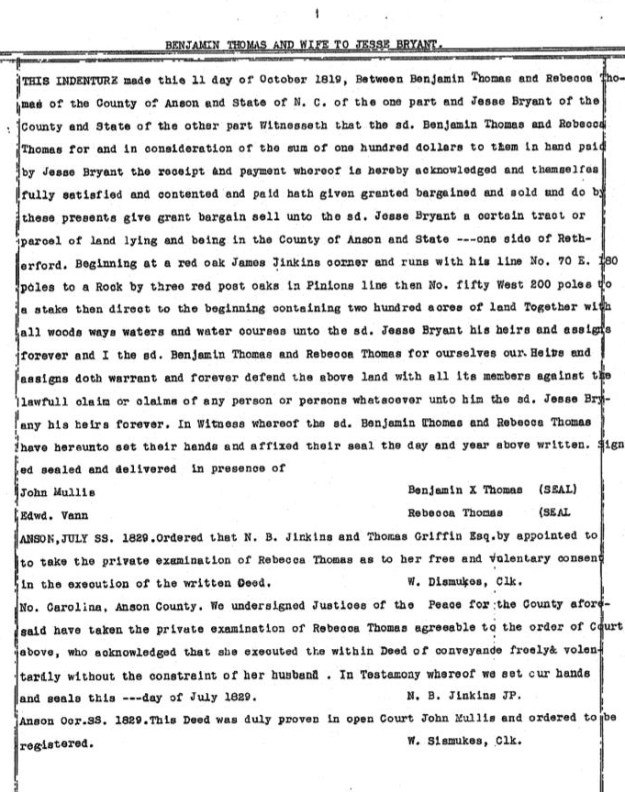
Dated 11 Oct 1819, Benjamin Thomas and wife Rebecca of Anson sold to Jesse Bryant 200 acres (Deed x-85, Anson NC ) This land was situated on “one side of Retherford (Rutherford/Weatherford Branch) …beginning at James Jenkins corner …to a rock by three red oaks in Pinion’s line.” Witnesses are John Mullis and Edward Vann:

ben and rebecca

I’ve yet to find a record showing how Benjamin Thomas acquired the above land. Likewise, I’ve found nothing further on how Jesse Bryant disposed of the same. However, years ago I was able to help others confirm that a Jesse Bryant who moved to Pulaski County Georgia is the same person as he who purchased the above land from Benjamin Thomas. And in that find I’ve yet to find anything of importance to our family.

So, …who was Benjamin Thomas? And, who was Rebecca? It’s possible this Benjamin is our patriarch who is believed to have been born in the 1750’s. It’s possible, though no real proof exists, that this Benjamin Thomas died ca. 1833 and is buried in what we know to be the Thomas Cemetery near Charity Ford of Richardson Creek.

It is also possible and even more likely that the above conveyance was made by his son, Benjamin Thomas Junior and a first wife we believe (from this record only) to be named Rebecca. We know for sure that Benjamin Junior owned land just above Charity Ford situated north of Richardson Creek and east of Stegall Branch. It’s also known that Edward Vann earlier from Martin County NC owned land nearby.

Note that in the deed, N. B. Jenkins and Thomas Griffin Esq were “appointed to take the private examination of Rebecca Thomas as to her free and voluntary consent in the execution of the written deed.” Was this dower land or land that had been received through bequeathal? What was Rebecca’s interest? If this is Benjamin Thomas Junior, why or what reason led to his moving beyond the family stomping ground to somehow acquire land just to the west along Weatherford’s Branch? It’s always been a mystery.

____________________________________________

Today I came across another land record connecting my family to Weatherford Branch. And, from past posts you’ll hopefully know that my Great-great grandmother is Allice or Alla Newsom, wife of David Thomas. Alice’s mother is Christian Barnes who likely married Joseph Newsom in Northeast NC. They lived along Gourdvine Creek near the present day Edmond Davis Cemetery. Also living nearby was William Barmes, the brother of my Great-great grandmother Christian Barnes Newsom. William Barnes owned tracts of land scatted along Richardson Creek between Gourdvine and Negrohead (now Salem) branches.

It is said that William Barnes acquired land, salted it with gold and then sold he land at high price before moving to Arkansas. Proof of this has eluded me though deeds at the time of William Barnes’ removal provide fairly strong hints. There must be more and today I stumbled across the record I should have found and seen years ago.

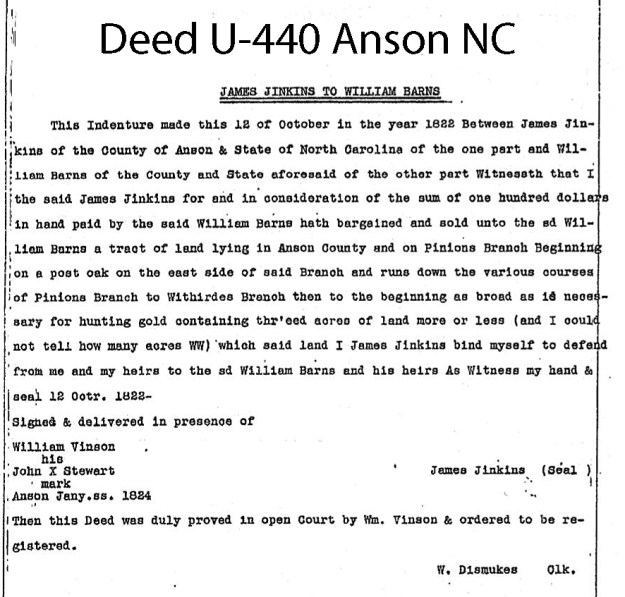
Dated 12 Oct 1822, William Barnes purchased an undefined quantity of land being “as broad as is necessary for hunting gold containing thr’eed acres.” This is pretty cool as the date of 1822 predates much of the hype found in early papers. It may be the earliest mention of gold hunting in the annals of Anson County.

Now, as for the deed, the bounds as seen below ran the “various courses of Pinion’s Branch to Withiride (Weatherford) Branch.

barnes gold

What really excites me in all of this is the similarities in location of Benjamin Thomas’ deed with that found in William Barnes.’ We now know that in 1822 William Barnes was going out purely for gold on the waters of Weatherford near Pinion and Jenkins. Also, and being 3 years earlier, Benjamin Thomas and wife Rebecca sold 250 acres in the same vicinity. That was the same land or very close to where William Barnes would later hunt gold. And, we know William Barnes’ family married into the family of Benjamin Thomas Junior.

Gold is at the root of many things and here I wonder when its influence swept through the lands along Rocky River. When he sold his land, did Benjamin Thomas have any idea he was sitting on a potential gold mine? We still don’t have the answers though now we have more ideas on what may have been.

GOLD AND STORIES OF GOLD

store.jpgI was talking to distant cousin Alan Thomas today about their family’s ties to goldmining for which he had no knowledge. Alan’s ancestor is David M. Thomas who was a blood brother to my great grandfather George Washington Thomas. Before going into David’s background I’d like to say a little about my great grandfather.

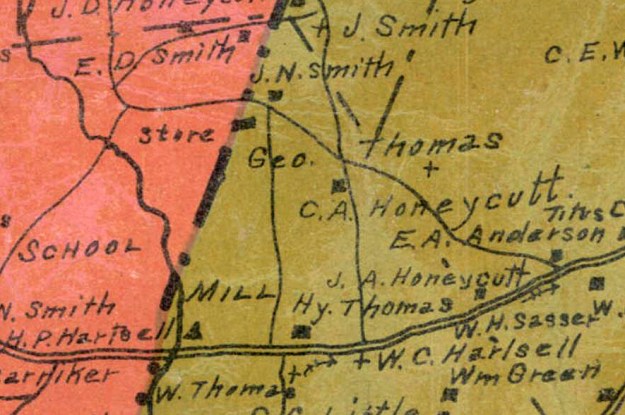
George Washington Thomas farmed, ran a saw mill and also a brick making kiln likely first begun by his father-in-law Solomon Pless. Located between present day Stanfield and the town of Big Lick, the 1904-1910 map of Stanly County locates George’s mill on the front side of the old farm south of where his store was once located. It is said George had bags of gold that he hid in his well; that late in the evening you could see him counting his gold by the light of the moon.

So where did George get his gold? He may have mined it and there may have been small amounts of gold gathered from his own and neighboring farms. George may have even received some from his wife’s family. There’s documented evidence that Peter Pless, the grandfather of George’s wife Julia, had also acquired gold. A member of Flat Rock Lutheran Church, surviving church minutes indicate that for a period of time, Peter was banned from the church for selling alcohol to slaves in return for bits of gold. This was in the 1830’s and is supported by a court record in which Peter Pless was charged with selling alcohol to slaves which at that time was forbidden. Learning of this I’ve always wondered if that practice passed down to my great grandfather? Did George Washington Thomas discover and mine gold himself or had he somehow bartered and traded for it?

That’s the story of my Thomas family but as for Alan, his background includes the discovery of a large nugget rivalling those found at Reed’s goldmine. You see, Alan’s ancestor David M. Thomas married Mary Margaret Austin, the daughter of Bryant Deberry Austin and Ellen Elizabeth Hamilton. Bryant (B. D.) Austin’s parents are Jonathan Austin and wife Permilla Williams. Both B. D. Austin and his father Jonathan are buried in the same family cemetery off of present day Sugar and Wine road near the waters of Gold Mine Branch …a clue.

Dated 28 Nov 1828, a deed of sale begins to tell the story of Goldmine Creek. At that time B. D. Austin’s brother Jacob Austin sold out his one and one-half tenth part of 35 acres known as the Anson gold mine (Deed U-284, Anson NC). The land was situated on Weatherford’s Branch near Cedar Branch where it adjoined the lands of William Mullis, Daniel Jenkins, and that belonging to Pinion. There was something big that drove the said Dismukes to buy into this operation and it turns out that gold had been found in the area prior to 1810. Several months prior to the above purchase, the following article dated 28 Aug 1828 appeared in newspapers across the region:

Clipping from Fayetteville Weekly Observer - Newspapers.com

From the above found on Newspapers.com, we now have clear evidence of gold being found on lands owned by the “Heirs of Jonathan Austin.” This would certainly included his son B. D. Austin.

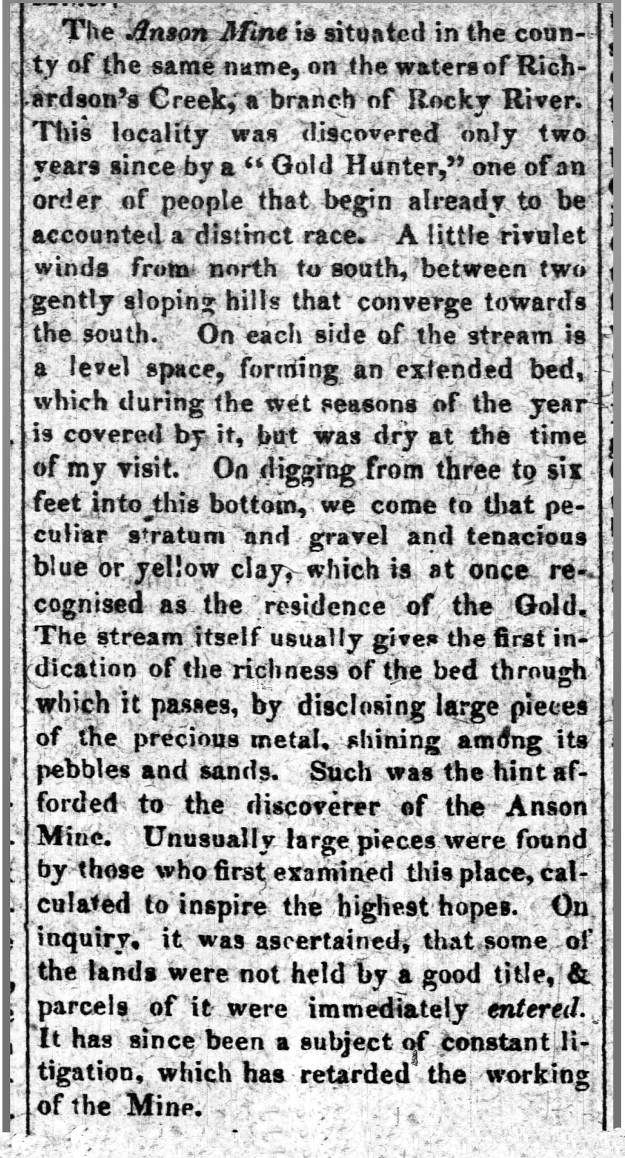
There were numerous articles prior to the above that mentioned Anson Mine and the finding of gold in area creeks surrounding Reed mine. The following was published 28 Jul 1826 in he Raleigh Register:

28 Jul 1826 The Raleigh Register - Newspapers.com

Bryant Deberry Austin died 5 Jul 1885 and as has been previously stated, is buried at the Austin family cemetery in New Salem NC. He left a sizeable estate mentioning daughter Margaret and her husband David Thomas. But as luck would have it, David died during the probation of his father in-law’s estate. Dated 22 Jan 1889, in a petition for final settlement, the listing of heirs records—— — “Mary Margaret Thomas…who is now a widow”.

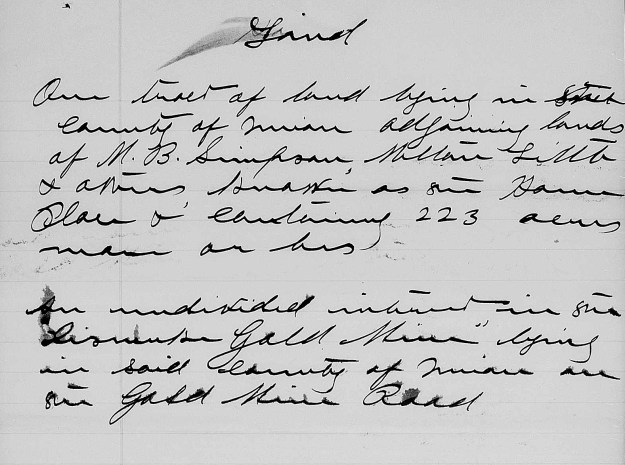
So what was the status of the gold operation at the time of the 1889 settlement? Is there anything there to verify what we now know happened? Found among the estate papers is the following:

interest in gold mine.jpg


We know there was a gold mine and we know it yielded sizeable gold including a 13 pound nugget. As late at the 1890’s the Anson Mine was identified in papers as far away as Belfast, Ireland. And like my own great grandfather, Alan Thomas’ ancestor married into gold. He came to it by way of his own father-in-law. It’s important that following David M. Thomas’s death his wife married again and she is buried in downtown Charlotte.

My distant cousin Alan has wondered where his David M Thomas is buried? It’s possible he’s buried in an unmarked grave at the Edmund Davis Cemetery along Gourdvine Creek in Union County. Many of David’s Thomas family are buried there. David could also be buried near his father-in-law at the Austin family cemetery. It would only be natural as the death of a girl’s father was soon after followed by that of her beloved husband. She’d want to be near the two most important men in her life. However, it’s also possible that David is buried near a home place we’ve yet to locate. I think finding that location will be among the family dreams for generations to follow.

JOHN PARKER IN ANSON COUNTY

Before delving into this, let me first tell you where I’m heading. There is a family of Thomas in early Edgecombe County whose patriarch is named John Thomas. John is a well-known Baptist minister in early Northeast North Carolina whose story is a defining component for not only that area, but for the history of all Baptists in state of North Carolina. John was deeply involved in the regular Baptist movement and was the founder of Toisnot Baptist Church. My own ancestors from the 1700’s were given names such as Ananias, Ezekiel and Jacob. I’m no scholar of religion but believe these names point to a strong Baptist root for my own family who lived in Anson County NC. And northeast of Anson where my folk lived, recent DNA discovery links us to the family of Joseph Thomas who lived in the 1770’s Wake County NC. That family’s history, through mostly lore, ties to an earlier Thomas family living further east in Bertie County. Without real proof, they believe Joseph Thomas was born in Bertie County and then moved from there to Wake.

I have problems with the idea that Joseph Thomas was born in Bertie. It may be true, but it also could be wrong. My concern is that many of the neighbors of Joseph Thomas in Wake County had lived earlier in Edgecombe County. There were very few who had made the jump as one motion from further east in Bertie. It’s bothers me that I see many more of his neighbors who were from areas of Edgecombe where lived a well-known person by the name of John Thomas. Our Y-DNA study does not yet link to any other Thomas family upstream in the migration. There’s no clear links back to either Edgecombe or Bertie. So, knowing there are no records of proof, it’s my hope that we somehow step up the effort to locate those from such ancestry for testing. With that out of the way, let’s look at what’s got me wishing.

____________________________________________

You just have to love working land records. Like cereal, a single piece of land is pretty much a bright sampling of what you’re about to enjoy when it’s all piled or puzzled together. That one piece along with others then becomes a sustaining meal carrying you forward with energy for at least a period of time. Then, there is the woe is me period of time as energy fails from a lack of nourishment. We depend on the next bowl being there and so the ups and downs go on and on. That’s why I eat my land plats for breakfast!
I like to surround myself with platted regions of land maybe in real life being 5-10 miles in dimension. There’s also the smaller groupings that as of yet do not mate up to the big picture. And finally there are all the left over bits or individual tracts in my pile of pieces waiting to be linked. Tonight I was going through this latter pile when I came across the odd star sort of shaped 150 acre piece issued to John Parker in Anson County. Being grant # 6469, the land adjoined that of Isaac Williams. Though eluding me for years, recently discovered connections allowed me to connect the lands of John Parker to the larger map. John’s 150 acre tract was on the west side of Gourdvine Creek located just below Jacob Gurley’s land near the present day Edmond Davis Cemetery.

littlemaap

In celebration and also knowing better than to leave the job half done, I ended the day with a quick look through the deed books in search of subsequent conveyances of this land. It turns out that John Parker was not in Anson very long as dated 25 Oct 1821 he sold the land [Deed U-52, Anson NC] to Solomon Mullis. It was in that deed that the said John Parker identified himself as now living in Clarke County, Georgia. I love it when people on the move tell you where they’ve gone! Why don’t they all~!!

This gets more interesting for me and my Thomas family research as a Google search for “John Parker” resulted in the following defunct Geneaolgy.com post by Jullie Sheffer:

Frances East daughter of Joseph East and Milly, was born in 1788 in northeast GA, probably in Wilkes Co. She married John Parker on 23 November 1808 in Clarke County GA. Fanny belonged to Mars Hill Baptist Church in Jackson Co GA, as did her sister Milly. Fanny’s husband John Parker was a first cousin of the John Parker who married Milly. Fanny’s husband John Parker also lived in Edgecombe Co NC, but in the Toisnot Swamp area. He was born about 1786 in Halifax Co NC, son of Aaron Parker and Charity Sheffield. John was Captain in the 241st District Company of Clarke County militia in 1815-1816; in 1818 he was elected as a representative to the Georgia State Assembly. In the 1820s he was in Captain Davenport’s District in Clarke Co. In the mid-1830s he owned land and slaves in Lee Co and in Cherokee Co.

John Parker lived in Clarke Co in the 1820 and in 1830. Over the years Frances was dropped from Mars Hill Baptist Church membership, and then rejoined. But finally in December 1835 was dropped for good because she and her husband had moved to Chamber Co AL. John Parker died intestate on 15 October 1860 in Chambers Co and is buried in the Bethel Baptist Church Cemetery in the northwestern part of Chambers Co. His wife outlived him, but also probably died in Chambers Co where they lived in 1860. His children can be determined from his estate records.

Maybe Jullie will find what I’m writing and in turn be able to further her research. That’s always the hope! And before getting too excited, a closer look at the Anson County deeds revealed John Parker selling land very close to the above on nearby Negroehead Creek. In that transaction [M-246 Anson NC] dated 3 Jun 1800, John Parker and wife Suca of Mecklenburg County NC are selling their land to Daniel Coburn. The deed is witnessed by Henry Ross and Stephen Parker. From an online DNA forum, Wayne Parker writes:

“John Parker born in NC maybe Anson Co., NC. Died in 1813 in Stewart Co., TN. His wife is listed in his will as Suca, her name maybe Susannah (Henderson). Their son Nathan Parker family (the y-DNA match is from this line) remained in Stewart Co., TN, Nathan Parker may have married (Frances Morris Pistole). At this time I have no information on their son David Parker. Their son Stephen Parker married Mary Ursula Gilbert and moved first to Henry Co, TN in 1830 and Marshall Co., MS 1840. Stephen died in 1848 either in Marshall Co., MS or Rankin Co., MS His wife Mary died in 1869 in Rankin Co., MS. Their son Dr. Hulling Houston Parker died in 1894 and is buried in Oakwood Cemetery, Austin,Travis Co., TX

From a quick search I’ve found nothing else accounting for John Parker’s stop in Anson County. Did he go to Georgia or Tennessee? Was this one person or two?  These guys lived very close to each other; are they the same? This may be new and maybe not and it could even be evidence of another person though I think the John Parker in Anson is the same as he who went to Clarke County, Georgia. Did you know that children of the Baptist minister John Thomas moved to the area of Clark and Hancock Counties GA? Did he go there or, did he go to Stewart County TN?

I love it when the records talk to you! And what’s so dang exciting to me is the mentioning in the above post of John Parker’s beginnings on the Toisnot. I’m sure you’re laughing but to me I love the sound of the door opening.

My Thomas family lived along Gourdvine Creek as did that of John Parker. Was this John a member of other Parker families who lived in the area? Did he know the families of Nicholas, Elisha, Thomas or Peter? As with in Wake, the Thomas family neighbors in Anson County do have ties back to the northeast. My Benjamin Thomas in Anson County is known to have had neighbors from Martin and Bertie Counties. However, I’m finding many more that had come closer afield from places like Edgecombe, Wayne and Johnston Counties.

Family is like dragging a busted bag of grass seed across the yard. You’ll drop seed at both ends as well as along the path you’ve taken. And as it pertains to our Thomas family, everyone seems to have found a likely candidate in early Bertie that sort of works but without proof. Is that what really happened??

TUCKER’S and LOVE’S


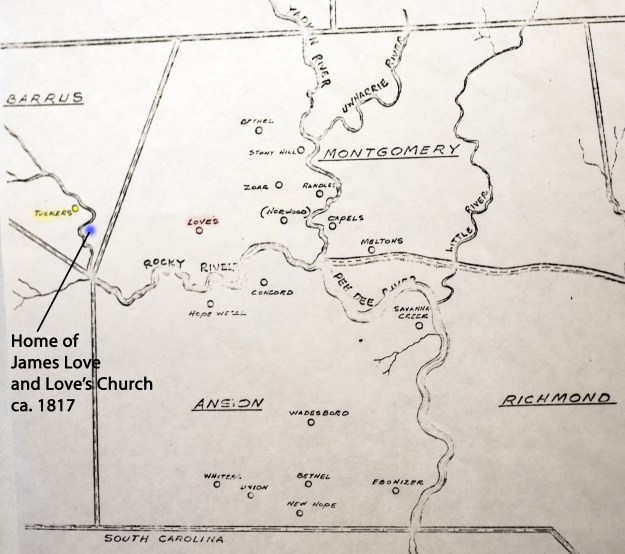
map
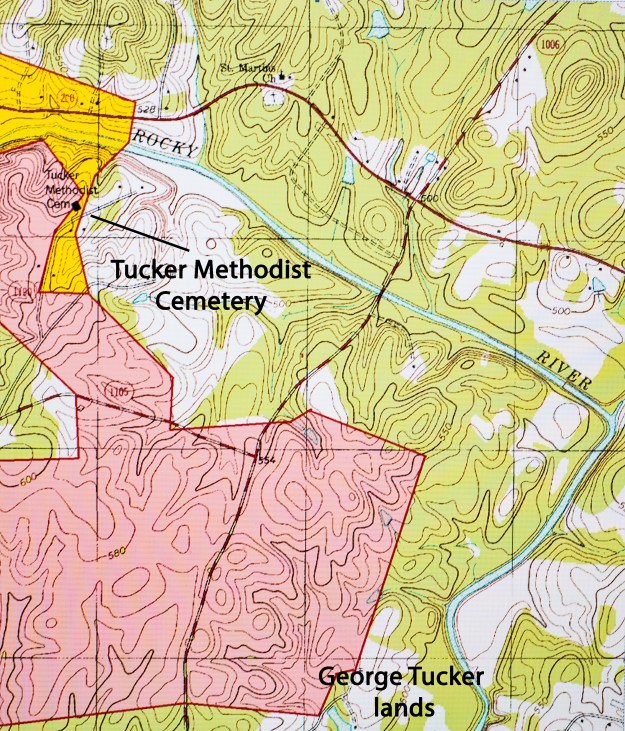
Several months or maybe even a year ago, the location of Tucker Methodist Church, now long gone, was discussed on the Cabarrus County Genealogy Society Facebook page. Some source unknown to me locates the church near the northern end of Edgefield Road. As it turns out, that’s true. However, in question of this tradition, I’ve wondered if Tucker Methodist Church might be located on the east side of Rocky River on what was a larger share of George Tucker Senior’s lands?

Many years ago during a visit to the Stanly County library I came across and copied a file of ca. 1808-1817 Yearly Planning reports for the Methodist church. Alongside other area churches was listed “Tuckers Church” with an accounting of its size in terms of membership and tithing. However, and as time and luck has their due, I’ve lost those important copies. Prodded by the online discussion about Tuckers Methodist Church, I made several return trips to the Stanly County library only to learn that the records were no longer there. As a matter of fact, papers of other sorts also seemed to have disappeared…strange!

I’ve recently learned that most of the important records held in the county library have been moved to the newly formed Stanly County History Center. And, on a recent visit the manager, Paul Morrison, helped me find what I was looking for.

_____________________________________________

At the top of the page is a map I found within a folder of photocopied Methodist records housed at the Stanly County History Center. I don’t think the map is super old and its origin is unclear. It may have been created in the 1960’s by those who donated the records I’m writing about. However, on the map, Tucker’s Church is identified (in yellow) on the western side of Rocky River where tradition has always placed it. And, it’s the same location where today sits the only remnant known as the Tucker Cemetery. It’s there where prominent settlers like Andrew Carriker and Thomas J. Shinn are buried.

Looking at the map above you’ll also see “Love’s” which by location must be present day Love’s Chapel UMC built on the lands once belonging to Jonah Love. This is important because it dates the map to a time after the 1848 founding of Love’s Chapel.

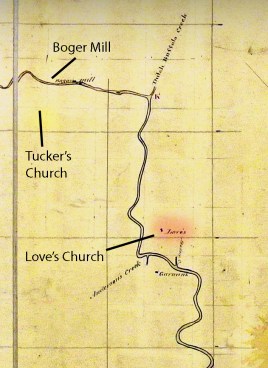
dsc_0832-copyOther records going further back mention “Tucker Methodist” by name. Also, listed is “Love’s Church” over 30 years before the founding of chapel. Before discussing records linked to these two churches, let’s take a look at the following 1820’s map that was used in a feasibility study seeking to convert the Rocky River into a canal. The goal was to increase revenue by diverting the flow of goods from west to east across the state rather than having them shipped out of state by way of the Pee Dee and Catawba rivers.

The map locates (James) “Love’s” near what we now know to be Reed Gold Mine. Also nearby would have been a church James Love founded known as Mount Moriah or Love’s Methodist Church. And, up the river and around the bend is Boger’s Mill. The old Tucker church was surely standing nearby on the south side of the river.

________________________________________________

With locations now established, let’s look at some old church records

Of the two documents below, the first is the 1813 Yearly Plan for the Methodist churches within the Rocky River Circuit. You’ll see the names of churches in the circuit along with membership and tithing. Traywicks (now Fountain Hill) and Preslars are to the south of Rocky River and next is Love’s to the north. Beside Love’s is “Allen or Rogers” followed by Tuckers. It all falls into place though I’d like to know more about Allen’s church. Make sure to click on the images and then click on full size to see the documents up close:


The second document in the above is the 22 Feb 1817 minutes of a first quarterly meeting of the Rocky River Circuit. The meeting was attended by Daniel Asbury, presiding elder; Samuel Harrison, itinerant preacher; Henry Ledbetter, local elder; William Threadgill, L. D; George Shankle, L. D.; George Allen, class leader; George Tucker, class leader; Peter Randle, class leader; Benjamin Mabery, class leader; and Samuel Temple, steward. Who are these people?

Daniel Asbury, the presiding elder is prominent in North Carolina history. From NCpedia:

Daniel Asbury, pioneer Methodist preacher, was born in Fairfax County, Va., the son of Thomas and Pettie Jennings Asbury. At the age of sixteen he went to Kentucky, where he was captured by a band of Shawnee Indians while transporting provisions to a frontier army post. He was taken first to the West and then into Canada and finally became a prisoner of the British during the Revolutionary War. Upon release from a Detroit prison, he found his way back to his father’s home in Virginia. There he was converted, entered the traveling ministry of the Methodist Episcopal Church in 1786, and was appointed to serve the Amelia Circuit in Virginia.

…Some years after his marriage, Asbury temporarily left the traveling ministry, although he continued to serve as a local preacher. Then in 1803 he returned to the itinerant ranks, and in 1806 was appointed presiding elder of the Swanino (Swannanoa) district. He served a total of fourteen years as a presiding elder. In 1808 he was elected one of eleven representatives of the South Carolina Conference (which included the western half of North Carolina) to the first delegated General Conference of the Methodist Episcopal Church.

Although Daniel Asbury was not related to Bishop Francis Asbury, they were close friends and collaborators, and the bishop visited Daniel’s home on numerous occasions.

And, as for the itinerant preacher Samuel Harrison, he too led an admirable life. From the History of Methodism in Kentucky:

Samuel Harrison …was born in Rockingham county, Virginia, October the 8th, 1782. His father emigrated from Virginia to Mecklenburg, North Carolina, when his son was only a youth. In 1803, he professed religion and joined the Methodist Episcopal Church.

Before he entered the ministry he married; and believing that God had called him to the sacred office, he laid his family upon the altars of the Church, and became an itinerant.

In 1807, on the 26th of September, he was licensed to preach, and on the 28th of December following was admitted on trial in the South Carolina Conference. After traveling the Rocky River, Montgomery, and Union Circuits, he located. In 1815, he reentered the itinerant field in the same Conference, and remained an active and zealous member until the session of 1818, when he again located. He soon afterward removed to Kentucky, and settled in Mercer County, where for several years he preached as a local preacher.

Among the listing of class leaders is George Tucker. Who is he? It appears that class leaders represented their churches at quarterly circuit meetings. From online: “The class leader was a layman who was a mature disciple of Jesus Christ and whom the leaders of the Methodist society believed could be trusted with guiding others in the pursuit of holiness of heart and life.”

George Tucker, the patriarch in Cabarrus, lived and died along the east side of Rocky River just upstream from Grandsire Jimmy, the Love family patriarch. George Tucker had a son of same name who moved into now southern Stanly County where he too lived along the Rocky River. This George Tucker II is buried in a family cemetery on church grounds predating Kinza Memorial Baptist Church. And lastly, there is George Tucker III who married Esther Carriker who tradition says was the second and much younger wife of Grandsire Jimmy Love.

I don’t believe it! There was yet another James Love who married Mary Tucker and who after serving in the War of 1812 died ca. 1820. Knowing throuh DNA that Grandsire Jimmy Love had a son James who moved to Georgia, I believe that person had also entered land grants near George Tucker II in now southern Stanly County. It’s my belief that James Love who married Mary Tucker is the son of James Junior of Georgia, the son of Grandsire Jimmy. This is where the name James Allison Love comes into the family. I believe Mary Tucker was somehow related to George III and following the death of her husband James A. Love, Mary Tucker Love married second to David Brooks. At that time records show her children Nica, Darling, Pleasant, and Hartwell Spain Love were taken in by their Aunt Esther and Uncle George Tucker III until they came of age and removed to Arkansas in the 1830’s.

So, the question remains, just who was the person named in the 1817 Methodist circuit meeting minutes? George Tucker I was dead and George II was working land miles away in now southern Stanly County. So, it’s my belief that George Tucker III was called to the Methodist church where he and his wife Esther served during their lifetime. But …did George Tucker serve at Tucker Methodist Church or did he serve at Love’s? Could he have served both? To the last question the answer is yes and to the first, …I don’t know! However, George Tucker III and his wife Esther lay at rest at the Love’s or Mt. Moriah burial ground located near the river below the lands of John Reed and Grandsire Jimmy. Theirs are but two of the few proper and legible stones in the cemetery. And as stated earlier, George Tucker, the patriarch, had owned land upstream from the cemetery.

There’s little more to say but please realize that faith is somehow behind the naming of Tucker Methodist Church. Somehow that story was important to the family as none of this would have happened without them.

In closing I’d like to share a little more information about the records you’ve been looking at. Also, the tract of land surrounding or next to Tucker’s Cemetery adjoins Rocky near two mill dams about which an important 1800 petition arose in an effort to protect the fishery habitat. Let’s look first at the records.

________________________________________________

The Stanly County History Center houses a broken photocopy series of early Methodist circuit minutes. They have all of the existing records pertaining to Stanly County though there is more pertaining to old Anson County. The collection originated in William Hatcher of early Hopewell Methodist in Anson County. William Hatcher passed the documents through his family to his great-granddaughter Viola Kiker. In April 1965 the minutes were taken to Duke Manuscript Library for permanent storage. It is there, at the David Rubenstein Manuscripts and Rare Books Library where I had the opportunity to see and photograph the originals used in this post.

The following two articles provide greater detail illuminating implications of this collection. Provided to me by Kelly Wooten, one of the staff at the Duke Manuscripts library, a link below the articles will redirect you to cloud based storage of digital images of the collection. Take advantage; the link may go down at some point so please download the records now if any of this is of interest.


Digital images of all the Methodist circuit minutes donated in 1965 by Ms. Viola Kiker: https://duke.box.com/s/c41pcw8z42pk8buf92khapeo8q0ngz3y

The plat map below shows two grants of land with one of which taking in the Tucker Methodist Church site. Accuracy in platting is pretty good though it would be easy to be off enough to change this story. Ultimately I think both tracts passed through the hands of John Melcher, Daniel Boger and then John H. Bost on whose land Bost’s historic mill was built. It’s not directly related to Tucker Church though I can imagine standing there in the early 1800’s, seeing the view and taking in the neighborly dynamics.

tuckercem(Red Tract) Grant # 3681, Mecklenburg NC, ent. 27 Jan 1786, sur 28 Apr 1787, iss26 Nov 1789. Issued to William Ross, being a large 622-acre tract, from the most southerly point and running the bounds northerly on the east side, the land adjoins George Tucker to the east, David Cagle to the northeast, John Hartsell to the north of the main body, and Douglass Winchester as the line approaches the south bank of Rocky River. Chainbearers: Henry Price, Joseph Howell.

Deed 2-38, Cabarrus NC, 19 Apr 1793. Daniel Bean to William Ross, Junior, both of Cabarrus. Being 662 acres, this was one of four tracts deeded in this conveyance. Wit: David McKinley, William Ross.

Deed 8-219, Cabarrus NC, 1 Nov 1793, rec. Jul 1813. William Ross, Junior to Daniel Boger. This tract again conveyed as one of four, being the same lands as in 2-38 above. Wit: Joseph Shinn, Tobias Klots jurat.

1800 – Petition of citizens to the General Assembly concerning John Melcher’s mill in hopes of granting “him to have his gates constantly shut, as he has removed his damm lower down in the river, and we can never derive any benifit from the fishery, very few [fishes]coming up that distance, and those few can go but about 6 miles higher up the river.

Deed 10-126, Cabarrus NC, 7 Jan 1801. John Melcher to Tobias Klutts, being 869 acres made up of four tracts “Whereon is built a grist and saw mill …as appears by a written instrument of agreement or conveyance from Daniel Boger to the said John Melcher bearing the date 1 Nov 1793. Wit: Daniel Little, Jno. Still.

Deed 12-88, Cabarrus NC, 15 Apr 1833, rec. Jul 1833. Martin Boger of Cabarrus and Peter and Elizabeth Pless in Montgomery County to John H. Bost. An undefined acreage being the lands whereof Daniel Boger died, seized, and possessed on the waters of Rocky River joining the lands of John Biggers heirs, Solomon Karraker, Joseph Howell and others; being the undivided interest of Martin Boger and Elizabeth Pless in the said lands which came to them by the death of their father John Boger. Wit: Jacob Williams, Robert A. Means.

Deed 12-154, Cabarrus NC, 27 Dec 1833, rec. Jan 1834. Tobias Klutts to John H. Bost, being “all of that one half of that tract” on both sides of Rocky River containing 100 acres “together with on half of everything thereunto belonging. Wit” Jacob Williams, Samson Bost.

(Yellow Tract) Grant # 3441, Mecklenburg NC, ent. 22 Oct 1779, sur. 8 Apr 1783, iss. 2 Nov 1784. Issued to DOUGLAS WINCHESTER, being 94 acres located on both sides of Rocky River including his own improvement. From a w. o. north 15 east chs. to b. o., north 38 east 12 chs. to pine, north 9 east 15 chs. (crossing the river along John Finny entry) to b. o., south 67 east 17 chs. (along John Ashly entry) to hic., south 10 chs. (crossing the wagon road and said river) to b. o., south 50 east 7 to w. o. (by James Fleman line), south 67 west 19 chs. ti stake, south 23 east 20 chs. to stake, (crossing the road) to begin. CC: Daniel Winchester, Charls Dorton.

Deed 1-66, Cabarrus NC, Douglas Winchester and wife Elizabeth to George Christman. This deed also includes a tract purchased by Winchester from John Ashley. Jurat: John Hagler.

Deed 4-72, Cabarrus NC, 3 Jun 1799, prv’d Jul 1801, George Christman to Elias Bost. Being the fifty acre portion of this tract lying on the north side of Rocky River. Wit: (in German), Michael Christman.

METHODIST BAPTISMS

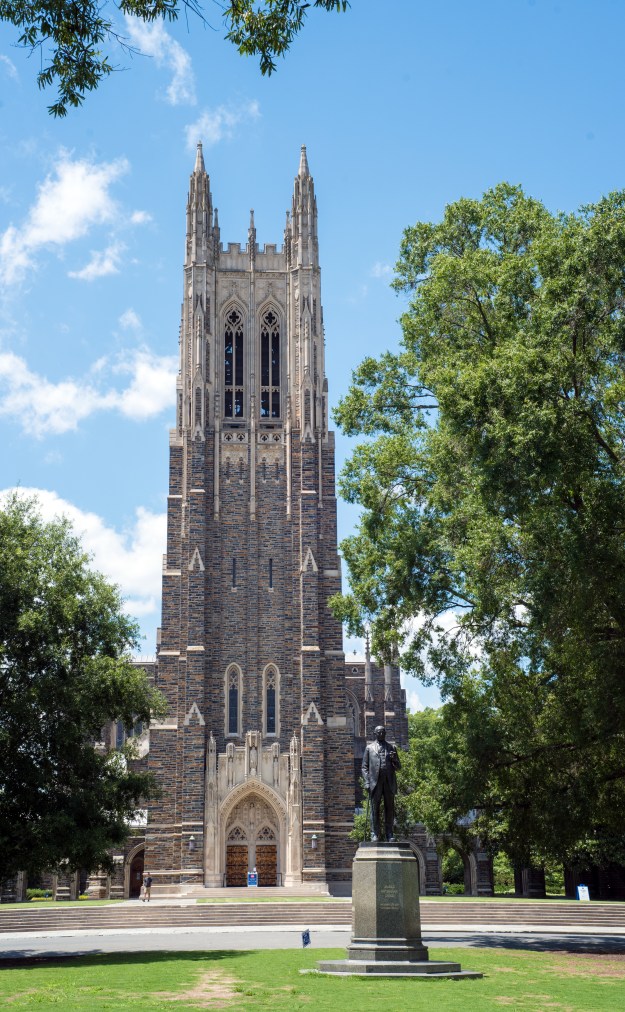
duke chapelThis week I’ve made several trips to the David M. Rubenstein Rare Book and Manuscripts Library housed at Duke University. My intentions have been to locate original documentation of the early Methodist church and its existence along the Rocky River in Anson, Stanly, Union, and Cabarrus Counties in North Carolina. Two times boxes of records have been requested after which the following day I made the trip to Durham with fingers crossed. Both times I came up empty handed with one more box coming in from storage hopefully tomorrow or Monday. Oh, the anticipation!

I’ve learned that Methodists were not efficiently organized in terms of their reporting to the central body of the church. The Methodist church was born in the American experience. Though they were crib mates to many in the founding of our country, their approach to record keeping was much different than their German brethren. Constantly changing as did the state, so did the look of the Methodist conference and its circuits. So, a note to the researcher …be warned that the church reshaped itself in ways that makes no sense to us today. For instance, there are Methodist churches in present day Union County that once belonged to circuits located in Lincoln County within the South Carolina Conference.

Surviving church minutes are filled with mundane operational business with little genealogical information on specific churches and their congregations. It’s really boring stuff. However, and as was used for annual reporting, a few surviving but broken books and folders of papers provide membership rolls during specific years. I’ve not plowed through the various circuits within our state but hope sometime to abstract such roll books for the churches along Rocky River.

And, I can’t move on before writing something about the Methodist records housed at Duke University. You’d hope that the Church itself, the mother of the organization, would have held or recorded all those lists and records documenting the life of each congregation. It did not happen that way. In your visit to the manuscript library realize that much of what’s there came through donations. Maybe a grandfather or other ancestor represented a church and in that responsibility came upon records that somehow fell into his hands. Whether given in such way by individuals or given though the wisdom of individual churches, such records came to Duke piecemeal reflecting very little in terms of an overarching organization. It’s a big deal in understanding the collection to which even the helpful librarians concede to be a huge hurdle.

With that said and out of the way, I was surprised today to find several pieces of paper documenting “Baptisms” in the early 1880’s. Though not labeled, several of the pages, I’m sure, represent the congregation of Bethel UMC in Midland NC. There is another for Mill Creek. Later I’ll share roll books adding in Zion UMC in Union County. Enjoy for now!


LOVE …IT HURTS SO GOOD

Oh it’s my wish that once things are found they would remain found and be forever true. And, I wish that I could simply accept as gospel what others have researched. But I can’t …I’m a doubting Thomas. I can’t even trust my own self for I’m always finding records contradicting what I once accepted as true.

These findings really are a pain! How do I go about updating and getting the word out when I’ve cast such a wide net? How do I get the word to everyone? I don’t want to spend my time doing that when the fun is in hunting down new leads! But yet I’ve wronged many in the process of trying my best to get it right! Oh, the agony, the pain!!

___________________________________

Today I was going back through past records cross checking them against the familysearch online services. It’s smart and the right thing to do. Within minutes of searching the 1820 census for “James Love” I found something shattering. I haven’t had time to digest this and am not even sure I’ve got it right in my mind. But anyhow, take a look at the following and see if you see what I see:

rutherford

If not, and if you need a little help, let me give it a try. You see, around 1800, the son of old Grandsire Jimmy Love of Cabarrus removed west to Rutherford County in an area that later became Cleveland County. You can see Charles Love in the above census record. Also seen above, Charles had a son John who later moved to Georgia. And listed below John is Charles’ son James Love who later gave the land for the county seat of what later became Cleveland County NC. This younger James Love’s portrait hangs in watch over Cleveland County board meetings.

Look above Charles Love and you’ll see a passel of Brooks family. You’ll see William who must be the patriarch. There’s also Constant and then Isaac. Are they the same clan as are found in present day Stanly County? Did they move west along with Charles Love and others from the area?

It’s in the name of Isaac Brooks where the earth shakes. You see, and according to the family beliefs of this Cleveland County family, their old William Brooks came from Lancaster, Pennsylvania. Okay, so maybe he’s from a different set …easy peasy and we’ll just leave it alone. But, on the following find-a-grave site, take a close look at William’s son Isaac: https://www.findagrave.com/memorial/33607919/william-brooks

His name is Isaac Crayton Brooks …for real!!!??? Note that our Grandsire Jimmy had son Jonah Love who remained in the area of Cabarrus/Stanly County NC. His neighbor to the north was Isaac Crayton and it was William Crayton who was a son-in-law and in partnership at John Reed’s goldmine. William Crayton’s son Isaac sunk the first shaft at the mine in 1833.  Is what I’m thinking possible and what does this tell us?

Beyond the obvious fault line now at the foot of our family tree, there’s the James Love who appears in Campbell County GA along with others who were once living in Cabarrus. That James Love’s DNA matches descendants of old Grandsire Jimmy. We’re pretty sure that James Love who died and left a will in Georgia is the son of old Grandsire being the same James Love Junior who signed a petition to build public buildings in the newly formed Cabarrus County.

Looking at the last will and testament in Campbell County Georgia, who is Mary Brooks? Out of what tree did this Brooks family in Georgia spring?

State of Georgia}
Campbell County}
Georgia, Campbell Co.: In the Name of God Amen. I James Love of the County and State afor Said being of Sound Mind and Memory but Knowing that it is My Last Will Testament in Manner and Form following to Wit
1st I give and bequeath My Sole to god
2nd is My Request to be buried deasent in a decient And Christian like manner
3rd as tuching My Worldly effects I give and bequeath To My beloved Son Ingraham Love one dollar
4th I give and bequeath to My beloved son John Love one dollar
5th I give and bequeath to My beloved son James Love one dollar
6th I give and bequeath to My beloved daughter Mary Brooks one dollar
7th I give and bequeath to My the illegitimate heirs of My beloved daughter Elizabeth McUne One dollar
8th I give And bequeath to My beloved Wife Elizabeth Love And My two Youngest Sons to wit Josiah Love and Joseph Crafford Love the Balance of all I Posess together with all My Interest in the — ————–??? Stated land Lotery of gold Minds (sic) To be Equally divided among them one third to My wife Elizabeth Love and one third to My Son Josiah Perre Love and one third to My Son Joseph Crafford Love
9th I do hereby appoint Stephen James My Executor to execute? and carry out this My last Will And testament into effect in Testimony Whereof I have here unto Set My hand Seal this 26th day of May 1832 in the presence of (the words the legitimate (sic) heirs of was interlined before (Note: name illegible, scratched through) As Wisshed (?) in the 19th line of the 1st page)
s. James (his mark) Love.

Wit. Robert (his mark) Presley,
John Gilbert, JP
Wade Wright, JP

The above surely opens up new possibilities that need to be exercised. I think the earth will shake changing the landscape as we know it. Do the Brooks Family of Cleveland County go easily back to Lancaster County PA as they believe or are they somehow tied into the family of same name along the Rocky River? Oh what a change this may bring about and oh what a painfully good time we’ll have figuring it out. Whether being Crayton, Love or Brooks, I’d love to hear your thoughts on where to place this piece of the puzzle.

THE FAMILY OF DAVID AND ALICE

cencus 1850 david t

1850 Union County Cenus

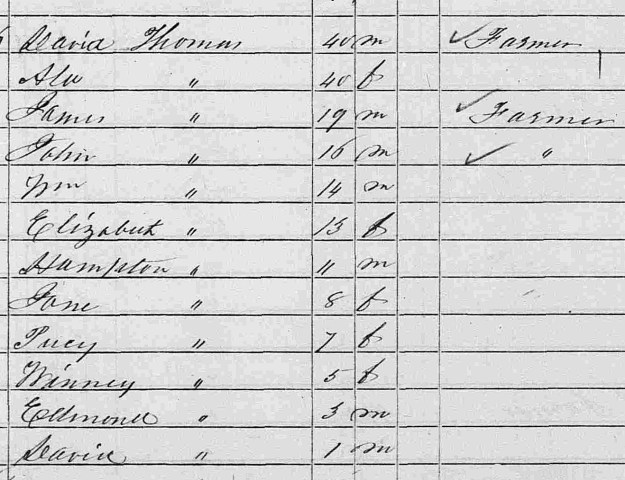
According to the above census, in 1850 my Great-Great grandparents David Thomas and wife Ala (Alice) Newsome were raising a large family in Union County NC. Their son, my namesake Great Grandfather George W. Thomas does not appear in the census as he was born more than a year later on 9 Feb 1852. George’s mother Alice may have died during childbirth or shortly thereafter as she does not appear in the 1854 estate probate records for David Thomas. There’s no proof as to where David and Alice are buried though I firmly believe they lie at rest in the Edmond L. Davis Cemetery which is located on or adjoining what was once the lands of David and Alice Thomas.

You can find lots on this family at my website geothos.com. However, the site includes very little in terms of images or other flavorful information. In this post I’ll revisit the children of David and Alice Thomas mainly with the goal of giving you the chance to study our family traits made visible through old photographs. Let’s start with oldest son James Robert Thomas, working our way down to baby George Washington Thomas.

James Robert Thomas
james r thomas

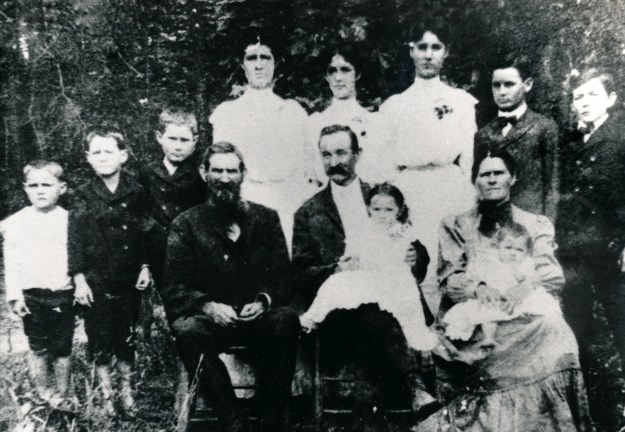
James Robert Thomas Family

James Robert Thomas was born in Jun 1832 and married Mary Jane Curlee on 25 June 1853. Mary Jane is the daughter of Thomas Griffin Curlee and Jane Catherine Lotharp. When James’ father died in 1854, the Reverend Edmond L. Davis and James Thomas were listed as Administrators. And, in the 1855 July term in Union County, James R. Thomas was appointed guardian of his younger brother Edmond. James Austin and the Rev. Edmond L. Davis paid guardian bond.

A farmer from Union County, James R. Thomas enlisted on 21 Aug 1862 at Statesville NC. He served in CSA Co. F, 48th Regiment through October 1864. Returning from the war, James farmed and raised a family on what is now Ansonville Road near Hamilton’s Crossroads.

James Thomas is seen sitting in the front left of the above photograph. James’ son Cornelius is sitting to his right with toddler in his lap. Beside Cornelius is wife Sophronia Alice Pierce (daughter of John Jackson Pierce and Eliza Bass). I’m not sure of the other folks in this photo but here are the names and the spouses of Cornelius and Sophronia Thomas’ children: Mary Jane Thomas (John M. Williams), Nora Alice Thomas (Connie Brewer), Zilphia Ellen Thomas (Kindley Cleveland Moore), Marion Frank Thomas (Wilma Little), Melton Ellis Thomas (Lillie Helms, Letha James), Edger Green Thomas (Mary Lee Gaddy), Joseph Hurley Thomas (Bessie Griffin), Cornelius Wesley Thomas (Ora Griffin), Effie Lou Thomas (Preston Perry), Annie Kate Thomas (Henry Clayton Baucom), Graham Mott Thomas (Edna Taylor). (note: I’d love to be able to identify the others in this photograph not named

The children of James and Mary Curlee Thomas are: Cornelius Whitfield Thomas (Sophronia Alice Pierce), Milton Stanhope Thomas (Louisa Link), Clement M. Thomas,  Mary E. Thomas (Marshall E. Harwood), Bedie Thomas, and John H. Thomas (Julia Lulu Moore).

Sarah Ann Thomas
Solomon Rasberry Brewer

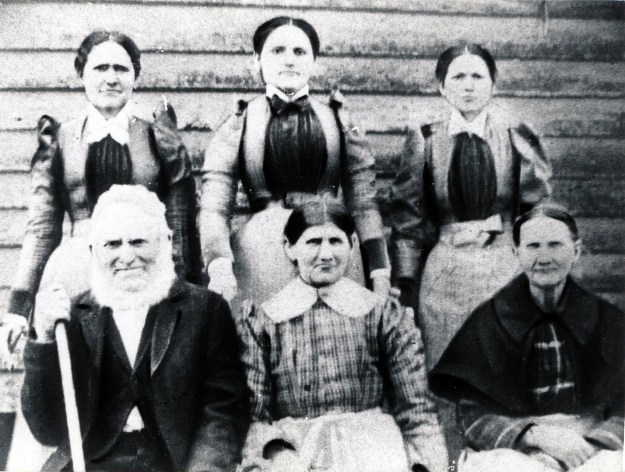
Solomon Rasberry  and Sarah Ann Thomas Brewer Family

Sarah Ann Thomas was born 26 Apr 1833 and she married Solomon Raspberry Brewer. Ms. Annie Lee Traywick gave me the above picture and I remember her not being 100 5 sure though she believed the image is that of Solomon Raspberry Brewer, his wife Sarah, and their daughters. Solomon is the son of Kizzie Brewer and there’s a story in that fact that I wish I could remember.

Solomon Brewer enlisted in the CSA Senior Reserves though he was beyond fighting age. Solomon and Sarah owned a farm along the branch at the end of what is now Dusty Road in Union County. Their children are (A) John W. Brewer (Mary Elizabeth Griffin), George Washington Brewer (Margaret Cornelia Parker), Jackson L. Brewer (Lucindy Moore), Mary Elizabeth (Timothy C. Braswell), Martha Jane Brewer (Pinkney Honeycutt), James Rasberry Brewer (Frances Dry), Allie Martelia Brewer ( William A. Polk), Kizzie Lougenia Brewer (Ellison Lee Parker), and Sarah Catherine Brewer (Charlie Morgan).
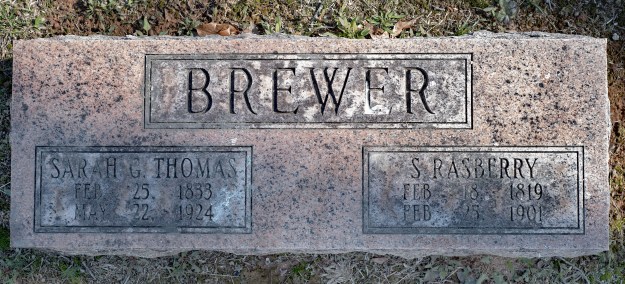
Solomon and Sarah Thomas Brewer are laid to rest in the old graveyard at the front corner of the Mount Moriah UMC campus at New Salem. brewer
John Milton Thomas

john m thomas

John Milton Thomas

I love the way information flows. While overseeing the woodshop at that NC State Crafts Center, discussion with one of my students led to the realization that we were cousins. Cool! It turns out his family descends from John Milton Thomas and the photographs here were given to me by his grandmother Dowdy.

John Milton Thomas was born 5 Aug 1834 and he married Ms. Sarah Elizabeth Redfern on 6 Dec 1860. Sarah is the daughter of William Albert and Elvia A. Hubbard Redfern.
Before the Civil War, census records show that John M. Thomas was engaged in business with T. D.Winchester and D. Hayden. On 16 Feb 1862, John enlisted in CSA Co. T, 48th Regiment. Captured at Sharpesburg, VA, he was released and later wounded at Fredricksburg. Promoted to rank of Sargent, John was wounded again at Bristoe Station, VA and later captured in Salisbury, NC. Military records show he was sent to Nashville, Louisville, and finally to Camp Chase, Ohio before being released on 4 May 1865.

Returning to Union County, John Milton Thomas continued in business as a Grocer and became postmaster at Monroe. Dated 20 Apr 1917, an obituary appeared on the front page of The Monroe Journal. Amidst articles pertaining to the advances of WWI, John M. Thomas was eulogized as “probably the last of the before the war Monroe merchants, postmaster here during Cleveland’s Administration, ex-Confederate soldier, and well known citizen”. Here’s the obituary:

MONROE, N. C., FRIDAY, APRIL 20, 1917.
DEATH OF MR. JOHN M. THOMAS
______________

A Before the War Merchant, Soldier, and Postmaster During Cleveland’s
First Administration, Passed Away Wednesday Afternoon.

Mr. John M. Thomas, probably the last of the before the war Monroe merchants, postmaster here during Cleveland’s first administration ex-Confederate soldier, and well-known citizen, died Wednesday afternoon at 5:30 at the home of his daughter, Mrs. H. B. Billingsby, after a lingering illness of several months. Old age was the cause of his death; he had not been able to leave his room but once since last Thanksgiving.

The passing of Mr. Thomas removes a landmark from this community. Actively engaged in business before the war with the late T. D. Winchester and D. F. Hyden, he had been an important cog in the social and business activities of the town up until about twenty years ago, when he moved to Lilesville. He was appointed postmaster by President Grover Cleveland during his first administration and he served the patrons of his office well and painstakingly.

When Jefferson Davis called for volunteers in ’61, Mr. Thomas was one of the first to respond. And his devotion to the cause of the Confederacy never wavered for a moment. He fought valiantly through the war until sometime in ’64, towards its close, he was made a prisoner by the Federal forces. He was carried to Pennsylvania, where he was imprisoned until long after the war had closed. He reached home sometime towards the close of the year 1865.

Penniless when he reached home, he started rehabilitating his condition, incidentally contributing his share towards the rebuilding of the South during the days of reconstruction. He took a leading part in the business activities of those days, and all remember him as being honest, kind, and one who was willing to serve.
Mr. Thomas joined the Baptist church in his youth, and was a consistent and faithful member of the church here until he moved to Lilesville, where he carried his membership. Too much could not be said about Mr. Thomas’ conscientious and upright life. He was a good man: all who knew him readily vouch for that.

The deceased was a son of the late Mr. and Mrs. David Thomas, and was born in this county on August5, 1834. He was therefore nearly 83 years of age. In 1860 he married Miss Elizabeth Redfern, daughter of the later Albert Redfern, and she with the following daughters survive: Mrs. H. B. Billingsby, Monroe; Mrs. H. C. Boylin, Hamlet; Mrs. J. T. Sanders, Lilesville; and Mrs. Ellerbee Buchannan, Chicago. To this union were also born two sons, but they are both dead.

For the past three years Mr. Thomas had been making his home with Mr. and Mrs. Billingsby. While here he renewed his old acquaintances, after an absence of nearly twenty years; but they all found him to be the same upright man of the former days.
The funeral was held yesterday afternoon at four o’clock by Rev. J. E. Abernathy. Interment was in the Monroe Cemetery.


The children of John Milton and Sarah E. Redfern Thomas are Mary Alice Thomas, (Hezekiah Boles Billingsley), Louise Frances Thomas (Henry Clarence Boylin), David Franklin Thomas (Augusta Osborne), Fitzgerald Thomas (Joseph Tillman Saunders), Martha Thomas, Ella Thomas (Isadore Franklin Buckhants), Inez Thomas, and John Fredrick Thomas (Frances Clair Steinback).

William Green Thomas
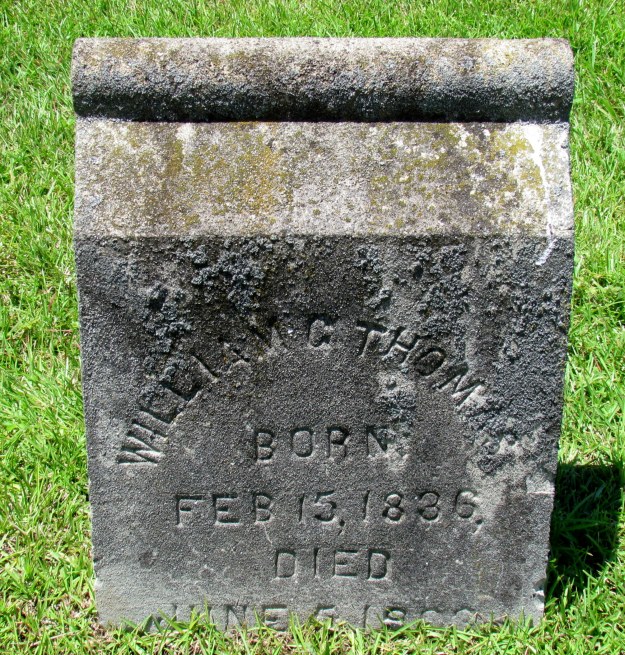
william green thomas.jpgBorn 5 Feb 1836, William Green Thomas married on 15 Sep 1858 Lydia Adeline Dry. Her parents are Charles and Adeline Dry of Union/Stanly County. On 21 Aug 1862, William G. Thomas enlisted in CSA Co. F, 48th Reg. NC. Listed as a resident of Union County, he volunteered in Iredell County on the same day as his older brother James R. Thomas. William G. Thomas was listed as 35 years old at the time of enlistment. Wounded and captured at Hatcher’s Run on 9 Feb 1865, William was confined at Point Lookout, MD until being released on 20 Jun 1865. Following the war, William received a land grant on 15 Apr 1876 for 25 acres on Suscoes’s Branch in Union County. The land adjoined his own as well as that of Drury Morgan, Milton Austin, and C. B. Curlee. Chainbearers were Thomas Swink and James M. Williams. The land was very close to that of his father-in-law.

At some point William and wife Lydia moved just over the Union County line to the Arlington section of Mecklenburg County. In 1901, W.G. Thomas applied for a Soldier’s Pension and received ½ Disability. William Green Thomas and wife Lydia Adeline Dry are buried at Arlington Baptist Church.

The children of William and Lydia Dry Thomas are Ann Thomas (George Braswell), Sarah Ellen Thomas (Thomas Swink), William Daniel Thomas (Sarah Ann Austin), Saphronia Alice Thomas (Eli F. Cagle), Lydia Almetta (Mimmow) Thomas (James Austin), John W. Thomas (Mary J. Ward, Annie Heafner), Julia C. Thomas, (Monroe Groves, Edmond G. Thomas (Margaret Addie Rea, James A. Thomas (Lula Lee of Paw Tucket), Charlie Benton Thomas (Jennie Belle Clontz, Mrs. Cornelia (Griffin) Whitley),and Jane Thomas (Tommy Harrington).

I’ve run across only one surviving photo representing this family. The above is that of younger son Charles Benton Thomas. Below are the graves of William and Lydia A. Thomas.

Elizabeth Thomas
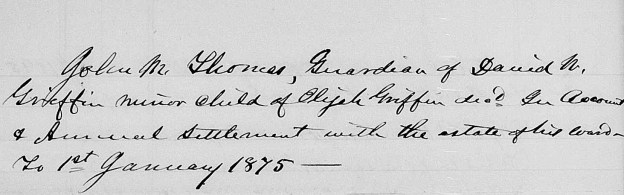
elijah m griffinElizabeth Thomas was born ca. 1837 and married Elijah Griffin in the 1850’s. Theirs was a short marriage as Elizabeth died prior to the 1859 estate papers for her recently deceased husband. From the sizeable amount of paper in the estate records we know that Elijah and Elizabeth had but one son named David W. Griffin. David Griffin is enumerated in 1860 Union County as being aged 3, at that time living in the home of his Aunt Jane and Uncle Sylvester Williams. Sylvester Williams went to war and never returned home. The estate of Elijah Griffin was held open through the 1870’s when David W. Griffin’s Uncle John M. Thomas was listed as Guardian.

David W. Griffin married 15 Dec 1881 Martha Ellen Dry, the daughter of Charles Albert Dry and Lydia Adeline Brooks. The marriage License listed both of David’s parents as deceased. As also proven in the estate records of Sarah E. Thomas, who was Elizabeth’s grandmother, David W. Griffin was listed as the sole heir of Elizabeth Griffin, dec’d. David W. Griffin and Martha Ellen Dry lived out their lives in Stanly County and are buried at Philadelphia Baptist Church.

Hampton H. Thomas
hampton

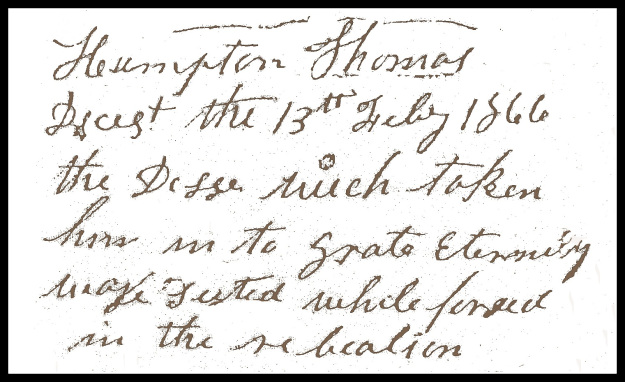
Entry from the Joseph Newsome family bible

Born in 1839, Hampton Thomas lived with Guardian Edmond L. Davis following his father’s death in 1854. . When Hampton came of legal age, Edmond Davis made a court documented return to the “Estate of Hampton Thomas & Others.” Since he was the oldest child appointed to E.L. Davis, the estate return was listed under Hampton’s name. E. L. Davis disclosed returns to David M., George, Puah, and Winney A. Thomas. Each child received $237.50.

In the 1860 Union County Census H. H. Thomas is listed twice. He is 21 years old and a mechanic living at the house of John Warwick, a shoemaker and emigrant from Pennsylvania. H. H. Thomas is also listed as a mechanic living at the house of James Richard. James is an Innkeeper, born in Cromwell Co., England. Dated 17 Aug 1860, Hampton purchased a one-acre lot near Monroe from J. D. Stewart.

Hampton H. Thomas enlisted and served as Sergeant in CSA Co. B, 26 Reg. NC. On 3 Jul 1863, he was captured after being wounded at the battle of Gettysburg. Following the amputation of his right leg, Hampton was transferred to David’s Island, N.Y., to Fort Wood at Bledsoe’s Island, and then on Christmas Eve of 1863, to the Point Lookout Prison in Maryland. Exchanged at City Point, Va., he stayed there until 1865. It is believed that Hampton returned home, where he shortly died from sickness. In the Joseph Newsome Family Bible, “Hampton Thomas- Deceased the 13th February 1866, the disease which taken him into Grate eternity was—?— while forced in the rebealion.”

Jane Ellen Thomas

Jacob Thomas was appointed guardian of Jane Ellen Thomas in Jul 1855 following the death of her father David Thomas. In April 1858, Jacob Thomas made a court recorded return in the amount of $140.00. And, on 11 Jul 1858 Jane E. Thomas married Sylvester Williams. Sylveter enlisted in CSA Co. G, 48th Reg, NC. On 9 Jun 1863 Sylvester died of disease at Goldsboro, NC.

The children of Jane E. and Sylvester Williams are John M. Williams (likely died young), Sarah E. Williams (William E. Helms), and Lethe Williams (likely died young).

Puah Ellen Thomas
puah e

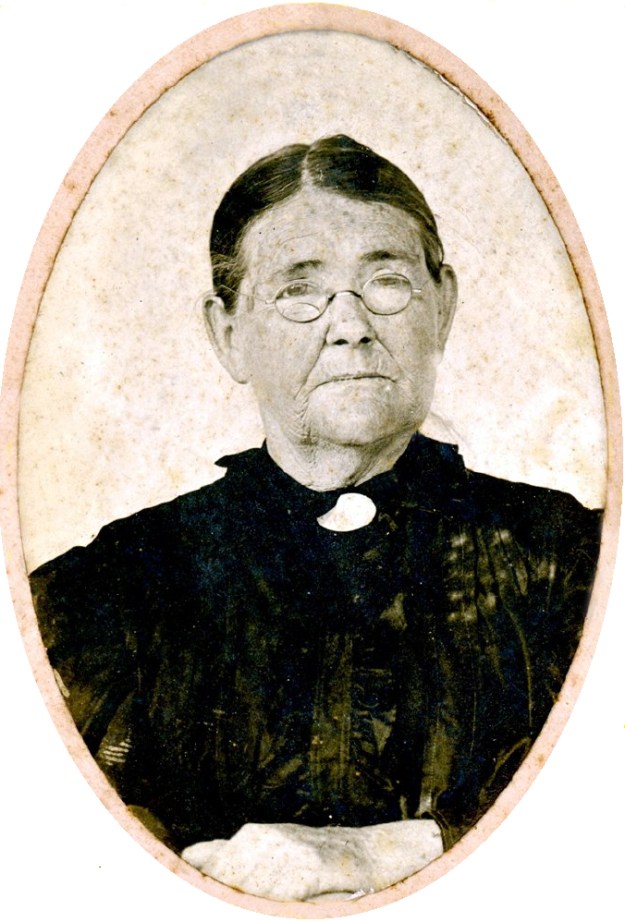
Puah Ellen Thomas Brooks

Though born 7 Jun 1844 in a family whose patriotism was fervently defined by the Confederate Cause, Puah’s name is surely a throwback to the abolitionist Quaker traditions in the Newsome side of her family. You see, in the bible, Puah was one of the Jewish midwives who looked after the baby boys during Passover. The Quakers seized on this in communicating shame to southern ladies in that they too have a responsibility and will someday be held accountable for how they treat others …those enslaved. The message went something like this …even the Jewish midwives treated slaves with dignity, how about you?

Puah married on 6 Nov 1865 Joshua Brooks. The house where they lived on Buster Road in Stanly County was demolished following hurricane Fran. It is said Puah and Joshua created one of the first libraries in the area.
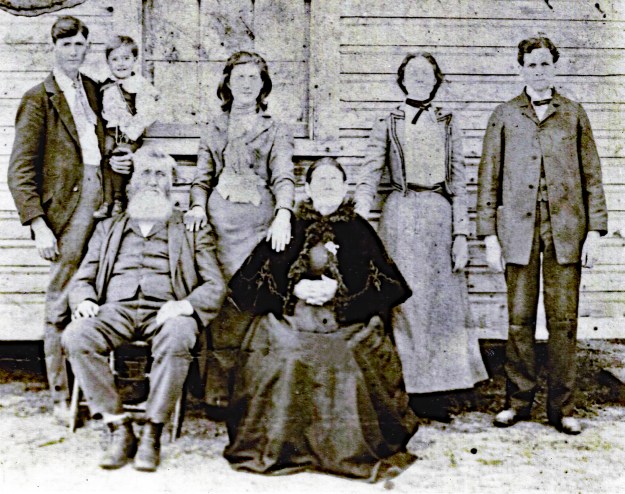
puah2

The Joshua and Puah Ellen Brooks family
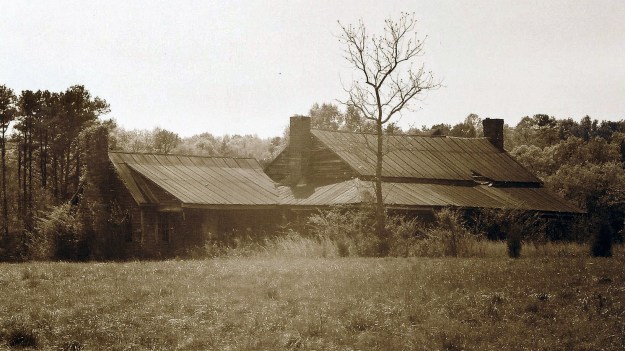
josh

Joshua Brooks Homeplace on Buster Road

Joshua and Puah Ellen Thomas Brooks are buried at Philadelphia Baptist in Stanly County. Their children are: Menora Brooks (Adam Morgan), Ida Brooks(Robert Hill), Lessie Brooks (Killis Almond), Martha Colon Brooks (Luther Efird), Carrie Brooks (Martin James), Maude Brooks (Adam Hill), John Brooks (Arrie Greene), Willie Brooks (unmarried), and Edmond Wyatt Brooks (Flora Alice Green).

Winney A. Thomas

Born ca. 1845, we know that Winney died in 1860. After her father’s death, Winney’s uncle Ananias Jr. was appointed guardian. And at some point prior to the 1858 death of Annanias, Jr., the reverend Edmond Davis was appointed her guardian.
The death of Winney A. Thomas is listed in the 1860 Union County Mortality Census. At 15 years of age and a spinster, she died of Typhoid fever after being sick for 22 days. Winney is likely buried at the Edmond Davis Cemetery near her parents.

Edward Wilson Thomas
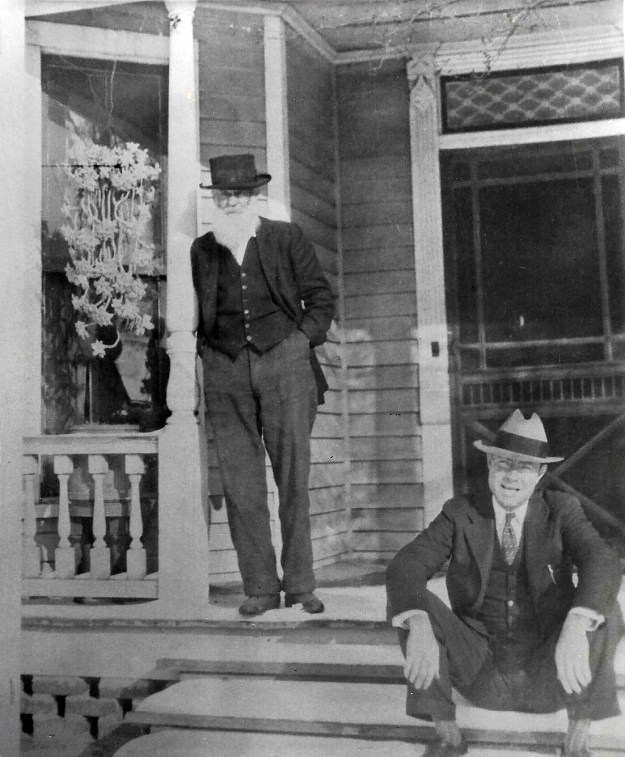
edmond thomas

Edward Wilson Thomas and son John Wilson Thomas

Edward Thomas was born 10 Jan 1847 and his older brother James R. Thomas was appointed guardian following their father’s death. At some point his Uncle William Newsom was appointed guardian as in the 1860 Union County Census, Edmond W. Thomas was listed as 14 years old and living at the house of William Newsom. Dated 10 Aug 1869, in the loose estate records of William Newsome, the widow of William Newsom deceased made a $544 dollar return to E. W. Thomas.

Edward Wilson Thomas married first on 31 Dec 1867 Susan Caroline Phillips the daughter of Enoch and Mary Phillips. Susan is buried at the old Phillips Burial Ground and note that Wingate College was built on or near by to the old Rev. Enoch Phillips home place. The children of Edward and Susan Phillips Thomas are Conley Thomas (Mittie), Joe E. Thomas (Emma Ross), Genolia Ann Thomas (Dr. George Benton Nance), Mary Elizabeth Thomas (George W. Simpson), Essie Thomas (Carl Bailey), and John Wilson Thomas (Lillian Maude Hasty). Edward W. Thomas married second Lillie A. Traywick, the daughter of Dr. B. S. and M.H. Traywick. Edward and Lillie are buried at the Weddington UMC. Their children are Walter Bryant Thomas (Josie Ella Hemby), Eloise W. Thomas (E. C. Stephenson), and David E. Thomas (unmarried).

Edward Wilson Thomas and wife Lillie Traywick lived in present day Weddington where their home has been added on and converted to make the town hall. Known now as the Thomas-Wrenn House, the photo above is of Edward W. Thomas and his son John Wilson Thomas. In a photo of the house from the town’s homepage, look closely at the porch and you’ll be able to imagine Edward Wilson Thomas and son from years ago.
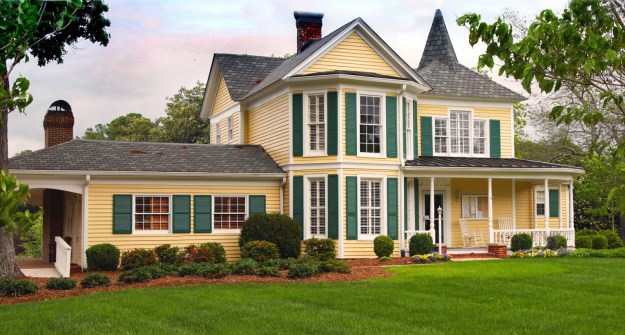
finalwth

Thomas-Wrenn House, Weddington NC

David M. Thomas

Born in 1848, David Thomas married on 15 Jan 1871 Mary Margaret Austin, the daughter of Bryant Deberry (B.D.) Austin and wife Elizabeth Hamilton. When B. D. Austin died in 1885, David and wife Mary were listed in the estate records. Dated 22 Jan 1889, in the petition for final settlement, the listing of heirs records—— –– “Mary Margaret Thomas…who is now a widow”.

Little else is known of the life of David Thomas. The children of David and Mary Margaret Thomas are: Edward W. Thoma (Ida), Mary Thomas, David Milton Thomas (Minnie A. Simpson), Lillie E. Thomas (Coram S. Lawrence), Lexy Thomas (Lucy Leola Perry), and Bertha Thomas (John Clanton). Following the ca. 1889 death of David, his widow Mary Margaret married Julian Baker.

George Washington Thomas

Born 9 Feb 1852, we know from records that George’s mother Alice died less five months after giving birth. And, following the death of George’s father in 1854,the reverend E. L. Davis was appointed guardian. My great grandfather George lived in several households until moving to Stanly County where he lived in the home of John Brooks. There, on the waters of Island Creek, George married Julia Ann Pless, the daughter of Solomon and Caroline Furr Pless. George and Julia continued to operate a store, the Solomon Pless saw mill and a wood fired brick kiln on a hill above Island Creek.

George died in 1922 from influenza and Julia died not too many years after. Julia’s folks are buried at Flat Rock Lutheran cemetery and George and Julia are at rest in the lower cemetery at Love’s Chapel UMC. The above pictures are of George and Julia Pless Thomas The photos below are of young Sylvester Thomas courting with the home of George W. Thomas in the background. It’s likely the old homeplace of Solomon Pless. Also shown are the sons of George W. Thomas working to make bricks.

The children of George and Julia Pless Thomas are: John E. Thomas (died when his gun misfired in a hunting accident), Jane Alice Thomas (Henry J. Yow), David Luther Thomas (Emma Jane Morgan), Minnie Thomas (Reverend Tildon Sasser), Henry Washington Thomas (Ara Bell Huneycutt, Elsie Wilma Dry), Ellen Thomas (Albert Grady), George Sylvester Thomas (Lessie Sasser), and Daniel Arthur Thomas (Eva Lucinda Burris).

1044784_376837135771720_1251989167_n_tonemapped

Work at the brick kiln on George Washington Thomas’s farm
gwhouse

Sylvester courting in front of George Washington Thomas’ home

STANLY HALL: A STORY OF FAITH AND TRUST


stanly hall image

Stanly Hall, Locust Level NC


stanly hall-1

Mooreville Enterprise, 15 Sep 1927

Often I stumble across new finds only to quickly realize there are many who are already aware. It’s tough to get excited when the response to such finds is “oh sure, such and such wrote about that,” or, “take a look …there’s a link about that on the town’s front page!” Today I happened across an old newspaper article making me aware of what many others already know. This may be nothing new, but the article does add context to a story worth retelling.


In March of 1879 Miss Frances Ellingwood Ufford faithfully left New York in support of the Presbyterian Home Mission. She moved to Concord NC where nearby Log Cabin School on Rocky River Ridge became the setting for her vision of a better way of education. On that site sprang White School which later became Jackson Training School.


As mentioned in the article above, Miss Ufford sensed and acted on the need for a proper school in western Stanly County.  Named Stanly Hall, the school is located next to Beulah Presbyterian Church on the 1904-10 C. M Miller map of Stanly County. Take a look:

And from a pamphlet remembering Miss. Ufford’s works can be found the above images of her schools including the majestic Stanly Hall which once broke the skyline along present day Hwy 24-27.

I ask that as you drive Hwy 49 curious as to the remnants of Jackson Training School, take time to imagine the old log cabin school along with the later White School. And for those passing through Locust, take time to imagine Stanly Hall. How did its construction change the demographics along the old Charlotte Hwy? From the article we learn that the school fell to fire but that its memory was once honored in the form of a class reunion.

The story was always there but I had no clue. There are many articles on this subject; take time to do a google search. Did you know there was even an act of our state legislature commanding that no alcohol be made in the proximity of Stanly Hall?