Category Archives: Uncategorized

BROWN HILL AFRICAN METHODIST EPISCOPAL: A CHURCH TRANSFORMED (Pt. 1)

ame_tonemapped
My mother grew up in Stanfield where her family attended Love’s Chapel United Methodist Church. She tells of times in the early 1930’s when her parents carried the family to hear services at Brown Hill AME in the nearby town of Locust. Mom has always spoken well of the visit and remembers her parents being moved by the lively choir. They were drawn to the church by both the message and a powerful messenger.
My family’s experience was nothing new. Written in an endearing dialect of the old south, a regularly occurring social column praises an earlier service held at the church:

The Concord Times, 17 Oct 1895

…Well, I like to forgot the colored folks had a glorious jubilee at their church at Brown Hill over a little way in Stanly last Saturday and Sunday – Children’s days on Saturday. The cornet band from Pioneer Mills country (Cabarrus) was there, and it being a new thing in that country, why the white people of that vicinity gave them a rousing, cheerful presence. Some have told me they outnumbered the colored folks, and the good colored folks gave them the middle tier of seats in the church, and the band played and the children sang, and then lastly the 10 cent lunchins were served, and lots of money was realized, the band paid off, and some left, and old Aunt Rose says the white folks had the most money and shelled it out too. So everything passed off quietly, friendly, affectionately with tender love and felicity …

It’s now 2019 and the town of Locust is planning its 150th anniversary. Little do they know of the real beginning of Brown Hill. It is commonly believed that Brown Hill AME Church first held services in 1870 about the time Locust was founded. From the church’s online history:

The Brown Hill A.M.E. Zion Church was organized in 1870, where the records indicate that Henry and Sarah Love obtained a special parcel of land. The parcel was mostly farmland, which was worked by surrounding farmers usually six days out of the week. Apparently, the subject about a place to worship was mentioned on numerous occasions. The founders probably chose this place to start gathering in 1870, which was the birth of Brown Hill.

…the first Brown Hill Church was constructed in 1874 when a group of African American Christians held a meeting and decided on a permanent place of worship.

Dated 27 Oct 1874, Wilson M. Carter of Mecklenburg conveyed 8 acres (Deed 11-459, Stanly) for a price of $50. The land was purchased collectively by Michael Barnhardt, Wesley Morgan, Adam Morgan, Henry Love, and Solomon Reed. L. A. Carter and John M. Carter served as witnesses. The purchase known as the “Brown Hill Church property” adjoined “the road” and a tract of land owned by Michael Garmon. Not spelled out in the transaction and differing from the official deed, the church’s history indicates the purchase was for “nine and one-fourth acres of land, and an old church building, which is believed to have been a Bush Arbor for $40.00.”

It’s at this point where my findings begin to diverge from those held by the church. I believe the richly African American Brown Hill AME church had its beginnings first as a Methodist Protestant Church. Serving a predominantly white congregation at that time, the Methodist Protestant church predates Brown Hill AME. Before delving into that story a little local church background is in order.

Circa 1830, the Methodist Protestant church was formed in the United States as an offshoot of the Methodist Episcopal Church. Unlike the Methodist Episcopal Church, the Methodist Protestants adopted greater self-control in terms of congregational governance. No longer under the control of bishops, the new order continued to hold Wesleyan doctrine and worship though it withdrew from the long held tradition of episcopacy. The division within the Methodist Church eventually healed from whence today’s United Methodist Church was formed.

Locally, in the early 1840’s, Love’s Chapel Methodist Episcopal was the first of its denomination to locate in southwest Stanly County. It wasn’t until the early 1860’s that Love’s Grove Methodist Protestant Church was founded nearby.

articleSeeking further information I came across two important newspaper accounts that I believe radically changes the local church histories. Firstly, and dated 22 Mar 1922, the First Protestant Methodist Church in Charlotte announced its ninth anniversary celebration. Beautiful music was to be played, there were guest speakers, and new art glass windows were “to be unveiled and dedicated to the memory of men who have rendered valuable service to the Methodist Protestant church in this community.” Among those to be honored were “Rev. Henry Garmon and his brother, Michael Garmon, who were among the first in this community to become Methodist Protestants.”

According to Western NC Methodist Conference archivist Jim Pyatt, “First Methodist Protestant Church was organized in 1913 (the NE corner of Central Avenue and Hawthorne Lane), changed its name in 1939 to Central Avenue Methodist Church, then in 1969 left that building, relocated to Albemarle Road, and changed the name to Central.” Central UMC was tragically burned in 2008 at the hands of an arsonist. The church was built anew in a testament of an unwavering faith. And in tracing the windows placed in honor of Michael and his brother Rev. Henry Garmon, such memories may have been destroyed by the fire. I’d love to be able to find an image of the windows placed in honor of Rev. Henry Garmon and his brother Michael. To those reading these words, PLEASE pass on such images or information about them if you are in the know of where they may be found. Below is an image of First Charlotte Protestant Methodist found online.

3_000

Getting back to Michael and Henry Garmon, they were sons of another Michael Garmon and his wife Maria Magdalena Shore. Maria is the daughter of Elizabeth Love who married Heinrich Shore in Stokes County NC. Elizabeth is the sister of Jonah Love who founded Love’s Chapel Methodist Episcopal church. So, there is a Methodist connection running through both the Love and Garmon families. And, remember that per the official 1874 deed, Michael Garmon owned a tract of land adjoining the property on which sits Brown Hill AME now stands. A very important detail, is it possible Michael Garmon’s Methodist influence led him in the founding of Brown Hill AME church? What’s the connection?

Going back to the height of the civil war, on 12 Jan 1864, The Charlotte Democrat reported on the leadership of an organization known as the Mecklenburg County Bible Society. The article lists leaders from various denominations including Protestant Methodists. Representing the Protestant Methodist church was:

“Brown’s Hill – Michael Garmon, James Allen”

The name James Allen runs deep in Stanly and Anson Counties. What was his connection to Michael Garmon and to the Methodist church? And then there is Michael Garmon …named as representative of Brown Hill Church well before the believed 1874 start date!

Apparently ten years prior to the 1874 acquisition of land for use by the Methodist AME church, there was already a church in place. From the article we know Michael Garmon represented Brown Hill in 1864. And as told in Brown Hill AME’s history, we know there was an old building on the property when at that time it was purchased. We now know where now stands Brown’s Hill AME, there once stood a Methodist Protestant church having the same name.

So, why was there a change? Remember that Love’s Grove Protestant Methodist was formed just down the road in the 1860’s. I believe in honor of her husband Michael Garmon Love, Phoebe Love, the daughter of Thomas Love (brother of Jonah) donated land for the new church ca. 1865. And note that Thomas Love, also a Methodist, was once on the board of trustees for Bethel Methodist not far away in Cabarrus County.
Serving in the civil war Michael Garmon Love wrote home to his wife Phoebe in Nov 1863. The letter reads:

…Deare wife I wish that this civil ware wod stope soe that we all cold come home to live with our famles a gain as we Did Be for this ware tuck plase and I am in hopes that we all will be at home til Spring – hit is thought that N. C. will go back in the Union and I hope that she will and that Be fore Spring for I cant help but think that we are on the rong side.

Michael Garmon Love held to sympathies. Yet, the spring came and turned to summer. The war raged on until in1864 he was forced to return home from Virginia due to illness. Michael Garmon Love died in November 1864 which event I believe inspired his wife Phoebe to build a new church.

As one church came to be, the other fell. There was not room for two. And though Brown Hill Methodist Protestant Church may have begun long before the 1860’s, its doors closed as those at Love’s Grove first opened. And in doing so, the old church building known as Brown’s Hill was purchased and eventually made anew by African American’s who were once Free People of Color as well as the slaves of those whose ties continued in faith and the occasional sharing of worship. For generations to come, I feel it important that the congregations be able to envision this thread of history binding Brown Hill AME to its namesake Brown Hill Methodist Protestant. The thread also winds through the congregations of Love’s Chapel and Love’s Grove Methodist churches in securing a beginning for First Charlotte Methodist Protestant as well as today’s Central UMC.

The land upon which Brown Hill AME stands today has a long and rich history. Please stay tuned for an upcoming post to be based on information gleaned from a study of local land records. Illuminating the lives of those who came before the founding of Brown Hill AME, there are more stories to be told.
GROWING FAMILY

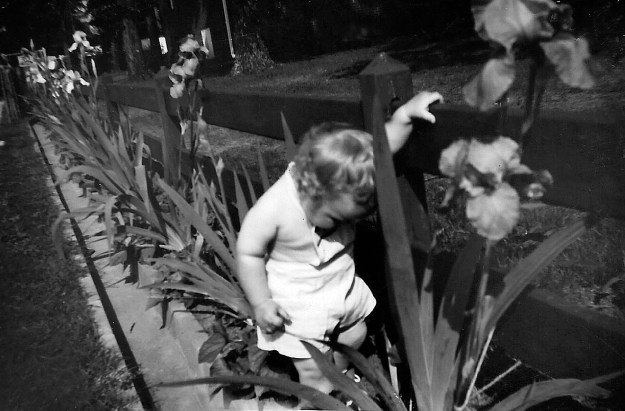
gtirisThe photo above stirs within me vague memories of the place where I was born. I see that curly haired boy and can almost remember the bed of irises along my family’s driveway. And, in seeing that mop of hair, I’m reminded of my mother telling of bathing me in the kitchen sink …of her smiling at the ringlets of hair that sprang from my little head.

Do I really remember that far back, or are these mental images merely the embodiment of all the stories I’ve heard so many times? Just as it is with any form of history, what is known about our past is predictably finite. At some point our recorded memory fails to accurately tell the story. For this reason, all the knick-knacks, pictures, and heirlooms filling our homes are there for but one important purpose. They trigger our thoughts, allowing us to hold to our past for but a little longer. Unlike the written or spoken word, or even photos or other sorts of pictures, such items reawaken our minds through the added sense of touch, smell and even taste. The value of such keepsakes last as long as their relevance is appreciated. Their overall composition, in turn, drives our visualization in a constant pursuit of an improved design.

_____________________________________

This year’s clouds of pollen have passed and now my own landscape is being blessed by the showers and warmth of spring. Though my house is filled with heirlooms reminding me of our ancestral heritage, the story telling need not be confined within the walls of home. Even the things I grow and the stories they tell are not without value.
About the above irises, being in the 1950’s, my dad paid a dollar a head for them at a hardware store located on Statesville road. By 1962 the family moved across town to a new home in south Charlotte. My dad, of course, planted more irises and yet developed a liking for other flowers. One of his favorites was zinnias which he called his “pretty boys and girls.”

Following the passing of my father in 1995, I remember driving to Pope County Arkansas with my mother to learn more of her Love family who had moved there in the late 1830’s. Mom and I visited several graveyards including one belonging to Pleasant Love. Situated on a hill overlooking the Arkansas River basin (now location of a nuclear plant), the little cemetery stood on the edge of a wooded lot. Spreading out wildly from the gated family plot was a large patch of old cultivar iris. Maybe they were first planted at the death of Pleasant Love in the 1800’s. Standing there quietly, I wondered if the irises were the result of a hand full of bulbs the family brought by wagon from North Carolina. Was the story told by the flowers intended to begin in Arkansas or North Carolina?

Also, while in Arkansas, I visited nearby Pless Mountain where my father’s GG-grandfather had purchased land in the 1840’s. Peter Pless bought land in Arkansas although soon after he returned to Stanly County where in 1854 his last will and testament mentions his lands in Arkansas.

Item. I give and devise to my daughter Catherine, all that tract of land in the state of Arkansas, being in Pope County on Arkansas River containing eighty acres to have and to hold to her, and her bodily heirs in fee simple forever.

Peter gave his land to daughter Catherine who had recently married the widower George H. Teeter. Peter Pless’ son Solomon, my ancestor, did not make the trip and remained in Stanly County on the waters of Island Creek. Peter’s youngest boy, John Adam Pless was also raised in Stanly County. He made the move west around 1860. It was upon John Adam Pless’ land in Arkansas that Pless Mountain got its name. While in Arkansas, I collected a slab of black sandstone from the top of Pless Mountain. At that time, a family descendant and distant cousin gave me a prized photograph of John Adam Pless taken on his 101st birthday. Together, the photo and the slab of stone serve to remind me of this important chapter in my family past.


Amazingly, years after my trip west, I learned of the old Love cemetery near Rocky River. There, too, is a patch of iris …similar in shape and flower. I wonder if the flowers from the two locations share the same source. Are they genetically related? Related by the same families who loved them so?

This story is not centered solely on irises. You see, not long ago I witnessed a Facebook user group discussing old chimneys standing guard in memory of failed home places. With the dwelling structures having long since disappeared, it seems there’s now a similar epidemic inflicted upon the remaining masonry. Folk on the web site were expressing pity that the grand ole homesteads were all but gone. But the community conversation overlooked something important. The remaining brick still lie scattered across the fields of our American south. Unused and unwanted, they are there, accessible and in need of a little respect. They should not be picked up and hoarded for personal gain though I can imagine community monuments based upon piers constructed of the old brick.

Here’s my idea: each brick could be catalogued and etched with a number keyed to the family home from which the brick came. What a way to honor the people of our past! People visiting such a monument would not only receive the intended message, but could also see that their ancestor was a part of the community. From slave to prominent citizenry, bricks offer one of the best surviving elements we can draw upon to symbolize their existence. Monuments, like the keep sakes in our homes, are put in place to connect us with our past.

For me, this idea of bricks and of the architecture of landscape is personal. My father always thought hard about the matters of land. He served in England and brought back inspiration after seeing many a English garden. After dad’s passing, I made visits to any cousin, close or distant, who would listen to my incessant hunger to learn more about family. It was during such a visit to my father’s first cousin, George Houston Thomas that I learned of an important family artifact. I’ve always heard that my family made bricks at a kiln along the banks of Island Creek. However, from George Houston Thomas I was gratefully given a photo of the family “boys” actually making brick. The photo wonderfully connects me to another day and time though falls short in a physical sense.1044784_376837135771720_1251989167_n_tonemapped

As with others in his family, my grandfather’s home was made of wood cut on the farm with the chimney being constructed from the clay under his feet. The old home place stood from the early 1900’s until years ago when my grandparent’s farm was sold. It was eventually burned as practice for the volunteer fire department. I was there the day before the fire and was given permission to walk the land …to gather up any articles I wished. At that time the chimney was still intact and the home standing.
Looking high and low I was able to scrounge about 50 bricks in total. Some of which had markings of thumb prints while others showed the flashes of color inflicted by fire and uneven heat.

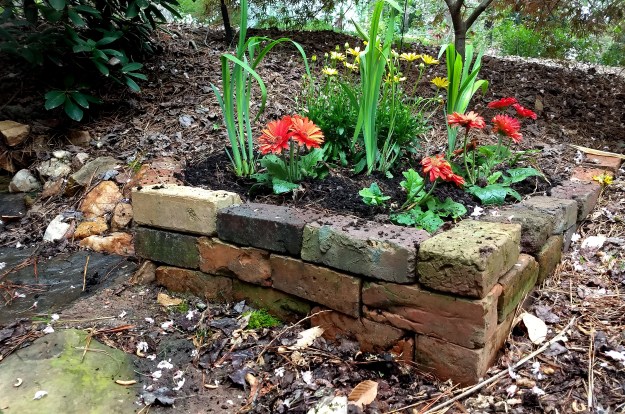
Today, I’ve devoted part of my bounty of bricks towards the making of a small flower bed near my front door. The flower bed is filled with daisies and there are also zinnia seeds planted and ready for the heat of summer. Sadly, though, I have no Iris from my childhood memories, and I failed to bring back plants from Arkansas. This loss was rectified during my honeymoon, as my wife and I paddled the waters of Moccasin Swamp (what a name!) in Johnston County. Deep in an eastern North Carolina cypress swamp we came across a great hollowed tree surrounded by stagnant water. Protruding from a hole in the tree, a wild variety of flower called Iris Virginica presented itself to me and my wife. It’s commonly known as the Southern Blue Flag iris. Beyond its natural beauty, and finding it in such a remote habitat, the flower also serves as a reminder that many of my ancestors in southern North Carolina once lived along the waters of Moccasin Swamp. William Gurley of Anson and others once owned land along the water.bed

Remember that all the knick-knacks, pictures, and heirlooms filling our homes are placed with care, reminding us of many great things. Their value will last as long as their relevance is appreciated. And from me to you, I ask that you not limit your family history to only the written word. Include your family in the architecture of the garden. Share plants and strive to perpetuate the love they’ve inspired. There are many simple ways our gardens can be used to speak on behalf of both those we love as well as family we’ve never even met.

UPDATE: LANDS IN SOUTHWEST STANLY

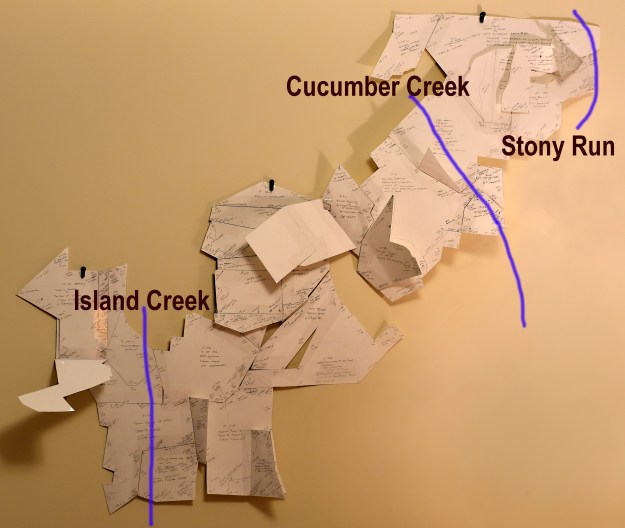
island map

During late fall of 2018, I mentioned personal plans to begin pushing further east with my platting of lands in western Stanly County. To date, I’ve covered all of present day Locust reaching north, well beyond. And, the lands along Island and Cucumber Creeks, reaching north to Stony Run, are now mostly platted. And also underway, I’ve begun to connect the lands south along Stony Run, moving southwest into present day Oakboro. It’s all starting to come together.

Hopefully, by end of summer, I’ll have completed the arduous task of finding and connecting all of the old pieces of land in southwest Stanly. After the drawing and hand-work is completed, I’ll spend a period of time reformatting the hand drawn images as overlays on top of digitized topography maps. The expected date of completion of the Stanly County phase is Christmas 2019.

In the end it’ll be nice to have a slick and searchable place for folks to locate where their ancestors once lived. That’s my goal and I hope you’ll enjoy using the resource. But, with that being said, I absolutely love the paper. It’s yet another experience to receive information in its touchy feely form unfolding before you with a connectivity allowing you to venture well beyond the confines of the words read in a land record. It’s not the land records that matter, but how they come together and connect with others in illustration of the progression of generations moving about within our ancient community of families.

With that in mind, this morning I sat myself down and made the following videos I hope you’ll enjoy!


STORY OF A JEWISH FAMILY IN EARLY UNION COUNTY NC

princess lamballe
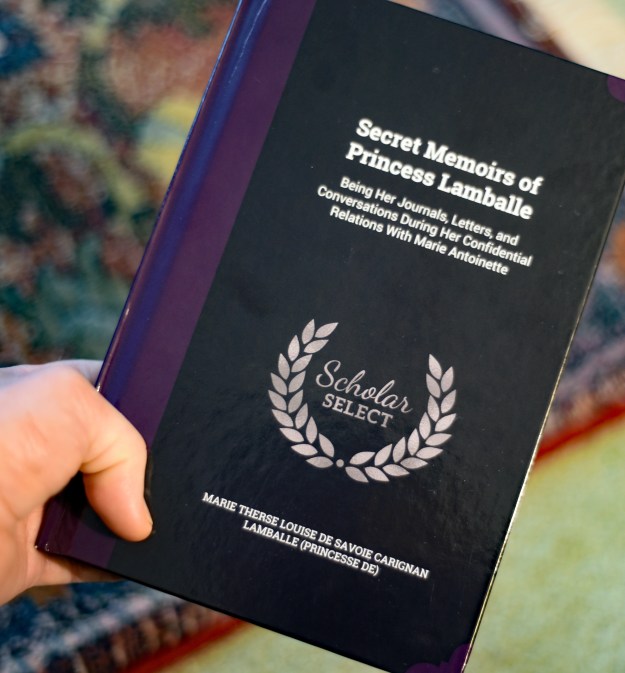
I’m feeling pretty good after recently purchasing the above through amazon.com. It’s in preparation for upcoming talks I’ll be giving on an early Jewish Family and their time spent in present day Union County. About the book, The Secret Memoirs of Princess Lamballe is a mind-blowing account offered and edited by Catherine Hyde, Marquise de Couvion Broglie Scolari. While studying art in Paris, Catherine was noticed by Queen Marie Antoinette and her Princess, Marie Therse Louise de Savore Carignan Lamballe. A childhood friend of Marie Antoinette, Princess Lamballe mentored her protégé, Catherine Hyde, as to the ways of royalty. Telling of her special relation with Princess Lamballe, Catherine Hyde wrote:

Whether it was chance ability, or good fortune, let me not attempt to conjecture; but from that moment, I became the protégé of this ever-regretted angel. Political circumstances presently facilitated her introduction of me to the Queen. My combining a readiness in the Italian and German languages, with my knowledge of English and French, greatly promoted my power of being useful at that crisis, which, with some claims to their confidence of a higher order, made this august, lamented, injured pair, more like mothers to me than mistresses, till we were parted by their murder.

In the days leading up to the 1793 execution of Queen Marie Antoinette, and being fearful for her own life, Princess Lamballe passed on personal memoirs to Catherine Hyde for safe keeping. It is she, Catherine, who edited and first published the above book. Appearing in the special Introduction, the following tells of Princess Lamballe’s final days:

The Princess Lamballe, as will be seen, was as loyal to her own conscience as to her less clear-sighted mistress. When the catastrophe was impending the Queen and King implored her to leave France and so save her life. The beauty and purity of her character was equaled by her devotion to duty and her courage. She scorned to leave her friends in the hour of peril, “faithful among the faithless” titular nobility who scampered away to safe hiding-places until they might creep back in the returning sunshine. She was harassed with repeated attempts at bodily injury, and when arrested, calmly refused to forswear her principle of fealty to the monarchy, while cheerfully willing to accept the mandate of the nation. Thereupon the gentle and brave woman was stabbed to death by the fiends who invaded her cell, and who added the exquisite pang to the sufferings of the Queen by parading the head of the Princess, on the point of a pike, before the window where her mistress was expected to see it.
marie antoinette murder

Okay, so how did I come across all this, what importance is it to me, and what connection does it have to our State of North Carolina? During the reign of Marie Antoinette my family was scraping out a living in the red clay of North Carolina’s southern piedmont. I know little else about them other than their occupation of farmers as is enumerated in the 1850 census. And for Catherine Hyde, it turns out that she was born Jewish, the daughter of Moses Hyams of London. While Catherine left to study art in Paris, her brother Samuel Hyams, a merchant, sailed for Charleston SC. In the early 1800’s Samuel Hyams’ daughter Caroline married Abraham Labatt. Along with Abraham and wife Caroline, Samuel’s son Moses Kosciusko Hyams left for what’s now Union County NC. It’s there, in 1829, that Moses Hyams came into contact with my great-great grandfather David Thomas. Though I can imagine their conversations and how the two young men shared each other’s ways and differences in beliefs, it’s hard for me to imagine the challenges and resulting accomplishments achieved by this extraordinary Jewish family.

UNC – THE COMPROMISE FOR BEAR CREEK

old east

People place too much emphasis on where they attended school when in reality one’s energy should be directed towards what a degree can do for you and how best to put it to work. A simple woodworker by love, it’s my belief a diploma is representative of a much more important set of tools. Of course some tool brands are better than others, but where you buy them is of little importance. And, then there’s school pride!

I’m a lifelong Wolfpack fan as I received an undergraduate degree from NC State. And yes, as a young college student my woodshop locker sported a bumper sticker that read “UNC Students Are Ugly and Their Mammas Dress Them Funny.” I also learned the State fight song which unofficially includes the derogatory exclamation telling Carolina where it can go. With all this being said, I was absolutely bedaffled when I recently learned of a 1799 petition to our state’s general assembly in which my earliest known Burris family ancestor, …and his neighbors, expressed a similar dislike for the University of North Carolina. It’s safe to say that my 5th great-grandpa Solomon Burris was not a Carolina fan.

Quoted directly from the above mentioned 1799 petition, the University of North Carolina was referred as:

“…an institute, whereof we have a sorry opinion after reading in Abraham Hodges’ Journal, the scandalous & shameful behavior of some students, neither can we derive any advantage from it by getting our sons academically educated, as we are doomed to a rural and obscure life, which we would be very well contented, if we only could not get disturbed, even therein.”

Note that Abraham Hodge was the first official printer of North Carolina’s governmental records. From the town of Warrenton, his publications also included the North Carolina Almanac and State Journal.

What was it about the university that troubled my ancestor and his fellow neighbors who all resided near Bear Creek in present day Stanly County? To really understand you must get to know the lands my ancestor lived upon. You must also understand the scheme used for funding the new University of North Carolina. These are deep issues that need more time than I’m willing to give in this post. For now, let’s talk UNC.

On 2 Nov 1789 the General Assembly of North Carolina, then meeting in Fayetteville, met and enacted a law establishing the University of North Carolina. Chapter 20 of that particular session’s meeting reads in part:

“WHEREAS in all well-regulated governments it is the indispensable duty of every Legislature to consult the happiness of a rising generation, and endeavor to fit them for an honorable discharge of the social duties of life, by paying the strictest attention to their education: And whereas an university supported by permanent funds, and well endowed, would have the most direct tendency to answer the above purpose…”

Those were tough economic times. Hardships during the Revolutionary War had been replaced by new trade wars with England. The new government of North Carolina was not taking in the amount of revenue needed to properly pay for the creation of a university. Seeking a funding stream that would least upset its citizens, the above act of the General Assembly was followed up with another law “for funds, appropriated for building &c. the university &c.” Chapter 21 of the 1789 session reads in part:

“ WHEREAS the General Assembly by their act, entitled “An act to establish a university in this state,” passed on the eleventh day of December instant, have declared that a university shall be established and erected in this state, which shall be called and known by the name of The University of North Carolina : And whereas adequate funds will be found to be the means which will most effectually ensure to the state the advantages to be hoped and expected from such an institution

I. …That a gift of all monies due and owing to the public of North-Carolina, either for arrearages under the former or present government, up to the first day of January, one thousand seven hundred and eighty-three, inclusive, (monies or certificates due for confiscated property purchased excepted) shall be and is hereby declared to be fully and absolutely made, for the purpose of erecting the necessary buildings, employing professors and tutors, and carrying into complete effet the act before recited …

II. And be it enacted, that all the property that has heretofore or shall hereafter escheat to the state; shall be and hereby us vetted in the said Trustees, for the use and benefit of the said university.”

It was in the above clause, highlighted in red, that the citizens of old Montgomery County were at odds. Let me explain with a one paragraph crib note version. Here goes >>>
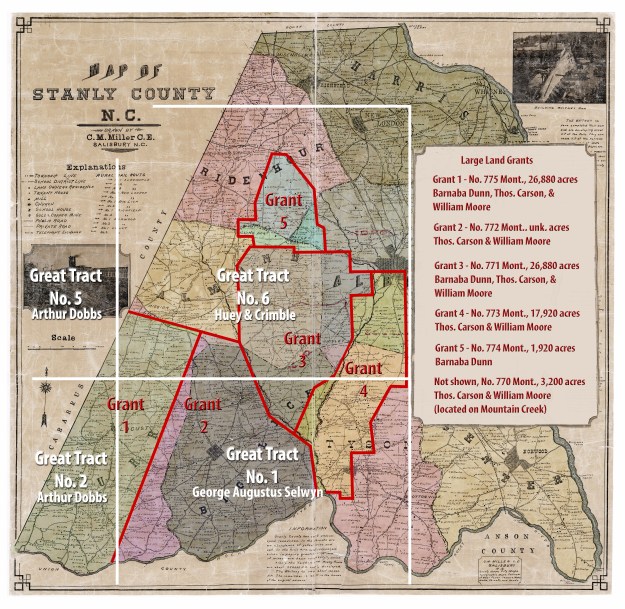
Much of the suggested loyalist’s lands to be sold were located in Montgomery, now Stanly County. And, much of the lands in that region were bought by deed as sub-divisions of the Loyalist purchased sub-divisions of Gov. Dobb’s 100,000 acre Great Tract # 6 …which was initially purchased for resale by James Huey. Complicating the matter, following the Revolutionary War, residue of the Loyalist owned Great Tracts were escheated to North Carolina for issuance as land grants. Barnaba Dunn and several other land speculators got into the picture and gobbled up six tracts comprised of multiple entries totaling approximately 64,000 acres in now Stanly. They planned to make a profit by their own scheme of subdivision, selling at a higher price than what was paid out in the grant. That’s huge, and unbeknownst to Barnaba Dunn, he really didn’t get the land owed him as much of it had already been scarfed up in process of sub-division of the Great Tract! So, in short, the common folk of now Stanly County had to deal with a toxic concoction of land acquisition by both state as well as privately sold lands. Complicating the issue, the 1789 act by the State of North Carolina gave right to sell all unclaimed land for the benefit of the new University. Got it? If not, take a look at the following image. Overlaid on C. M. Miller map of Stanly County, it shows the great tracts in white and the large grants issued to speculator Barnaba Dunn and others are outlined in red.

Stanly Great Tracts 1

It really is a mess. And it was in that environment where Solomon Burris and others made a go at life in our new country. With that bit of background covered, let’s look at the petition, the signers, and let’s see how things played out for those living near Bear and Long Creeks of Rocky River:

To the Honourable; The General Assembly of N. Carolina

Gentleman,

About three years ago, Adley Osborn, attorney for the Trustees of the University, intimated to us, that our improved Plantations and all vacant land lying in Great Tract No. 6 first granted to Murry and Crimble, and escheated, were given as a Donation to the University & wanted to compromise with us for it. But we been entirely uninformed of any thing, concerning this matter, and thinking ourselves safe enough by our state, grants, refused firmly to enter into any compromise and ever since we geen let alone, till now lately said Attorney Osborn attempted the second claim for our lands by a threatening advertisement to which we are unwilling to agree, and taking the refuge to your kind & deserved protection, he postponed his procedure till after your present session.

The vacant land around us is in the hands of a few speculators and we’re bereaved of the chance of entering any parcel of land to meliorate our circumstances have to buy it from the mercies of userers at their own price, Whereby we and our poor families must groan while only a few individuals enrich themselves on the turf of a multitude of honest, poor, and industrious farmers; And to complete our melancholy fate, even our respectable State is claimed for the benefit of the University; An institute, whereas we have a sorry opinion after reading in Abram Hodge’s Journal the scandalous & shameful behavior of some students neither can we derive any advantage from it by getting our sons academically educated, as we are doomed to a rural and obscure life, which to lead we would be very well contended, if we only would not get disturbed , even therein.
We therefore beg most humbly, the Honourable The General Assembly may seemingly consider that we, are in the righteousness possession of our lands by state grant have paid regularly our taxes and never deviated from any duty, which could make us unworthy and deprive us of our Property, Liberty, and Independence , and to reinstate us in our former peaceable possessions and rites, and to secure us graciously from the present & all future claims and attempts from the University as well as any other Corporation or any Individual whatsoever; in which expectations and confidence we subscribe ourselves respectfully

The Honourable; The General Assembly

Montgomery County
Novbr, 23, 1799

Martin Almond       Ambros Honicut
Conard Almond       John Sides       Augustine Rowland
Adam Smith       Elisha Honicut       Richard Holland
Henry Oudee       Hardy Hatley       ……….. Holland
Jacob Oudee       James Mainord       Hosia Rowland
Droury Honnicut       Young Wardrobe [Waltrop]       Isac …born
Titus Wittly       Uriah Smith       Sharwood (x) Smith
Nicholas Rauch       Drewry Smith       Aaron (x) Green
Dempsey Honnicut       Thomas Notley       John Manor
George Springer       Benjamin Cagle       Edward (x) Herrin
Solomon Borras       George Carkey       Geore (x) Whitly
Richard Almond       Sharad Rowland       Absolum Harwood
Nathan Almond       Robert Rowland       Thomas Lowder
Alexander Underwood       Bird Pyron       Richard Green 
Christian Coble           John Medlin
Joel Rowland           Thomas Almond
Richard Honeycut           Howel Harwood
John Smith
Hardy Honeycut
Mally Rowland
F’ Rowland
Thomas Castle
Asa Smith
William Sugg
(written in German)
Gideon Almond
Urias Spaight
Draper Burges
(written in German)


Also acted upon during the same session, being Fall 1799, there was even a petition by one of the speculators who sought compensation for troubles he had encountered. In 1794, Barnaba Dunn received a grant for 12,220 acres made up of lands that had been escheated or returned back to the state as it once belonged to British loyalists James Huey and Murray Krimble. Barnaba complained:

“your petitioner proceeded to have the said land surveyed, but on an actual admeasurement, it appears that 8,641 acres of the land could not be surveyed agreeable to the locations in consequences of entries being made thereon previous to those of your petitioner by James Huey and Murry Crimble. These facts are clearly stated by the certificate and oaths of Surveyors.”

See? Didn’t I tell you this was messy! The General Assembly agreed with Barnabus Dunn’s assessment though he was denied compensation based on the grounds of failing to verify the 8,641 missing acres.

Getting back to the petition of citizens from old Montgomery County, the documents mentions lawyer Adley [Adlai] Osborn and how he

“intimated to us, that our improved Plantations and all vacant land lying in Great Tract No. 6 … were given as a Donation to the University & wanted to compromise with us for it.”

Imagine coming in from a hard day’s work to be greeted by a high and mighty muckety-muck who wanted to intimate that the land you owned had been given away. What??

I’m not yet sure how far this all ultimately played out along the lands of Bear and Long Creeks. That’s because any contest towards Adlai Osborn’s actions in Montgomery County were likely lost in the devastating 1838 courthouse fire. Surprisingly though, the Montgomery County petitioners concerns are validated in a surviving deed found in neighboring Cabarrus County. Before looking at the deed it’s important to understand that the great tract No. 6, as with others, was initially subdivided into eight large parcels. Each parcel was numbered as seen below.

sudivisions

Now that you’ve got your bearings let’s look at the deed. Dated 10 May 1795, Aldai Osborn, Commissioner and attorney for the Trustees of the University of North Carolina, for 5,000 pounds, sold the following to David Cowan of Rowan (Deed 2-7, Cabarrus NC):

First Tract: “Being in the county of Montgomery in the said state to wit, Tract No. 16 from the Great Tract No. 6 granted to William Houston by George the Second King of Great Britain by patent recorded March 13, 1745 afterwards conveyed to William Tryon containing 12,500 acres beginning at the southeast corner of Tract No. 15 at two post oaks on the east side of Long Creek running east 250 chains, thence north 500 chains, thence west 250 chains, thence south to the beginning.”

Second Tract: “Also one other tract No. 17 subdivided from the said Tract No. 6 granted to Henry Slingby by George the Second, King of Great Britain by patent bearing the date March 3, 1745 containing 12,500 acres beginning at the east corner No. 16 running north 500 chains, thence west 250 chains, thence south 500 chains, thence east to the beginning bounded by said Tract No. 16 on the south and tract No. 18 on the west.”

Third Tract: “Also one other tract No. 19 subdivided from the said tract No. 6 granted to Houston by George the Second King of Great Britain by patent recorded March 3, 1745 beginning at a gum the northeast corner of Tract No. 12 running south 500 chains to two post oaks and dogwood, thence east 250 chains, thence north 500 chains thence west 250 chains the beginning containing 12,500 acres.”

As you can see in comparison to the map above, the third parcel lies on both sides of Bear Creek just north of the lands of Solomon Burris and others. And for my ancestors who lived mostly in southern Stanly County, note that the southern boundary line of great tract 6 can be readily seen on modern day GIS maps. It runs east to west just north of the present day town of Locust. Surviving deeds from the 1800’s mention tracts with large acreage and refer to the line as being the “Deberry Line” indicating that family once owned the south end of Great tract 6 in the area of tract 14,15, and 16. And as for tract 13, the southern line of that tract is referred to in early deeds as the “Couins Line” likely meant to be Cowan’s who was once owner of that tract.

In closing, I hope you better understand the concerns faced by my early ancestors. Please forgive me for the cheap shot against that fine ole Institute known as the University of North Carolina. It’s a good school as are all within the UNC system. It makes me proud to be a North Carolinian! However, and as always, GO PACK!

I’d also like to thank Dr. Bruce Pruitt and Mitch Simpson on their collaborative efforts to reconstruct the early lands of Cabarrus County. You can find their research in Concord as well as at the North Carolina State Library on Jones Street in Raleigh. And also, Stewart Dunaway researched every record imaginable in connection to the land dealings of “Henry McCulloh and son Henry Eustace McColluh,” which is the title of his must-read book on the subject. For those interested in learning more, there’s no better place to start than with a visit to the library with a few days devoted to reading the works of Pruitt, Simpson, and Dunaway. And lastly, a huge thanks goes out to the Facebook page Stanly and Montgomery County Genealogy.  It’s there where a member post first led me to the 1799 petition.
,

+

IS IT IN NORTH OR SOUTH CAROLINA?

As for some of us, our family story along the Rocky River begins with a 1770’s trip down the Great Wagon Road. It begins there or, for many, it begins with an early arrival into the Chesapeake Bay followed by a much slower spread from eastern Virginia.

For those earliest of days, our understanding is complicated by the scarcity of official oversight, the impacts of unsettled Indian affairs, and the radically evolving jurisdictional laws especially pertaining to land acquisition. In this atmosphere, the race was on and officials at all levels hastily leveraged their meager resources in power plays designed to maximize political influence. Sometimes it all went badly wrong as things got out of hand. For instance, imagine the governor of one state issuing land not in his own state, but in the bounds of a neighboring state? Though you’d rightfully think they can’t do that, the above image shows it indeed happened. And, the case I’m about to share all took place in a budding community upon the waters of our Rocky River.

Situated in present day Cabarrus County, North Carolina, the above 200 acres Jacob Smith entered was located on the waters of Coldwater Creek. As South Carolina did not support local county land offices, requests for land were accepted in Charleston. It’s there where records show that Jacob and others petitioned possibly as a group for land on 8 Oct 1756. Issued out of South Carolina on 4 May 1762, Jacob’s land grant was located nearly 40 miles north of the present day South Carolina border. Jacob’s land was clearly in the bounds of North Carolina.
Jacob Smith was not alone. In late summer of 1756, South Carolina Council Journal minutes show that he and others were among a larger group who petitioned several times to the State of South Carolina in request of the following lands along the Rocky River:

William Leopard -100 acres on Rocky River
Frederick Charles– 100 acres on Buffalo
Charles Hart– 250 acres upon Buffalo (possibly several entries)
John Busard-250 acres upon Buffalo
John Sowder-300 acres upon Buffalo
John Slagen-350 acres upon Buffalo
Peter Crowell-400 acres upon Buffalo
Jacob Smith-200 acres upon Rocky (possibly several entries)
Stuffel Barnhat-350 acres on Rocky River or waters therof
John McKinly-250 acres on a branch of Rocky River
John Carr-Upon a branch of Rocky River

In addition of the one survey plat for Jacob Smith that I’ve posted above, I decided to look a little closer at the lands of Charles Hart. I’m not sure if or not there’s a surviving plat for Charles’ South Carolina land grants. However, on 7 Apr 1756, Charles Hart did in fact enter a grant in Anson County within the State of North Carolina. Note that Cabarrus grew from Mecklenburg which grew from the above Anson County. Issued 7 Apr 1750, the 500 acres of land was located on a “large branch of the Rocky River about eight miles west of the Great Lick.” From my platting projects in this area, I’m quite certain the land was situated upon the Dutch Buffalo Creek. However, of interest in this case is the file number given by the North Carolina Secretary of State office many years ago when they originally organized the grants into shucks. For this grant, the file number given is 0299. On microfilm, file numbers beginning with zero are located at the back of all the other films. Note this is true for all counties. And, the use of zero indicates a grant was entered but was never issued. Keep in mind that the Secretary of State’s office paired up all the entries and final issuances, placing them into shucks with a brief descriptive front label. After completion, there sometimes remained entries with no issuance. It’s like pulling out the family’s box of playing cards, matching them up, and then wondering what to do with the extras left over at the end. As for the land grants, either the final issuance record was lost or the grant was never finalized. In simple terms, the grant never matured. So, in these cases the grant was never officially issued (more on this later as deed records indicate a bit of a twist as to how this all played out).

The above makes sense for Charles Hart as he may have entered land in Anson County that never matured. Why did it not mature? …because Charles was not certain of jurisdictional control and ultimately turned to South Carolina where records there show he received two grants totaling 500 acres.

Beyond this struggle involving the basic mechanics of land acquisition, those earliest settlers along Rocky River faced a much greater threat. Primarily, there was the power struggle between the governors of North and South Carolina. And at center of the controversy was the South Carolina Governor’s dislike for Henry McCulloh who was the land agent for North Carolina’s Governor Arthur Dobbs. The remainder of this post will detail a series of petitions appearing in the minutes of the South Carolina Council Journals which illuminate the hardships faced by the earliest settlers of Rocky River. They seek understanding and legal clarity and their petitions tell of land and of the unfair decisions faced in identifying truth and the rightful way to move forward. All the while these early settlers faced the hardships of the new world and yet were met with a greater threat thrust upon them by their trusted leadership.

_________________________________

Dated 20 May 1755, the Grand Council for the State of South Carolina received and acknowledged a petition of inhabitants of Rocky River. In October of the following year, the petitioners had made application for their family rights. They were then granted warrants of survey which were properly surveyed and returned for issuance. However, the executive officers of North Carolina sent armed men to “free them to be subject to the laws of their Province and to pay their levies as if they were the subjects of that Province. That they were likewise threatened and scared away by Governor Dobbs’ officers with regard to his taking their land from them or obliging them to buy it from him.” The petitioners prayed for his Excellency’s “protection in their seemingly miserable condition and the eyes of many and of all their settlement which was large.”

The petitioners were:

Andrew Logan         Isaac Ross
David Caldwell        Pat’k Gibson
Will’m Crawford     G
eorge Crawford

On 12 August of the same year, another petition of the inhabitants of Rocky River was read before the Council. Having applied for grants from the State of South Carolina, some of the petitioners now lived upon the land “being secured to them agreeable to his Majesty’s Instructions and the Laws of this Province.” “…they were environed on all sides by Heathen Nations by whom some of the first settlers had not only sustained the loss of their goods but of their lives. That they had undergone many difficulties in settling the back parts of this Province such as poor lodging, Scarcity of Broad &C.” “That his Excellency Arthur Dobbs Esq’r, Governor &c of North Carolina, had lately been at most of their dwellings and claimed the lands they live upon as his property and he demanded of them twenty pounds sterling of an extraordinary rent annually for every one hundred acres or he would force them immediately to quit their respective plantations. That the petitioners were poor and unable to comply with such demands and being confident they were within the limits of this Province.”

Dated 24 Jul 1755 and being from Rocky River, South Carolina, the petitioners were:

James Turnbull                                     John Neil
Matthew Yong                                      William Lofton
James Loosh                                          John Wilson
Samuel Patton                                     George Neils mark (x)
John Eakin                                             Adam Alexander
Dennis Leverty                                     Alex’r Whitley
John Carmichael                                  James Belford
James Holland                                      John Queiry
Jos’h Harri’s mark (O)                          John Rodgers
Robert Russell                                      Will’m Penny
Henry Pierson                                       Saml Ferguson’s mark (0)
James Holey                                          James McPherson
Will’m Carmichael’s mark (S)           William Woodside
Andrew Logan                                      David Calwal
Will’m Crawford                                   Patrick Gibson
Isaac Ross                                             William Carr
John Mercer                                          Neal McKelly

“The board having considered the foregoing petition and letter were of opinion that his Excellency should write to Governor Dobbs and acquaint him that it is the opinion and also that of his Majesty’s Council that the petitioners and other inhabitants of Rocky River should continue in the peaceable possession of their respective plantations until such time as his Majesty should give his instructions for running the Boundary line between the two Provinces. “

And yet again, almost a year later, the following petition of 53 inhabitants of Rocky River was brought before the Council. This time the complaint was against Arthur Dobbs, as he had appointed a person to act as an agent on his behalf. Much of the petitioner’s lands (possessed by South Carolina surveys) was “resurveyed by virtue of precepts from the Governor of North Carolina …to their great concern and confusion and threatened to put them out of their houses and lands in a few weeks and in particular those who had obtained his Exc’ys warrant for survey.” The petitioners sought an official South Carolina presence in their neighborhood including a magistrate and captain. Also, “together with his instructions whether or not they should apprehend and bring before his Excellency in Charles Town the following persons viz’t Governor Dobbs’: agent and surveyor.”

Dated 7 Jan 1756, the petitioners were:

Robert Magrin      Alex’r Wiley        Will’m Crawford        Jn’o Person
James Neal
       David Calwell        And’w Logan        John Hawthorn
George Crawford        George Crawford        Pat: Gibson        John Query
John Logan        Sam’l Crawford        James Loosk        Den’s Laverty
Francis Logan        John Wilson        Tho’s Neal Sen’r        Rob’t Trimble
John Adkins        Alex’r Whitley        Thomas Neel Jun’r        James Neel
Robert Wilson        Moses Whitly        And’w Neels mark        Tho’s McCall
Robert McDowell        Andrew Davis        John Neel        James Wyley
John Crawford        Isaac Ross        Will’m Warren        Da: Adams Sen’r
John Rodger        George Craford        William Small        Da: Adams Jun’r
Matthew Young        Sam’l Craford        James Holland        James Adams
Samuel Paton        James Turnbull        Hen: Person
James McFaron        Alex’r McGrew        Geo: Youston        William Adams
N. Killin

_________________________________

In closing I’d like to thank Miles Philbeck who many years ago gave me my copy of the Jacob Smith survey. Also, much of this post is built upon the labors of Brent H. Holcomb and Stewart E. Dunaway. Brent transcribed verbatim the “South Carolina Council Journals” along with other record sources for that state. I advise those interested to look him up. His books on South Carolina are a wonderful resource. Also, my appreciation goes out to Stewart E. Dunaway who collected everything he could find on the life and work of Henry McCulloh. His old style phone book sized book titled “Henry McCulloh and Son Henry Eustace McCulloh” is packed and a must read for those interested in learning more about the Great Tracts of North Carolina. And always, a thanks to those who work the desk at North Carolina State Archives.  Theirs is not a job of doing your work and of finding the missing pieces of your history puzzle, though they do a great job of giving guidance in where and how to locate any available record housed at this wonderful depository of historical records.

LOVE AND THE CANADA CONNECTION

canadaDid you know that in early North Carolina divorce was officially granted through petition to and by an act by our state’s General Assembly? The contract of marriage is serious business, but what’s that got to do with Canada? In this post I’ll share two divorce cases with the first being considered by many the most humorous document housed at the North Carolina State Archives. Originating in now Stanly County, I gleaned the second case while tracing a petition related to the sales of land in support of the University of North Carolina. You’ll note that both petitioners blamed their woes in part on Canada. Let’s get to it and look out in the future for a post on the stand of a group of Stanly County citizens taken in connection to the creation of UNC.

During the 1990‘s, Ms. Grace Turner, my friend and mentor, motioned for me to take a look at a document she had at her table. It was a Saturday and we weekend history warriors were armed with pencils, pockets of quarters, and master lists of all we hoped to search. Ready to burst out in tear provoking laughter, Grace was most eager to show me a record she had discovered while methodically exploring boxes of loose Secretary of State papers. Her excitement was over the divorce petition of John Oquin who lived in Wayne County NC. Occurring in Wilmington some eight to ten years prior to 1812, the petition details events as follows:

“…while in company of sundry others who were supposed to spend the evening in a convivial manner ( after having recourse to the inebriating liquors, as an impetus to the actions) repaired to a House in the Town where the occupants were of the female sex, and notorious for their prostitution.

Your petitioner being then in the prime of life, and a disposition rather volatile –he did not hesitate to become one of the company, and expatiated freely on the subject of matrimony; —He did not believe that any scandal would result from such conduct, as a Justice of the Peace was in company with him; -and as his sole object was, – the acquisition of knowledge to enable him the better to discriminate; between women of virtuous and vicious habits.

But a short time had elapsed, before the inebriating liquors proved absolutely predominant; and your petitioner became utterly insensible of the transactions of the night.

In the morning when he awoke, to his inexpressible mortification, there lay by his side a Huge Mass of Creation, purporting to be of the female sex, who called herself Mary Jackson; —whose uncouth appearance indicated that she was formed by nature in a rude and ranting frolic –and whose touch along was amply sufficient to recoil the feelings of the most profligate wretch in society.
[your petitioner] hastily arose from bed, and inquired into her intrusion upon his repose: when he was informed that a Justice of the Peace who was in company in a fit of intoxication had joined them together as man and wife, and at a time when your petitioner was utterly insensible of the whole transaction – upon this information he precipitately retired, with pungent feelings of grief; and Alas!, when too late protested against the proceedings of that fatal night.

This fortuitous occurrence has proved as destructive to the repose of your petitioner, and has excited as much consternation among his friends; as was experience by the Trojans; upon the introduction of the Grecian Horse into Troy.!  Your petitioner further states that he is firmly impressed with the belief that if none of the fair sex, were ornamented with features and forms more enchanting; than this Mary Jackson; procreation would certainly cease, and be forgotten. Your petitioner further states, that the said Mary Jackson has gone off as a prostitute to Canada with the troops of the United States; -and it, as reasonable an expectation, that a camel can go through the eye of a needle; or the leopard can change his skin; as to believe that the said Mary, and your petitioner will ever dwell together –and as other moral and civil institutions require that all contract (if obligatory) should be entered into, with the free and full consent of both parties; He prays the interposition of your Honorable Body in his behalf; and hopes that the marriage aforesaid may be absolutely abrogated by an act of your Honorable Body…”

It’s one thing to read a typed copy of such old records, it’s yet another to hold such in your hand or at least to lay eyes upon it …especially in the quietness of the research room at our archives! To see the words as were written, and to engage the spirit the writer must surely have felt; all our senses are gifted by the experience of this petitioner’s wicked ability to tell a story. None of it can be made more real without actually being with John Oquin during his dreadful time in Wilmington. And now, let’s look at the petition that reached the General Assembly from western North Carolina on behalf of Catherine Dick. Her petition is a little less exciting, though much more revealing of the legacy she left in old Montgomery County. Before moving forward, here’s the petition for your own perusal.

To see in full size, click on the image, look at bottom right for “Full Size” and click there.
Click again on image to magnify.

______________________________

For the year 1799, several petitions appear in a folder containing sub-committee papers housed within the loose records of the General Assembly. The petitions were signed by citizens who all lived upon Bear and Long Creeks in Montgomery, now Stanly County. The petitions were signed in protest of the reversion of unsold land within the bounds of what’s known as the great tracts. Profit from the sales benefited the newly created University of North Carolina.

Going back a bit earlier, in Jan 1796, a survey of land on Bear Creek was made on behalf of Catherine Dick. Next, in Mar 1797, Catherine paid 20 pounds to Thomas Lowder for what appears to be the same acreage. Two years later, being 1799, Catherine Dick petitioned the General Assembly for relief from her unfortunate marriage to Joseph Dick. Catherine’s 1799 petition is stored alongside the above petitions raised by her neighbors concerning the sale of nearby lands in support of UNC. They were all read by and stored within the same General Assembly sub-committee folder. This fact is no coincidence and tells me that Catherine Dick’s issue was likely brought to justice at the same time and by the same person who handled the petitions concerning land and UNC.

In Catherine Dick’s petition,

“having been so unfortunate to marry Joseph Dick, a peddler from Canada, and by birth a French man, who by foolish trading, brought distress and ruin upon his poor family, so, that everything [has] been taken from us by the constables, and after that my said husband deserted me the first time the 22nd Dec. 1787 and the second time for good and all in April 1790 and since I heard nothing, of him anymore. I took therefore the resolution to begin at a new to acquire a small maintenance for me and my little son John, which I attained by sore work and frugality, but grown old and weak, I need it now very much and live in constant fear, my husband might take from me again what little I have saved;

I beg, therefore most humbly the General Assembly may favour me with the privilege of enjoying the fruits of my labour and secure my small estate to myself free from any and all claims of my dissipating husband …”

Signed by Catherine (x) Dick on 13 Nov 1799, the petition was witnessed by several Dutchman whose handwriting I cannot read (see document). Also signing in agreement with the petition are (in German), Thomas (+) Almond, Tobias Theoppilus Lattor, John Mainor, Elisha (X) Honnicut, Sharod Rowland, Jacob Milder, (in German).  And, here’s a copy of Catherine’s petition and signatures for your perusal:

Unlike the first, this latter petition has consequences I better understand. And, it all happened in the neighborhood of my ancestors. I learned a little more about Catherine though her son John whose family became tightly woven into fabric of today’s southwest Stanly County.

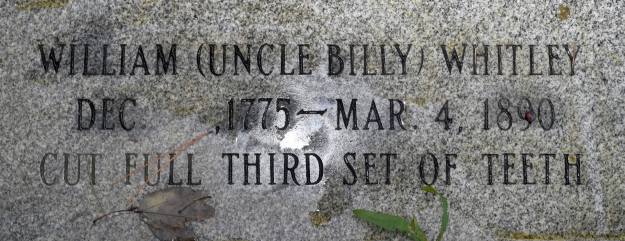
John Dick, the son of Joseph and Catherine Dick, owned land in the area of Bear Creek and Ramsey’s Branch adjoining the Burris family and others. This land owner is surely the same John Dick who married Martha Hathcock, the daughter of Benjamin. Following John Dick’s assumed death ca. 1820, his widow Martha married second the colorful William (Uncle Billy) Whitley who is believed to have lived to the age of 115 years. Both Martha and William Whitley are buried in a family cemetery off of Garmon Mill Road.billy

The children of John Dick and Martha Hathcock are:

1. John Dick – married first Sylvia Springer and then Susannah Hathcock.
2. Sarah Dick –married David Wright Burris upon whose land Pleasant Grove stands and where he is buried..
3. Sophia Dick –married William Burris and assumed  buried alongside her mother.

Looking back in time, I ponder the path taken from France by the elder Catherine’s husband Joseph Dick. Did he move south alone and by himself? Did he have family nearby? There is a John Dick who lived and died in Orange County North Carolina. Items sold at his 1792 estate sale looks like what might be found in a store or on a peddler’s wagon. Could this John be the father of Joseph Dick? This story needs further exploration

THE WEREWOLF OF RICHMOND COUNTY – A LESSON FROM EARLY AMERICAN POLITICS

bloodmoon
Last Friday I visited my favorite place in Raleigh to pull a 1799 petition in support of a post I’d recently seen on the Stanly and Montgomery County, NC Facebook Genealogy page. More on that later. As always, one search opens the door to another and on this particular visit to archives I found seven or so relevant petitions read before the General Assembly … Bonanza!

One of the petitions was absolutely the longest I’d ever seen and from a quick glance, the paper also appeared to be the most bizarre I’d ever read. More on that later, but first there was the unusual weekend that followed.

It rained hard on Saturday followed by a sudden and severe drop in temperature. The skies cleared late in the day on Sunday with temperatures dropping into the teens. That night we planned to join at a friend’s house to watch the much hyped Bloody Wolf Moon, the brilliant rare red moon occurring during totality of a full lunar eclipse. It was awesome, everything we had been told and more. The small group huddled in a front yard and watched in wonderment thinking what it might have been like in days of antiquity.

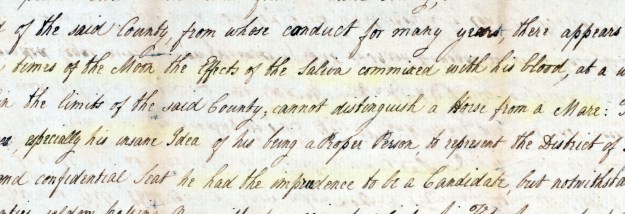
Back home and then on Monday morning, cold air settled in while I buried my retired self at home digging into that crazy petition. The four page double sided paper quickly opened up with the accusation that “Mr. McFarland feeling at certain times of the moon the effects of the saliva commixed with his blood, at a wound received in an encounter, which he formerly had with a mad wolf within the limits of the said county, cannot distinguish a horse from a mare.” Truth! …that’s what was presented to the General Assembly by a group from Richmond County.

The memorial or deposition of sorts continued that “the same cause is to be attributed many of his eccentric ideas and artifices especially his insane idea of his being a proper person.” It’s at this time the reader begins to realize the petition is really a complaint concerning practices of politics. The mad wolf was really an overzealous politician whose methodology was deemed out of place if not illegal. It’s also possible this was a well-placed hack job on a candidate who had won fair and square.

In this post I’ll step away from any politically leanings maybe hinted at in the document presented. But, realize in 1799, like now, there were real concerns with the manner in which our newly formed government behaved. It’s my belief things have changed only little with similar ideas still empowering present party politics to a whole new maddening level.

Some look at me with glazed over eyes when I tell them I dig genealogy and family history. It’s reading papers like the following that keeps me coming back for more. You can’t make it up. Who’d have thought that I’d have the chance to find such an article a day or so prior to the rare appearance of a big red wolf moon:

To the Hon’ble, the Senate of the State of North Carolina,
in Session in Raleigh

Memorial from the County of Richmond in Senate November 26th, 1799
read & referred to the Committee of Privileges & Election
by order M. Stokes, clk

The Memorial of sundry of the inhabitants of the County of Richmond is most respectfully presented in favor of Mr. James Sanford the present member in senate from the said county, and in order to make known some of the proceedings and designs of a certain Duncan McFarland of the said county, from whose conduct for many years, there appears sufficient reason, to believe that the said McFarland feeling at certain times of the moon, the effects of the saliva commixed with his blood, at a wound received in an encounter, which he formerly had with a mad wolf within the limits of the said county, cannot distinguish a horse from a mare: To the same cause are to be attributed many of his eccentric ideas and artifices, especially his insane idea of his being a proper person to represent the District of Fayetteville in the Federal House of Representatives, for which important and confidential seat he had the impudence to be a candidate, but notwithstanding the extreme eagerness with which he pursued the election in several counties, seldom passing one without calling to solicit his vote, he was treated with the neglect he deserved and fortunately for the District, lost his election. quote

Enraged at his disappointment, he had recourse with redoubled diligence to his former mad project of endeavoring to govern and yoak the good citizens of this county to attain that end, he was almost continually going to and fro, up and down the said the said county seeking whom he might deceive, and in order to carry his said governing and yoaking schemes into effect, he renewed his system of terror, which he had first began in his own neighborhood with a deserter from the British army, by the powerful and of this Worthy armed with his implements of conjurations sieve, shears, and Bible, he, (McFarland) convened at or near Major Carmichael’s in the said county, a considerable number of men and women, chiefly honest well-meaning North Britons many of whom not understanding English and then and there the said McFarland assuming legislative and judiciary powers, formed a new —?— which was administered to most of the said North Britons, each of the said people having one of their own hands on their own heads respectively and their other hand under the sole of one of their own feet, and in that situation were made to swear by “Devoting all to the Devil between their two palms” or in words nearly to that affect, if “they did not answer truly to the questions to be asked them” such as “Did you not take the juice out of McFarland’s corn-stalks in his field?” Did you not bewitch his “butter and take the milk from his churn?”  “Did you not bewitch the said McFarland? Did you not harass him by appearing to him in several frightful forms” and “made his pursuits in the shape of a snake by vanishing in the dirt when he had a stick uplifted to kill you &c” or in words of nearly the same purport the distress of many of these absurd people was extreme for when and accused, there was no escaping, their solemn denial of the absurd charge, on the oath imposed on them did not avail, for the infamous auxiliary having had his due, caused the ever unnerving judges, his terrific sieve, shears and Bible to find the unhappy persons guilty; Such was the tyranny of the said McFarland aided by his said associate, full worthy of himself, who he found so well to answer his purposes in many respects, and more especially to help him to keep most around him in superstitious awe, that he ventured, to begin to punish some of them deemed guilty, and now assuming the executioner, not by proxy as was usual with him but, in person actually assaulted two defenseless women Sibyl McDaniel and her aged mother and with some offensive weapon wounded and drew blood from both above their eyes, with avowed intent of thereby baffling the Devil and forever after preventing the said two helpless women from doing him further harm or mischief by their sources; the said McFarland was, soon after, found guilty on two indictments and fined by the court of the said county for the two said assaults, and after making use of every subterfuge he was made to pay smart money for the same in the district court, to the no small diversion of the Inhabitants of Fayetteville.

-The said McFarland has for four or five years past, employed several months previous to each annual election, in canvassing the said county in a manner so unprecedented, persevering and determined as gives room to believe that he neglects every domestic concern and makes canvassing his sole business, his primary object having it continually in his view as his polar-star to conduct him ultimately, to the end of all his mad politics, namely to his often declared intention of governing and yoaking the citizens of the county but finding it not to answer his present purpose, he denies having had the intention of yoaking the people generally and now threatens to yoak only “such as Governors and Generals.” Your Memorialists do not remember of the said McFarland having yoaked any of the states generals, but they well remember, that reports, not by any means kept secret, have for years been talked of in the said county that the said McFarland was at Hillsborough with and did assist the infamous, cruel and savage British Colonel Fanning in capturing, plundering and carrying off our late Governor Burke to the British Army in South Carolina.

–The said McFarland attends almost constantly at every election when he is a candidate as well while the votes are going in as when called out of the ballot boxes, and usually enters the names of all or many of the electors on different lists, in a little book, by which means he generally knows how they vote and often injures them who do not vote for him either by force or low cunning, this last being his strong-hold makes him to many ignorant poor men truly formidable. Sometimes he assaults openly those who do not vote to please him, others he binds to the peace, then aggravates them until they curse or swear inform against them, by which they are obliged to pay money that they cannot well spare; others he will have before a Magistrate for little or not any cause, and sometimes when his Vietem (Venom ?) he by his control over John Bounds Esq. prevents the papers from being returned to the court of the said county, others the said McFarland will have indicted on various frivolous presets or entangle with suit in the said county court, and he perceives his testimony is not sufficient or from any other cause that he cannot succeed, he then works his warried antagonist with such skill and severity in arbitration that the said McFarland seldom, by one means or other fails of success. Others are worried by written penal agreements, one of these one-sided agreements caused the loss of freedom for a time, to a free young man of colour, who the said McFarland bound to himself by indentures for a term of years, while he had the said young man of color prisoner and was himself conducting the said helpless poor young man to the common goal of the said county by virtue of an execution, believed to have been, obtained for a sum of money forfeited on one of the said McFarland’s one sided penal agreements. Your memorials could enumerate many more of this, would be the congress man’s curious artifices, but they trust the aforementioned will fully serve to show how much he ought to be detested and with what an iron rod the said McFarland’s rules when he has either usurped or legal power, he has indeed carried on his system of terror so long and so perseveringly , that he has tired down many of the most ignorant of the electors to be submissive to his imperious will, that some of those whom he had formerly used all vote for him, and declare to others that “they vote for him because they hope he [will] do at Raleigh and that they would vote for the said McFarland to go to hell.” Some declare they vote for him because “They cannot have peace near him when he loses his elections” and may not this last account for any swearing they voted for him when they did not vote for him or did not vote at all.

–The said McFarland has lately compelled many ignorant electors to meet at several places in the said county by a pretended legal authority, or the voice of real or sham constables, or by both, to swear for whom they voted at the last annual election endeavoring thereby to determine by open and extorted votes , what should be done by ballot. This your Memorialists believe to be unprecedented and directly contrary to the spirit and letter of the Constitution, which clearly established the mode of ballot so friendly to the most useful and most numerous class of citizens. McFarland by this swearing made of election had has brought his long planned system of terror into effect, and notwithstanding the General Assembly long since repealed the act that appointed three different places for the election to be held in to said county and thereby determined that there should be but one place of election and that one at the court house: the said McFarland has continued by his said new mode, to have ten or more to believe that he neglects every domestic concern and make canvassing his sole business, his primary object having it continually in his view different places of election within the county. The said McFarland having gradually and by — undermined the Freedom of many as electors and being blooded by, what he calls, success, now with a coup de main strikes at the liberties of all these who may be his competitors, for of those men who may hereafter be thought worthy of representing the said county in Gen’l Assembly, not many will be found whose fortunes or inclinations will admit them to follow this electioneering McFarland over the whole of the said county again and again prior to any election and again after, ——? —– duly elected, to be dragged over the said county at his will wherever his ambition shall lead him, until the General Assembly shall meet and even then their seat may be contested by a man they must unavoidably despise, over whom conquest cannot be an honour. The said McFarland having thus laid his plans to use superior to all opposition in the said county, or in fact to the election annually whether the electors will or not, without any person to oppose him, has, to appearance, extended his views, in hopes, without doubt of extending his system of terror, talks big and much of his old regulars, and in the extreme height of this deliberate follies has dared to threaten, as Mr. J. T. Sanford can prove, that if he, the said McFarland is not successful at Raleigh a thousand lives shall be lost. Is not this threat in an oblique manner for your Hon’ble House & does it not, in a great measure confirm the opinion of the effect of the life of the mad wolf to have been well founded?

The said McFarland became a candidate for a seat in the senate in 1795 and then there were double and triple votes found in the senate box which to the best of your memorialists remembrance were not heard of before in this county at the last election may also justly be, that McFarland might charge Mr. Sandford’s friends with so doing and thereto enable the said McFarland to triumph by oversetting an election at which he could not be chosen. The character and conduct through life of the sitting member and his opponent McFarland are especially different, Mr. Sanford comporting himself in a modest manner, becoming a man who wishes for the suffrages of his fellow citizens, attends to his production farm, or when in company behaves with respectful difference, not soliciting a single vote, while the other candidate is prowling day and night all over the said county for weeks together, breaking at several musters if not at every one and with the most consummate assurance, asks and presses almost every man he meets to promise to vote for him, to this may be added that it appears by the deposition of Doctor Bishop that the said McFarland has promised to pay the aforementioned John Bound Esq. two hundred dollars for going round the said county with him to swear the electors and has actually paid a mare, saddle and bridle to the said John Bounds in part of the said sum. The Bounds certainly ought to be well paid for he while going their rounds appeared to be dusted to and under the control of the said McFarland.

– Your Hon’rble House cannot be pleased to the said McFarland’s company in senate after hearing the depositions carried forward by Mr. Sanford, nor can there be a doubt for a moment, in the breast of an individual. Senator of the unworthy man at whose instance the double votes and ballots or supernumeracy were put in motion.

—Your memorialists therefore hope that coming up to the spirit of the Honorable, the General Assembly, and therefore ought not to be admitted new evidence, and that your Hon’ble House will permit our senator Mr Sanford to keep his seat. Your memorialist pray, and will think themselves honored, to have their memorial ————(lost two lines of text)————————– before your said committee, which will serve to educate and to prove several parts of this memorial, and your Memorialists will not only forever pray in the usual style, but let your decision on this contested election be as it may. They will, as true citizens, obey the laws and cheerfully endeavor to support them at the hazard of their lives and fortunes.

Ja’s Terry, Walter Leak, Henry W. Harrington, John Wall, Sen., Eli Terry, Micajah Gainey, L Macalister, Wm Robards, Wm. Wall, Sam’l Sprawls, Mathew Dockery, Daniel M. Lauchlen, John Mathias, Moses Knight, John W. Dowel, Benj. Smith, James Pickett, John Clark, Benj-n Long (by concent), Tod Robinson, Solomon Sprawls, Robert Webb, Daniel Sneed, Laurence Everett, Edwine Ingram.

CLEAN-UP DAY


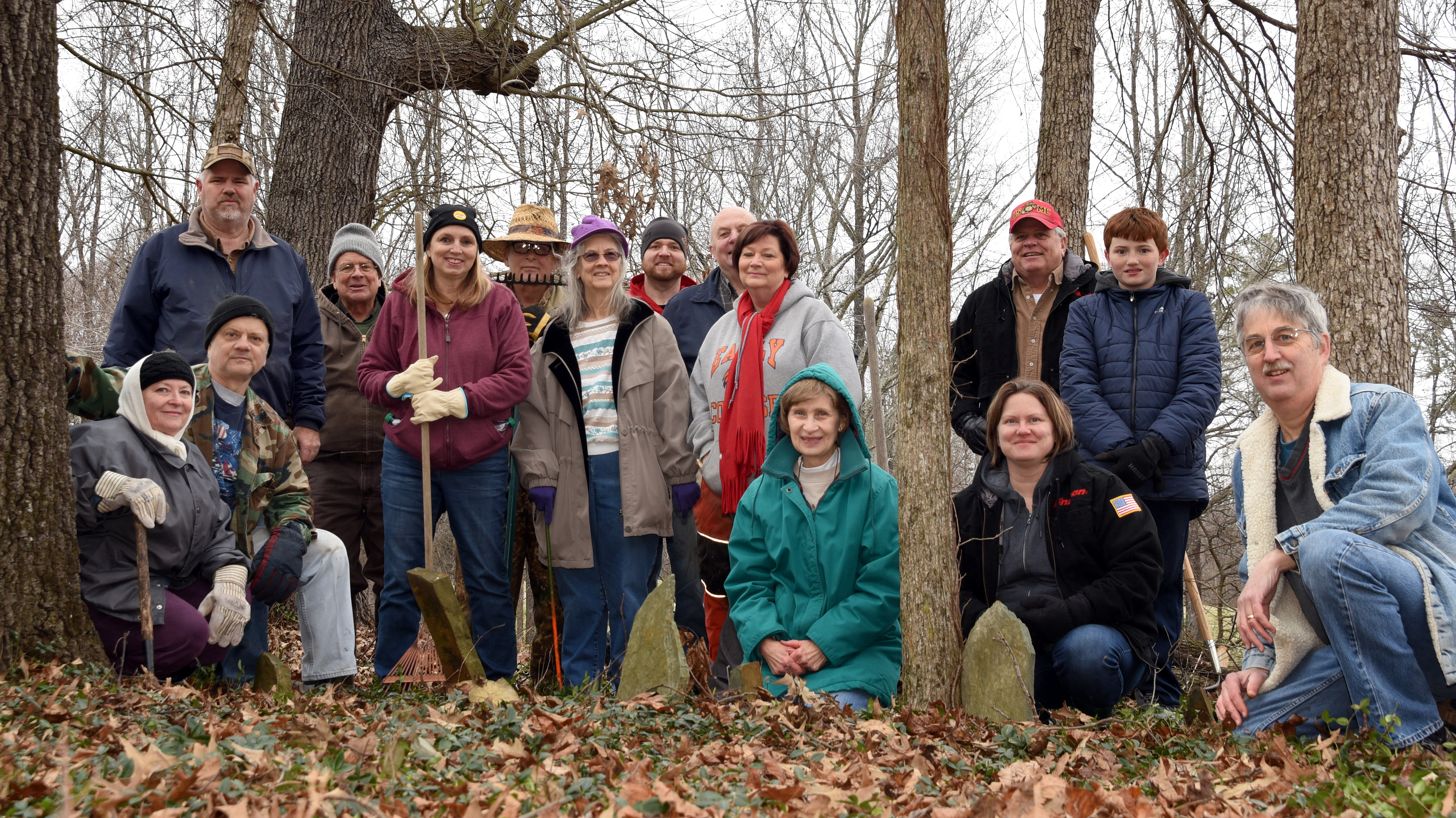
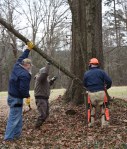
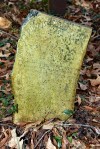
At this fall’s Burris Family reunion held at Pleasant Grove Baptist in the little town of Red Cross, a request for volunteers was made in order to clean-up the Commie Willis Cemetery. The location is east of Stony Run Creek where our earliest known ancestors Solomon and Judith Taylor Burris were once buried. In 1939 over 1000 descendants and friends came together for the celebratory relocation of Solomon’s and Judith’s graves to nearby Pleasant Grove Baptist Church. The move was made out of concern for security and the perptual upkeep of the old cemetery which was no longer owned by family.

The Commie Willis cemetery was left a few graves shy of its original size, but yet it is still hallowed ground. The cemetery remains the final home of other deceased members of our Burris family whose resting place is in need of attention.

Prior to the clean-up, I looked briefly at land records hoping to see more in print about the location we were about to work. I’m certain that the cemetery is located on the following but if not, it’s very very close. From deed book 3, page 20 in Stanly County, in 1850, William H. Randle deeded 226 acres to Kamy R. Willis. The land adjoined Stoney Run to the east, Deberry lands to the north, and Solomon Burris lands to the southeast. The deed included the following clause: “with exception of 26 acres which is reserved for the use of the widow Burris including the house and improvement which she lives during her lifetime.” Wow! Though this may not be Solomon’s original homeplace, I believe the widow Judith Burris lived nearby to be close to her husband. According to this deed, Judith may have lived out her life on 26 acres very close to the cemetery. At a later date I hope to provide a concise report on the location and originations of the Burris lands with emphasis on locating that spot where Solomon first called home. Fingers crossed!

Clean-up Day. This past Saturday, Jan 12, the clean-up day came and it was time to put in a little work. The day was boo-chilly and cloudy with forecasts of rain and sleet breaking out at any point. I had figured to receive an email cancelling the clean-up, but that never happened. That’s because our family is a hearty bunch and there were obligations to meet.

Gathering at the Eudy home on Ridgecrest road, our group of 15 or so were offered rides on the Eudy gator to reach the cemetery which was located near the bottom of an adjoining field. The support was great.

The cemetery was covered in vines of vinca, small shrubs, and numerous understory trees crooked and weak from lack of summer sun. The first task required pruning shear and a chainsaw to clear the grounds of unwanted shrubbery and trees. While this was going on, others sought out and recorded the old readable graves. Some of the stones had been knocked over presumably by wildlife, requiring a little work to upright. The old time technique of dowsing was even brought to task in seeking to locate stones hidden under years of decaying vines. Of this, it was duly noted that a future effort is needed to thoroughly probe the ground to identify stones lost from view.

And, here are a few of the stones in the cemetery. The Burris family seems to have used more symbolism on their stones compared to many in the area. To see much larger, click on “Full Screen” at bottom and then click the image again. The image will magnify. And, here’s a website site to help you understand the many images carved on tombstones.


At the end of the day, Paul Morrison, descendant and manager of the Stanly County Heritage Room, walked with Mark Eudy to a nearby spring (picture below). Lined with slate, I can imagine the old spring, and grandma Judith making her way there to fetch butter cooled by the free flowing waters. But the spring may not have been used as such back then. It may have been different. From a follow-up phone call to land owner Richard Williams, he remembered in the 60’s working with his father Cletus to line the spring head with slate.

Below are additional photos taken by Paul Morrison after everyone left. There are now corner posts to mark the cemetery and the grounds are cleaned, awaiting your pilgrimage to this, our family’s beginning. And to land owner Richard Williams and neighbor Mark Eudy and his father, we thank you sincerely as your caring attention to this little plot of land is near and dear to the heart of our Burris family heritage.

DAVID HARKEY: A LOYALIST’S FAMILY

Courtesy Archives of Ontario

We Americans like to ponder our patriotic roots, of being born to that generation of heroes, who, as we’d like to believe, served valiantly during the Revolutionary War. Walking the grounds of old cemeteries we gravitate to the old and important grave stones. I’m talking about those old ones accompanied by bronze shields indicating the interred served in the Revolution. But, our collective family is much broader than what we’d like to believe –they really were a mixed lot. Resting among those old graves are also the bodies of men who never betrayed their homeland. They remained English to the bitter end. And, there are also those of non-English heritage who bought into and gave aid in defense of the King. Beyond the life and death of all this, of soldiers from all sides, cemeteries are filled with generations of descendants whose stories are not complete without the retelling of some ancestral stance taken during the transformative war years.

My last post was about Flat Rock Lutheran Church in present day Stanfield in western Stanly County NC.  Before 1841 Stanly County was part of Montgomery County and prior to 1778 Montgomery was part of Anson. There are but a handful of records remaining of the long forgotten Lutheran church. As luck is sometimes good, these few remaining documents are from the very important first years. Appearing in the 1830’s and 40’s records of Flat Rock Lutheran Church, nearly half of the names on the surviving membership list are marked with plus signs indicating persons who had “move away.” Unique and a nice surprise, these were people who had left the church to move west beyond the lands of old Montgomery County. Where did they go? Yet unclear as to the exact reasoning why, almost all of those who left the little church ended in Pope County Arkansas.

Finding the names Isaac and David Harkey on the old church membership list made my imagination go wild. That’s because of what I know of their grandfather and of the curious devotion they must have reserved for him. Even though their grandfather served among North Carolina’s most known Tories during the Revolutionary War, every such grandchild would surely be both troubled and yet driven to do their best in understanding the life their grandparent lived. For me it’s a lesson not to judge too deeply as I was not there. It really was a family affair and it was they who felt the sting of American justice.

Isaac Harkey married Maria Phillipina Shinn and David married her sister Elizabeth Shinn. Leaving with the others to Arkansas in 1839, we learn more from the sisters’ younger brother Silas Monroe Shinn who also made the trip. He penned a fabulous personal memoir after journeying to the California gold fields during the 1840’s rush. Silas tells of being born in Montgomery County, of his widowed mother’s struggle to maintain the family, and of his own quest in search of the one true religion. Also gleaned from the memoirs, we learn of Silas’ brother Thomas Jefferson Shinn and of his trip to Pope County Arkansas where family from all over met to attend a reunion. On his way back home by train, Thomas J. Shinn suffered from a stroke and died soon after his arrival in Charlotte. He’s buried at the old Tucker Methodist Cemetery not far from Flat Rock Church cemetery near the river crossing at Hagler’s ford.

Like their wives, we know that Isaac and David Harkey also had interesting roots in Montgomery County. It’s believed that Isaac and David are sons of George Harkey who once lived in Montgomery County. Not far from Flat Rock Church, being just northwest of the present day town of Locust, in 1802  their father George Harkey received a land grant and deeded land adjoining the properties of nearby Reed gold mine:

Lands of George Martin Harkey

Tract A: Grant #196, Cabarrus NC, issued 5 Dec 1800 to John Reed being a combined three entries making up 330 acres surrounding Grant # 3325, Mecklenburg NC (in red) issued 2 Nov 1784 to Frederick Ciser, being 30 “in the forks of the first Meadow Creek where Killone Wagon Road crosses it in tract no. 5.”

Tract B: Grant # 401, Cabarrus NC, issued 6 Dec 1809 to John Reed, being 88 acres on the waters of Meadow Creek joining George Harkey and John Tucker land. Chainbearers: George Harkey, John Barba.

Tract C: Grant # 307, Cabarrus NC, issued 26 Jul 1804 to George Harkey joining Thomas Berry, Thomas Maynor, John Reed and his own lands. Chainbearers: Leonard Cagle, Daniel Perry.

GRAY CROSSHATCHED AREA Deed 14-41, Cabarrus NC, 13 Nov 1815. Jno. McLellon, High Sheriff to Lewis Tucker. Being 115 acres sold by virtue of an execution issuing from Cabarrus County against Silas B. Shinn for a debt of $2.25 which sum was collected by James Love.

Deed 12-360, Cabarrus NC, 13 Mar 1812, prv’d Oct 1831. Silas B. Shinn to David Karr of Mecklenburg. Situated on Meadow Creek and adjoining Paul Furer, Dan’l Boger, and Henry Wilhelm.

On 1 Jul 1821 and probated Oct 1828, George Harkey wrote  his last will and testament witnessed by John Barba. This is a copy from the typed Will Book A housed at NC State Archives:


George Harkey does not name his children but does name Mary, his wife. Showing that Mary too made the trip west, she appears in the 1850 Pope County Arkansas census as living in the home of her apparently single son named John. With them are John’s two unmarried sisters Elizabeth and Catherine:

Looking beyond George Harkey, this post begins in earnest with the life of his father David Harkey. This would be the grandfather of Isaac and David who left the congregation of Flat Rock Lutheran Church for Arkansas. As is well documented online, we know that the elder David Harkey joined and was loyal to the British forces. He followed them all the way to their defeat at Yorktown and even moved beyond to live a new life in Nova Scotia.

Seeking to lay my hands on the records from which such story is based; I visited North Carolina State Archives where I was shown the collection from the English and British Records Office that was officially hand-copied in London ca. 1902. What I’m about to show is not the original, but is my copy of a 1902 hand written official copy of the originals.

Outlining his services and losses as an American Loyalist, the claim by David Harkey is comprised of four pages. Written during late winter of 1786, David Harkey’s memorial states that he lately lived in New Montgomery in the State of North Carolina. I like that. For him, the county was new as it had been recently formed during the Revolutionary war period. Today, to me and many others, it’s old Montgomery County.

David Harkey joined the British Army in 1780 under the command of Lord Cornwallis and raised a company in the Commissaries department for which he received a commission. He was in actual service until being taken prisoner at Yorktown in Virginia. The memorial was completed and signed with his mark “David (x) Harkey” at the City of St. John, Nova Scotia on 9 Mar 1786.
Losses sustained by David Harkey “during the late unhappy dissentions in North America” are outlined on the next page. Totaling £1133, the accounting included reparation for services, livestock, wearing apparel, riding gear, and eight acres of Indian corn.

Completed on 17 Feb 1787 at St. John, Nova Scotia, David Harkey provided evidence of his claims. He stated that he arrived in Nova Scotia on the second fleet and went up the river before the winter. He came back down, never hearing a word, until he heard of Captain Vanderburgh. From there, David repeats his statement from the memorial adding that “he raised a company of Militia in the backwoods.” “His men were defeated, he made his escape himself and joined the British in Campbeltown [Fayetteville].” He stayed with Lord Cornwallis until taken prisoner. He had 25 men under him and was 19 months a prisoner at Yorktown. He now lived in Grand Bay. David Harkey produced a letter from George Stedman to show he was in the Commissary department. “He had 300 acres bought of George Crowell in 1779 for £60 and house, -his wife and children were driven off and land sold.”  <<<<< that’s a huge clue!

Continuing onto the last page of his claim, David Harkey states that all were left behind when he joined the British. David Harkey produced a certificate from David Fanning received on 7 Feb 1787 at St. John, Nova Scotia. Fanning stated that he knew of David Harkey and believed him to be a Tory. David Fanning, North Carolina’s most well-known Tory, led many skirmishes throughout the piedmont of North Carolina. Also included, Henry Underwood claims to have known David Harkey while David served in the Commissary department. Henry “heard he [David] had been raising militia before he came to Lord Cornwallis, heard he had lived very well and had a pretty plantation.” 

So, exactly what is a Commissary Department and what kind of service did David Harkey provide? An explanation of this can be found in the following two page status report outlining the commission or payment to which David was entitled and had yet to receive. Apparently David Harkey was paid to “collect cattle and sheep for the use of his Majesty’s army for which service he was to be paid 4/8 sterling a head for cattle and 2/11 for sheep – that he and those under his command drove to the army at different times two thousand and four good cattle and six hundred and seven sheep – which at the rate aforesaid amounted to £556-2-5.” “That the accounts of cattle so drove were kept in Mr. Stedman’s books who secreted himself from fear of ill-usage from the enemy upon the taking of Yorktown which was the reason why Harkey never received a certificate of the number of such cattle and sheep –but instead of it got the account marked “A” taken from Mr. Steadman’s books by Benjamin Booth another commissary to the Army –that he was taken prisoner and deprived of the warrant above mentioned and other papers –and that he only recovered the same papers marked “A”. Andrew Horne and Thomas Hale swear that they were employed under Harkey and that the said account “A”, to the best of their knowledge and belief is just fine and exact.”
2004 cattle and 607 sheep? The above makes me wonder to what degree livestock was commandeered versus being purchased? To some degree I suspect livestock was simply taken from the unknowing and from those openly against the King. But seems such actions would also not advance the favor of those sympathetic to the British cause. I imagine Mr. Stedman’s stance was well founded and can imagine the dislike for him, …and David Harkey, lived on after the war’s end.

The minutes as shown relating to David Harkey’s claim include a final determination which was made on 21 Feb 1787. It reads simply as follows: “The claimant is a Loyalist & bore arms in support of the British Government.” From this it appears David’s service was validated and that his claims were acknowledged.

What happened next and what did David Harkey do with his new life in Nova Scotia?  We know that David Fanning, who provided certification in support of David Harkey’s service held political office in St. John but was really detested by the local establishment. At one point Fanning was  charged with rape for which crime he was exonerated. David Fanning moved across the Bay of Fundy to the little town of Digby where he lived out his life operating a small fleet of ships. Interestingly, the next town up the coast from Digby is named Cornwallis.  And, today, David Fanning’s North Carolina blood stained bayonet scabbard is on display in the local museum. Did David Harkey leave such a legacy?

As has been widely researched, other websites tell of David Harkey receiving a grant for 200 acres in the county of Sunbury, Nova Scotia. They go on to say that the land was subdivided among 22 other loyalists. Making it less than 10 acres each, I’d have to believe this is in error as that would only provide ten acres per claimant. Another site  states that “on August 11, 1784, he [David Harkey] and 26 other Loyalists were granted 4,400 acres by the British Crown, said tract was situated on the northern shore of the Bay of Fundy between Musquash Cove and the mouth of St. John River.” David Harkey received lot #19 consisting of 200 acres. There were 22 lots of 200 acres each. If the latter scenario is correct, then David Harkey’s land was situated somewhere between Musquash Cove and the Mouth of St. John’s River as pinpointed on the map below. However, at that time the history as it’s told online reaches a dead end. There is nothing else published on whether or not David Harkey stayed put on his land. Did he die, freeze? Was he enveloped by the great tides of Fundy? The story pretty much ends there.

Looking back at David Harkey’s Loyalist claim, there’s two points that need to be mentioned before I close. Arising from David’s claim that “he had 300 acres bought of George Crowell in 1779 for £60 and house, -his wife and children were driven off and land sold,” is there any evidence that the believed George Harkey (and others?) is/are the offspring of David Harkey? I have not found the proof if there is. Circumstantially, George Harkey is of the right age, at the right place, and right time. And, as for David’s land bought of George Crowell, do we know where it was located? Where had David called home in his New Montgomery? Somewhere not too far from Reed mine I believe David was forced to give up his land. He left behind his wife and family to join the British army. As a result, his family was driven off the land, having to start anew.

This past week I visited NC State Archives and looked through the confiscated Loyalists’ lands recovered and sold in Anson, Montgomery, and even Rowan County. I found nothing. Unfinished business, I hope my future effort in platting lands in Montgomery County will yield some deeper clue as to how we might find David Harkey’s North Carolina homeplace.  If George is his son, which he likely is, then David’s land should have been situated somewhere nearby. Where was George Crowell’s land and where did he live? Somewhere there’s a record of 300 acres that was later taken up by somebody new. There’s still lots to ponder and that’ll hopefully be the basis of a revealing story told some day in he future.