Christmas doesn’t begin until the candles have been extinguished and the congregation ups their collective voice in singing “Joy to the World.” Every year, a high point for my wife and I is in joining my mother and her church family at the 11:00 pm Christmas Eve service held in Terry Chapel at Dilworth UMC. There’s no better medicine for the heart than holding to the ones you love while rejoicing the birth of Christ.
This Christmas was no different. Coming in from the cold, the small chapel slowly warmed by the gathering crowd. Greetings were extended and the chatter of spirited conversation grew as the worshipers took seat. We sat in front of a mother and her son. She told of him just coming from the Moravian church and shared his excitement in experiencing his first Moravian Christmas service. I so wanted to hear more and to tell stories about my family’s connections to Wachovia and the Moravian Church. But this was Christ’s night and the service was about to begin.
We all come to Christ in our own way and time. Sometimes I wonder how God feels that his people worship in so many traditions. I’ve also wondered about church in the olden days and what the journey to Christ might have looked like in early America.
_____________________________
In the late 1990’s, my mother and I made a trip to Pope County Arkansas to a place where much of her family from Cabarrus County NC relocated in the late 1830’s. Though we had read the stories and knew most of the records, there’s nothing like being there to experience the land and communities of family so far away.
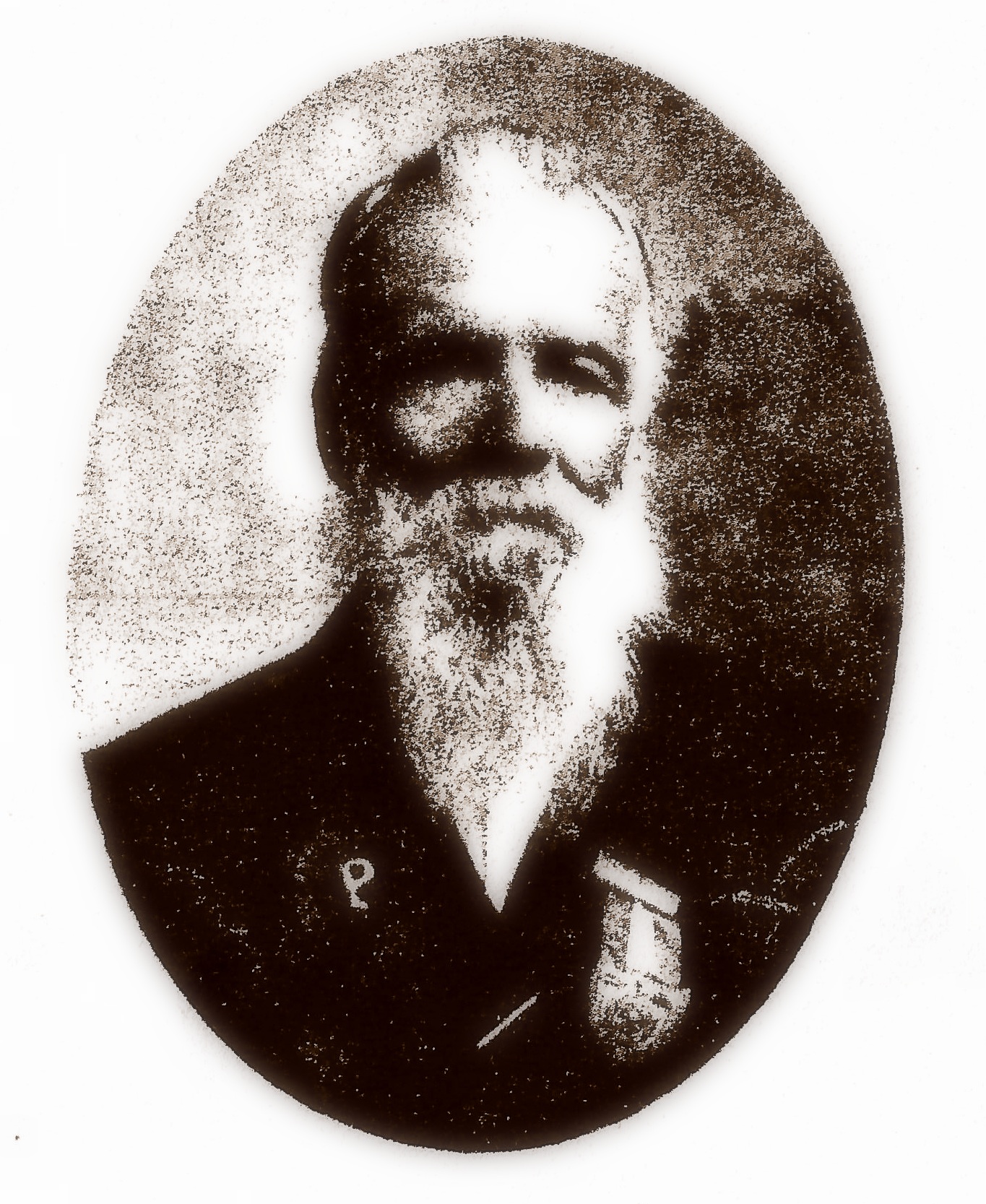
– Silas Monroe Shinn
While going through the local library, I came across a really interesting memoir written by a homeboy from Cabarrus County who made the trip to Arkansas and then even further to California. Silas Monroe Shinn along with three others joined a wagon train to the gold fields in 1850. Reading like an action movie, Silas’s story tells of an escape from Geronimo, the loss of their wagon and horses, the crossing of the desert, and the trek through the Sierra Nevada’s. The story really was exciting, though a chapter titled “Religious Experiences” offers a rare glimpse into the young man’s search for true religion. The chapter reads:
My children all married. We have only three children but we have twenty-one grandchildren living and twenty-five great grandchildren and three great-great grandchildren.
Wife died October 18 1908, since which time I have been living with my youngest daughter, Fredonia, until January 14, 1910, when I came to Healdsburg where I am now living with my second daughter, Mary.
I have written the foregoing scenes and reminiscences of my life for the satisfaction of the children and grandchildren and great grandchildren. I greatly miss her love and companionship. I have hurriedly written these sketches. There are perhaps other items omitted which if written would be interesting. But I might follow this with another side of my life’s history-my religious thoughts and experiences beginning back at my birth and early life.
I was born November 18, 1821, in Montgomery County [now Stanly], North Carolina. I was the seventh son of Silas B. Shinn and Elizabeth B. Shinn. Father died before my earliest recollections. Mother was left with ten children to feed, clothe and school. She was left unprovided for, and, under the circumstances, she had a hard time of it. She could not spare the children to go to school after they were large enough to work. So they were kept at home to run errands and to help earn a living. At that time in that country, there were no public schools, only now and then a subscription school. If mother subscribed she had to pay whether the children were able to go or not. If they started to school and an opportunity of earning something presented itself, she took them out of school. Of course they picked up a little learning here and there. They all learned to work and all got along fairly well. All had a natural ability and stood well in the several communities in which they lived.
Brother Ransom, the oldest, had a good farm and several negroes. When the war came up he lost everything. He was elected “Just of the Peace.” Brother Jackson was killed as he was growing to manhood. Brother Thomas J., the third son, also did well. He too, owned several negroes, but lost all in the war. He was elected to the state senate legislature from Stanly County, N. C. Brother Madison, fourth son, was also elected to the legislature from Pope County, Arkansas, in 1948. He also lost everything in the war. He was a Methodist preacher when he died. Brother Littleton, fifth son, was also in good circumstances. He was elected Justice of the Peace. Brother Nathaniel Duncan, sixth son, was also in good circumstances, and was also elected Justice of the Peace, County Judge and later to the legislature. He died in 182.
And now myself, Silas Monroe, who came from North Carolina to Arkansas in the year 1839, married there November 18, 1841, to Letitia L. Maddux, with who I lived in love, peace and harmony for nearly sixty-seven years.
My brothers were all religious men, as were my three sisters. When I was about eight or nine years old, I went with mother to a camp meeting. There was quite a demonstration of spiritual power. I was convinced of the truth of what many called heart felt religion and thought when I was old enough I would keep that kind of religion. Time passed on. I tried to be honest and truthful. When I was about fourteen or fifteen years old, I attended a school conducted by a Lutheran minister. At its conclusion, I joined the church, thinking I would yet seek the heart-felt religion. Time went on, yet I frequently had the thought of seeking that religion, but putting it off from time to time. I don’t remember that I mentioned my intention to anyone.Then we left North Carolina and moved to Arkansas, I was in my eighteenth year. There were no Lutherans in Arkansas at the time. One day I was by myself, and the thought of my purpose came over me. I felt that I had already put it off too long, and I then determined to attend to the matter at once. I went out and hid myself in the top of a bushy tree that had fallen and knelt down and tried to pray. The tears gushed from my eyes and I could not pray much. I felt afraid that someone would see me. However, I told the Lord that I had now made a start for the true religion and asked Him to keep me from being deceived. I wanted the genuine religion and no “fox-fire.” I outlined a plan to follow my seeking. I would go off to myself every day and pray. I would read the Bible and other good books. I would try to keep myself to my purpose of seeking until I had obtained that which I was seeking. I would not tell anyone of my purpose, but would keep it strictly to myself-yet if I had the opportunity of talking with devoted en on the subject, I would avail myself of doing so.
Well I believe I followed out my plan without a break for about three or four months, but it seemed that I was no nearer the goal than when I first started. That thought was discouraging, but I determined to persevere. I decided to change my plan in one particular; that was, I would let my purpose be known under certain conditions. There was a two-days Methodist meeting to come off only a mile from where I lived. I decided to go to that meeting and if there was a call made for those who wished to seek God and the forgiveness of sins, that I would go forward and ask the prayers of God’s people. That night service was held in my brother’s house as there was not at that time any church building. I went and found the house was crowded so I took a back seat, almost behind the door. I leaned on my elbow. In that position I went to sleep, but was awakened by the congregation singing. I did not know if the seekers had been invited until I saw the young girl, whom I had been paying attention to (who afterwards became my wife) go forward to the seat indicated for the seekers.
Well I just concluded not to go forward at that time, lest the people would say that I went forward because my girl did. But it soon came to my mind that I had promised the Lord I would go forward if there was a call made; the call had been made, and I had lied to the Lord. I wept sorely over not keeping my promise to God, but it was now too late. There were no more “Calls” during the remainder of the services, but I promised myself and the Lord that if I ever had another opportunity I would not again be caught asleep, nor would I follow another, but would be the first to go forward.
Now I think that it was two or three months later that there was another camp-meeting within about four miles of my home, and I promised the Lord that I would attend that meeting and go forward to each and every “call” for seekers. Well, I did go, and went forward at every call until the meeting was out and I had not yet found any religion. I felt very bad about it. Many declared to have been converted, and some were among my particular friends. There was another camp-meeting two weeks later, twenty miles away. I determined to avail myself of that, as the last opportunity, and would do all that I possibly could to obtain salvation. I attended and followed out my plan to be thorough on seeking, until I should find the blessing. I kept up until Sunday evening. When I was off to myself I concluded I had failed in my purpose, the meeting would soon break up, and I would just have to go back home without religion.
The question came to me: “Then what will you do? Will you give up?” I said “No.” I would go home, but would continue to seek all the days of my allotted life; even if I lost I would be on the line seeking. Then something seemed to ask me if I thought that if I followed out this plan of seeking, would I be blest. I said “No” then I felt safe. I laughed. Some of my friends were near me. I was unaware of their presences and they seeing me laugh, laughed also, and told me to get up and acknowledge it, for they knew that I had religion, that they could see it in my face. But I did not think THAT was religion I had been seeking and told them so, but they only laughed the more. They asked me: “Now where is that heavy burden you have been carrying so long?” I said I did not know. Then they continued laughing, saying: Oh, we can see it in your face. You cannot hide it. Do you feel the burden anymore?” I said “No,” and they praised and thanked God for my deliverance, but seemed amused at my seeming unwillingness to acknowledge it.
We went to the stand for the evening service. They called for seekers as usual but I did not go. I did not feel the least bit like going. I felt like singing and making melody in my heart to God. Yet still I would sometimes doubt that I had religion. The meeting was nearing a close. Some of my friends had already started home, but I stayed until the meeting was all over. Then I started home. I knew that word had preceded me home, and I expected mother to be looking for me, and likely she would be wrought up over the news that she might do a little shouting, and after all it might be a mistake. Yes, I felt that it might be a mistake, and I was sorry now that the news had gone out. They all seemed to be very sure of my being converted, but I was fearful about it.
When I rode up to the little gate, and got down, mother met me. She just put her arms around me and praised God and thanked Him. By and by she loosened her hold, and walked around the house, slapping her hands and uttering aloud many words of thankfulness. Then, it seemed to settle upon me for a certainty that I had no religion. Just then I think that if ever a man felt miserable I was the man. I had fooled my dear old mother. I had fooled my friends, who seemed to have so much confidence in my honesty, and lastly I had fooled myself. It was now in the gloom of evening. I asked a friend to go out with me. I told him all. I said: “You all told me that I had religion, but now I know it was a mistake, and I want you to kneel down here and pray for me.” We bowed down, but I got no relief. We returned to the house and mother had supper waiting. We sat down to the table, and I ate a few mouthfulls, got up from the table and went out. It was then quite dark. I was glad of the darkness. I withdrew a short distance from the house. I fell prostrate on the ground with my face down. I lost consciousness. I did not know how long, but when I come to myself I was as happy as man can ever be in this world. God’s visible presence in the form or a white halo was all around me. I felt it all around me. I felt it all through me, and for the first time in my life I said, “Glory! Glory! Glory!” Oh, it just gushed out of me: “Glory to God.” I then knew that I could never doubt any more, nor have I from that day. That was in October, 1841. I joined the Methodist church then, and have remained in the body ever since. Of course that was before the division between North and South. I remember that I regretted very much the division at the time it occurred and I still regret it. Even now I indulge in the hope of living to see the two bodies together again. I was in the South where slavery existed, but I was always opposed to it. I could never think it right to compel involuntary service from any living man, as I would not like to have any living man to compel it from me.
Well now I have been trying to live the life of a Christian for over sixty-eight years. My life has been faulty. I have not been as consistent as I should have been, but have continued to cling to the faith, although in muen weakness. I have no room for boasting of my Christian effort, but to humble me. I may say that I am ashamed of my lack of the ideal Christian life. Notwithstanding all my defects and shortcomings, and my many faults, and imperfections, I am still clinging to the Christian faith. I often feel the blessings of God –feel the soothings of His Spirit, and at this writing I still feel like holding on to the faith of Jesus.
I could relate some things in my personal experiences, somewhat wonderful, but I forbear lest people might think of me, above that, that they should. There has been enough weakness in my Christian life in the past, to keep me humble. But I think today I have great reason to be thankful to God that it is all well as it is with me. I might further add that my faith still clings to the promise of God. I feel more and more resigned to His will in all things, trusting in the merits of Jesus not my own righteousness. I have full and strong hope of Heaven and immortal life beyond the grave. Amen and amen. There seems to be much more unbelief and disregard of the doctrines of religion today than there was in my early life. When I was a boy it seemed to me that almost everybody had a proper regard for the due forms of divine worship. All would bow down on their knees in time of prayer. Nearly everybody attended church services whether they were members of a church or not. I am sorry that it seems greatly different to the claims of the Christian religion. There is much more infidelity, much more opposition and sneering at Christianity. Wickedness is exalted and is now found in high place. But I feel sure that there is a God.
The heavens declare the glory of God and the firmament showeth His handiwork. The truth of God’s word is established in my heart and soul, and remains the same forever. The principles of righteousness and unchangeable and eternal, and sooner or later all will have to bow the head and acknowledge God.
Many years ago, probably forty or more, I commenced to daily write something of my reflections and feelings on matters religious. This I kept up until it became monotonous, because of so much repetition. I dropped the matter, but today I could write about the same as I did then.
In the summer of 1890, the Shinn family held a family reunion in Pope County Arkansas. Silas Monroe Shinn traveled from his home on the west coast and his brother Thomas Jeffferon Shinn Sr did likwise from Cabarrus County NC. While on a train returning to North Carolina, Thomas fell weak and suffered a major stroke. He made it to Charlotte where he remained in hospital a short while before his death. Thomas J. Shinn is buried at Tucker Cemetery located on the south side of Rocky River: http://www.findagrave.com/cgi-bin/fg.cgi?page=gr&GSln=Shinn&GSiman=1&GScid=2197670&GRid=16750159&