Category Archives: Uncategorized

JJ: Finding Lost Love

In August 1877, Jno. C. Love of the City of Philadelphia Pa purchased the following tracts adjoining Reed gold mine and Rocky River:

• 30 acres of land from Aaron Linker and wife adjoining lands of “Moses Linker, Jackson Linker, Reed Mine Company & Rocky River.”
• An undisclosed amount of acreage from Aaron Linker and wife being “the tract of land on which they now live adjoining the Furr Garman Mining Company.” The land also adjoined that owned by Wm. Linker, and Jackson Linker.
• 60 acres (28-32, Cabarrus County NC) “on which I now live” … and joining Aaron Linker, and “the river at the mouth of the branch.”
• 154 acres from Geo. Barba & wife, being lands where Geo. Barba & wife now lives, adjoining the river, “a corner of the church,” “Reed & Hartsell’s corner,” and A. Hartsell’s corner.

These deeds found years ago stir deep thought as the lands must have been very near to that once owned by our own Grandsire James Love. Who was John C. Love of Philadelphia and did he relate to our NC family? Prior to opening the Charlotte mint, how was gold accounted in what must have been an arduous trip from Reed’s mine to the federal mint in Philadelphia? Was selling gold anything like selling hay; did we simply carry it in bulk, weigh it, and receive payment in money? Or, were there family or other agents in Philly who managed our interests? Of all places, why was John C. Love of Philadelphia buying land around Reed’s gold mine?!! The story of John C. Love is nowhere complete, though what we have reads like a classic southern tale. It even cracks the door open allowing us glimpses into the possible lives of other lost LOVE.

We know old Grandsire James Love had a nephew John C. Love who died much earlier in Stokes County NC. There’s no known descendants of our James by the name John C. Love; however, there was a John C. Love who enlisted and served along-side John E. Love, John J. Love, Jonah Askew Love, Michael Garman Love, James Wade Love and Postill P. Love in CSA Co. H, 42nd Reg NC.

On 30 Apr 1864, John C. Love enlisted as Private in Petersburg VA. He served under Capt. J. M. Hartsell and “joined from desertion Oct 18 1864 & deserted to the enemy Oct 29 1864.” A register of arrivals and dispositions of federal and rebel soldiers indicates J. C. Love was received Oct 30 1864 as a “Deserter from the Enemy” at Bermuda 100. From the register of rebel deserters taking oath, Headquarters, the Provost Marshall, Bermuda Hundred VA makes the following report. John C. Love was captured at Dept. Headquarters, Nov 4 186_ and confined at that time. On Nov 4 186_ he was turned over to Pro. Maj. Gen. at City Point VA with final remarks “To go to Philadelphia PA.” Looking at another paper, and on Nov 6 1864, charged as “Rebel Deserter,” Maj. Gen. U.S. Grant ordered that John C. Love be confined. He was sent on Nov 12 1864 to City Point where he was to be released. This by order of P. M. Gen Patrick. And again, the remark: “Went to Phila Pa.” Could it be? Is there a chance that this confederate soldier is the same John C. Love who purchased land in Cabarrus in 1877?

Poring through records from Stanly, Anson, Cabarrus and Union Counties, I found only one telling entry. The Jan 1867 minutes of the Court of Pleas and Quarter Session reads:

State vs. John C. Love
Suspended upon payment of costs.
E C. Griffin, Judgement of $50.

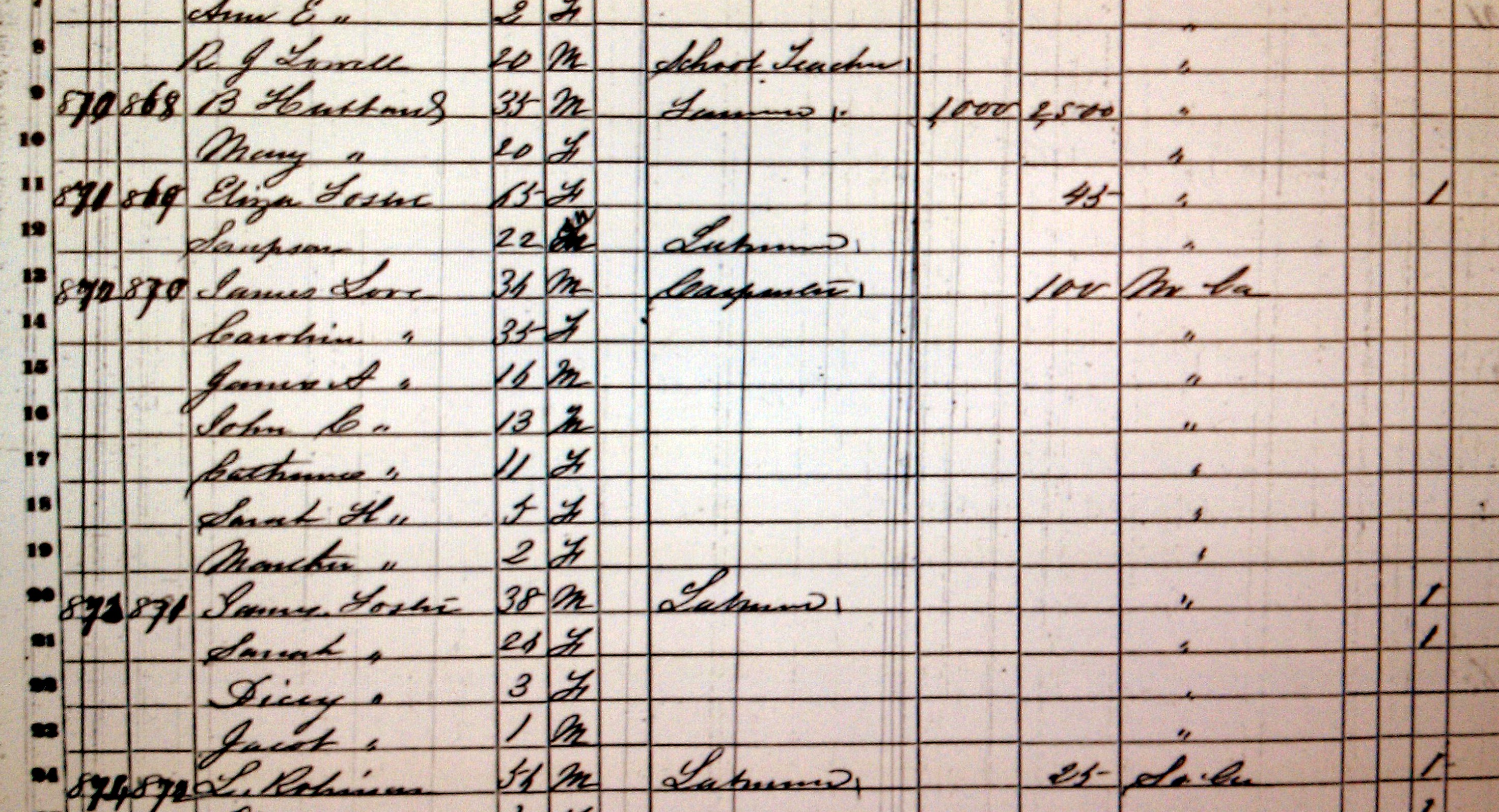
There was no mention of John C. Love in North Carolina census records, prior to or after the war. And though believing all LOVE in South Carolina descended from the likes of an early settler known as James the Weaver, the following census record from 1860 Jefferson Township in Chesterfield SC opens a door.

1860 Chesterfield SC

1860 Chesterfield SC

Born in North Carolina, James Love is listed as a carpenter living near the Brewer gold mine. The family does not appear in the county prior or after 1860. Note John C. Love, aged 13, would have sadly been of age to enlist in 1864. And also note that John C. Love’s father, (John) James Love is the same John J. Love enlisted beside John C. Love in the 42nd Regiment. More on the life story of John C. Love will have to wait for another day as the rest of this writing will be dedicated to the story of John James Love and other possible implications raised.

During and following the Civil War, J. J. Love and family first purchased land in Union County NC before moving to the Crab Orchard area of Mecklenburg. To my knowledge, there’s no further listing of son John C. Love in North Carolina. The family of J.J. Love:

Wife Mary Caroline Honeycutt Love, born 1823.
1. James Adam Love – born 1844, married Sarah Jane Griffin in 1866 Union NC.
2. John C. Love – born 1847 and is lost or possibly removed to Philadelphia.
3. Vicey Catherine Love – born 1851, married Churchwell G. Braswell 1867 Union NC.
4. Joseph Henry Love – born 1854, married Nancy Jane Harrington in 1874 Union NC.
5. Gustavus Beauregard “General” Love – born 1865, married 1882 Malinda Hinson.

Dated 28 May 1901, J. J. Love applied for a civil war pension claim. At age 78 and residing at Cluster branch post-office, he declared his service in “Co. B, 42nd Reg. NC. And in 1863, while in service at Seven Pines VA, he “received wound in left arm below elbow also on right leg.” Marking the death of John J. Love, dated 22 Jul 1904, 79 year-old Mary C. Love applied for widow’s pension while living in Rt. 2 Charlotte NC. She properly identifies her husband’s unit as Co. H, 42nd. Reg. NC. E. M. and Minnie Spoon witnessed on behalf of Mary’s claim. The following obituary marks the death of Mary just a few years later:

Obituary
Mrs. Caroline Love, widow of the late J. J. Love, died yesterday morning at 8 o’clock at the home of her son, Mr. J. B. Love, four miles from the city on the Mneville road. The deceased was one of the oldest women in, the county, being 83 years of age at the time of her death. She was a good Christian woman and had been for many years a member of the Hickory Grove Church. The interment took place at that church today. Mrs. Love is survived, by two children, Mr. J. B. Love and Mrs. Braswell, of Mint Hill.
23 Aug 1906 Charlotte News

Note that the death certificate for Gustavus B. Love indicates his mother’s maiden name was Honneycutt. Related or maybe not, there is a lost Love found in a bible record named Mary Fairly Love who married into the Honeycutt family. As with our J. J. Love, there are few to no records for Mary Fairly Love. However, there is also a person named John Fairly Honeycutt. In the tangle of Love, Honeycutt and Fairly is it possible there a possible family tie?
bible

Jesse Lee’s Preaching at Love’s Church

Please understand who I am and what drives me. I enjoy history, am a painfully slow writer and will only occasionally post on my blog site as I live with a work schedule that demands much of my time.

With that out of the way, let’s revisit an earlier post where, in October 1799, Rev. Jesse Lee and Francis Asbury spoke to a gathering held at Love’s Church in now Stokes County, North Carolina:

Monday 7. We rode through Stokes County, and attended meeting at Love’s church, which has glass windows, and a yard fenced in. After Jesse Lee, I added a few words on Hebr. ii. 1. We then came up to William Jean’s, near the Moravian Old-town. We have rode nearly twenty miles this day. Sitting in meeting so many hours among such a multitude of people, and frequently with a blister on my breast, with the difficulties of driving along broken paths, cause me to be variously tried and comforted.

It’s interesting that Asbury concluded the meeting with words on Hebrews 2:1

Therefore we ought to give the more earnest heed to the things which we have heard, lest at any time we should let them slip.

Beyond the assumed biblical interpretation, for us who study families and our history, it’s vital to listen well and engage in conversation that brings life to stories being told. Don’t merely seek to understand the prevailing thought, but make it real by taking time to learn more about the cast of players and how their mentioning adds to the story. From such perspective, I can only guess about Asbury’s sermon and how it related to the congregation of Love’s Church in the times that were. We can glean much from the Journals of Francis Asbury, but who was the above named Jesse Lee?

Jesse Lee

Jesse Lee

Born 12 March 1758 in Prince George’s County, Virginia, Jesse Lee experienced a state of grace in 1777 after which time he helped to bring Methodism to northeast North Carolina. Following the formal organization of the Methodist Episcopal Church at the celebrated Christmas Conference on 12 Dec 1784, Lee was requested by Francis Asbury to travel on a southern tour. In the piedmont of NC, while assigned to the Salisbury area, Jesse Lee preached to the Methodist community at the home of John Randle (known as Dumb John as he was deaf and could not speak). Located in present day Stanly County, Randall Methodist Church was formed. Jesse Lee is considered to be its fist “Circuit Riding Preacher.”

In 1789, Jesse Lee was sent north where he formed the first Methodist class in New England. He’s responsible for planting the seed of Methodism from Connecticut north to Maine. Remaining friends with Francis Asbury, Jesse Lee served as his assistant from 1797 through 1800. It was during this time that Lee spoke at Love’s Church in North Carolina.

Jesse Lee was appointed Chaplain of the United States Representatives in 1809 and then again in 1812. On 24 Aug 1814, Washington DC was tragically burned during the War of 1812. Following what must have been a horrific site, Jesse Lee was appointed Chaplain of the United States Senate a month later on September 27, 1814. He died in 1816 and is buried in Baltimore, Maryland.

In the short paragraph from Asbury’s Journal, there is mention of another person. Who is William Jean and how does he expand the story? More later…

Tried and Comforted

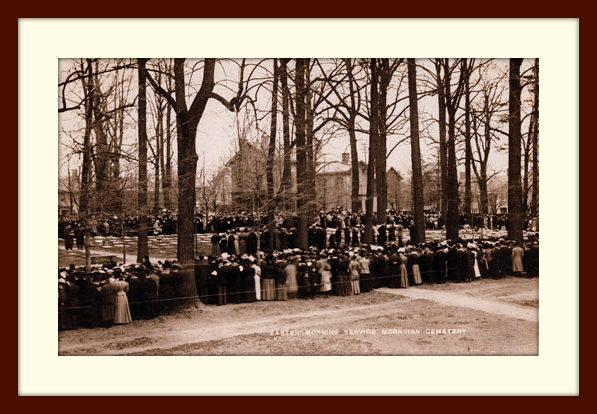
Sunrise Service at God's Acre, Winston Salem NC

Sunrise Service at God’s Acre, Winston Salem NC

“At five o’clock the congregation gathered in the Saal, and after the usual greeting went into procession to God’s Acre. The weather was fine.”

I can hear the proclamation by horns, the singing of “Christ the Lord has Risen Today” and the quietness of believers solemnly making way to the burial ground. And though the resurrection of Christ is celebrated similarly across our country, this was not your normal Easter. On 12 April 1788, the above quote was entered into diary by a Moravian minister in North Carolina’s settlement known as Wachovia. The minister continues his entry with the following:

Twenty-three Methodist preachers passed through on Good Friday on their way to Mr. McKnight’s to hold a Church Meeting as they call their conference, and stopped today on their return trip. The meeting had been called by Mr. Coke, who recently came from England to make a visitation among the Methodists in North Carolina. During the meeting seven deacons were ordained. They say that in addition to this church order, which is the lowest, they have elders (presbyters) and bishops. Mr. Coke claims to be a bishop, and this is confirmed by Mr. Astley [Asbury], the leading preacher and superintendent among the Methodists here. From here Mr. Coke goes to Virginia, where he has called a meeting and will make a visitation; and he will continue his work through all the states as far as New England. The Methodists make such visitations here and there each year.

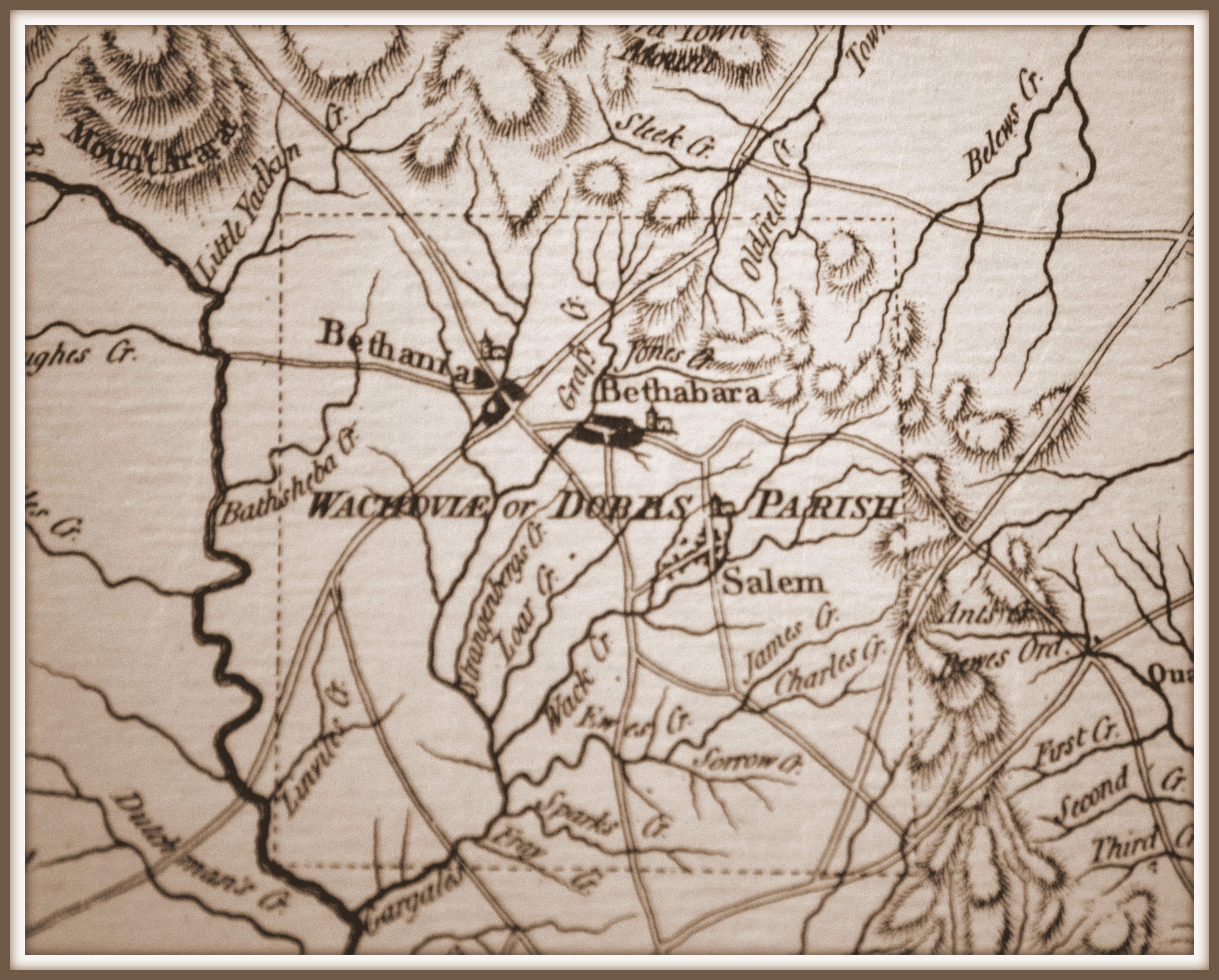
wachoviaBelieving they were about to be expelled from Germany, in 1754, the Moravian Sect under leadership of Von Zinnzenburg purchased 99,000 acres in western NC. Known as Wachau [Wachovia] in honor of the Wachua Valley of Austria, the land was subdivided amongst their own by way of church agent. Situated along the Indian Path that later became known as the Great Wagon Road from Pennsylvania, others, including Methodists, soon sought settlement on their tract. The Moravians were great keepers of diaries and other forms of social accounting. Much more about the growth of Methodism in our state can be gleaned by reading the volumes of Adelaide Fries’ Records of Moravians in North Carolina.

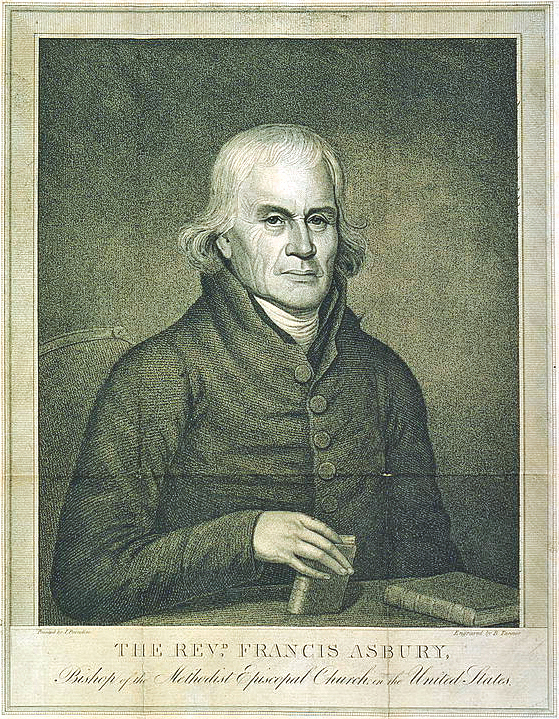
francis-asburyAnother wonderful source for understanding our past can be found in the Journal of Francis Asbury. We Methodists know well of the founding leadership of John Wesley, but it really was Francis Asbury whose journeys across the back country solidified our ways of worship. In October of 1799, while passing through the western wilds of North Carolina, Asbury writes:


Friday 4. We rode twelve miles to Mrs. Campbell’s, upon the south fork of Haw River. We had to work our way through the woods. Saturday and Sunday, I attended quarterly meeting at Bethel, upon Belew’s Creek, where I ordained five deacons, and preached from 1 Tim. vi. 11, 12.: we had a gracious time. We have rode only twenty miles in two days. I lodged at M’Daniel’s.

Monday 7. We rode through Stokes County, and attended meeting at Love’s church, which has glass windows, and a yard fenced in. After Jesse Lee, I added a few words on Hebr. ii. 1. We then came up to William Jean’s, near the Moravian Old-town. We have rode nearly twenty miles this day. Sitting in meeting so many hours among such a multitude of people, and frequently with a blister on my breast, with the difficulties of driving along broken paths, cause me to be variously tried and comforted.

The study of history and genealogy is much akin the journeys of Francis Asbury. We push forward on a broken path of records alternatively encountering  times of delight and torment. The Moravian records, along with this entry by Asbury, provide a wonderful wellspring of information from which new posts will flow.

Though the church of James Love has been identified, his life on earth will soon after end. His closing chapter will lead us in new directions. Future writings  will explore family, friends, church, and even an incredible walk by a man named Moses.

The Trail to Oregon

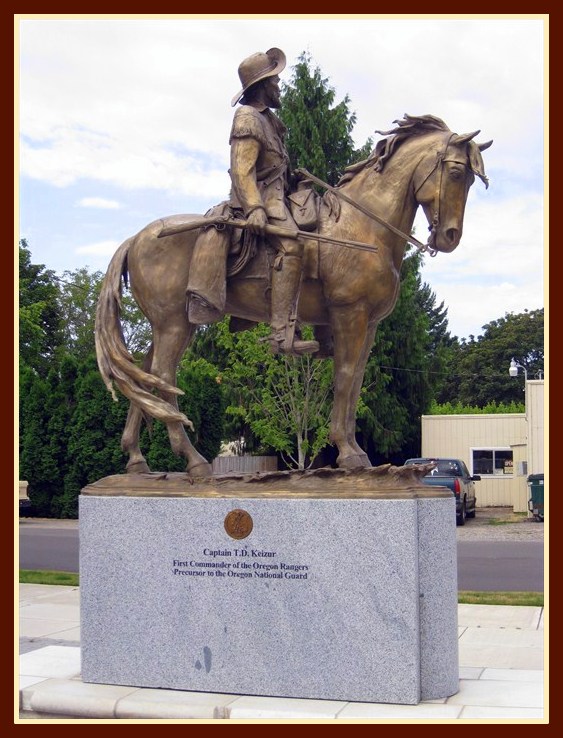
Thomas Dove Keizur Monument

Thomas Dove Keizur Monument

courtesy of  Ginger Powers

courtesy of
Ginger Powers

His life was a great adventure! The son of George A. and Mary Dove Keiser, Thomas Dove Keiser was born Nov 20, 1793 in a portion of Mecklenburg County NC that would soon become Cabarrus. He married in 1812 Mary Gurley, the daughter of James and Lydia Gurley. James was the son of William Gurley who settled ca. 1778 alongside my THOMAS ancestor on Richardson Creek in Anson County NC. In 1828 Thomas Dove (T. D.) Keiser and family removed first to Tennessee before journeying on to Arkansas.

With T. D. Keisur helping to lead the way, on May 20, 1843, the family loaded the wagons once more and joined the great Applegate wagon train to Oregon. Settling along the Willamette River in the Pacific Northwest, the region was not yet governed under the jurisdiction of the United States. A community based security force known then as the Oregon Rangers was quickly raised. Thomas Dove Keizur was chosen and served as first captain in this precursor to the United States National Guard. He continued a life of civil service benefiting the new state of Oregon along with the town that now bears his name.

As is the way with most of history, I never knew of T. D. Keizur until his story came to me by way of the works of others. During the Christmas holiday in 2009, a Keiser family member contacted me in advance of a major celebration about to take place in Oregon. On January 30, 2010, the little town of Keizer Oregon unveiled a bronze monument of Thomas Dove Keisur seated atop his faithful Morgan horse. Historian and author Jerry McGee provides a historic presentation on T. D. Keizur and the town.

______________________________________

In 1780, Henry Kent sold land on Utley Creek (F-1, Wake NC) to Davie Strait after relocating briefly to Mecklenburg (now Cabarrus County NC). Deed 11-31 in Mecklenburg NC identifies Henry’s land as lying on “the waters of Rockie River Nigh the Baptist Meeting House.” This was an intriguing find as it tied to my LOVE family while illuminating the migration from an area of northeast North Carolina where my THOMAS family may have once lived. More on these ties in a later post.

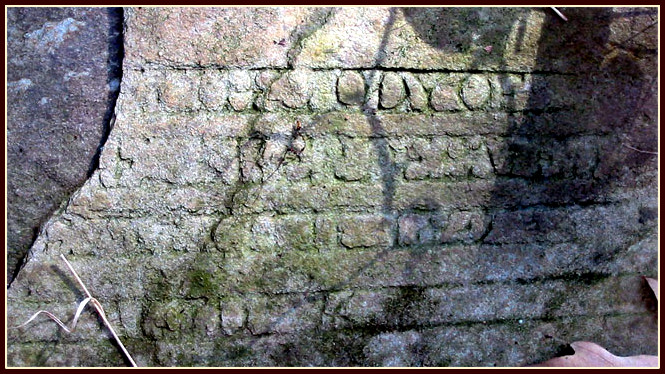
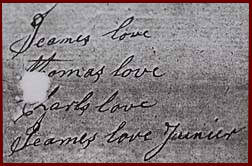
Believing land records had pointed me to the old Baptist church, I contacted the land’s present owner and was graciously shown the way to what I sought. Followed by an inquisitive herd of cattle, we walked a grassy ridge that provided panoramic views of surrounding pastures and the distant Rocky River basin. Rising to the north, and flowing around the land, was a spring head identified in early deeds as feeding “Meeting House Branch.” Eventually we reached an ancient hilltop cemetery in a small grove of trees. Though well taken care of, time and life had taken its toll on the graveyard. Just a few stones revealed readable words such as “the” or maybe “here.” The following is a digital image of the only surviving stone with words crying out to be deciphered.

stone.jpg

Further research revealed this to be the site of “Haynes Meeting House.” Lutheran minister David Henkel preached at Haynes Meeting House around 1800 and it’s also identified as the burial place for members of the Howell family. Found also in local land records, namesake William Haynes removed to western NC by 1785 and became the first preacher at Bill’s Creek Baptist Church located near present day Lake Lure.

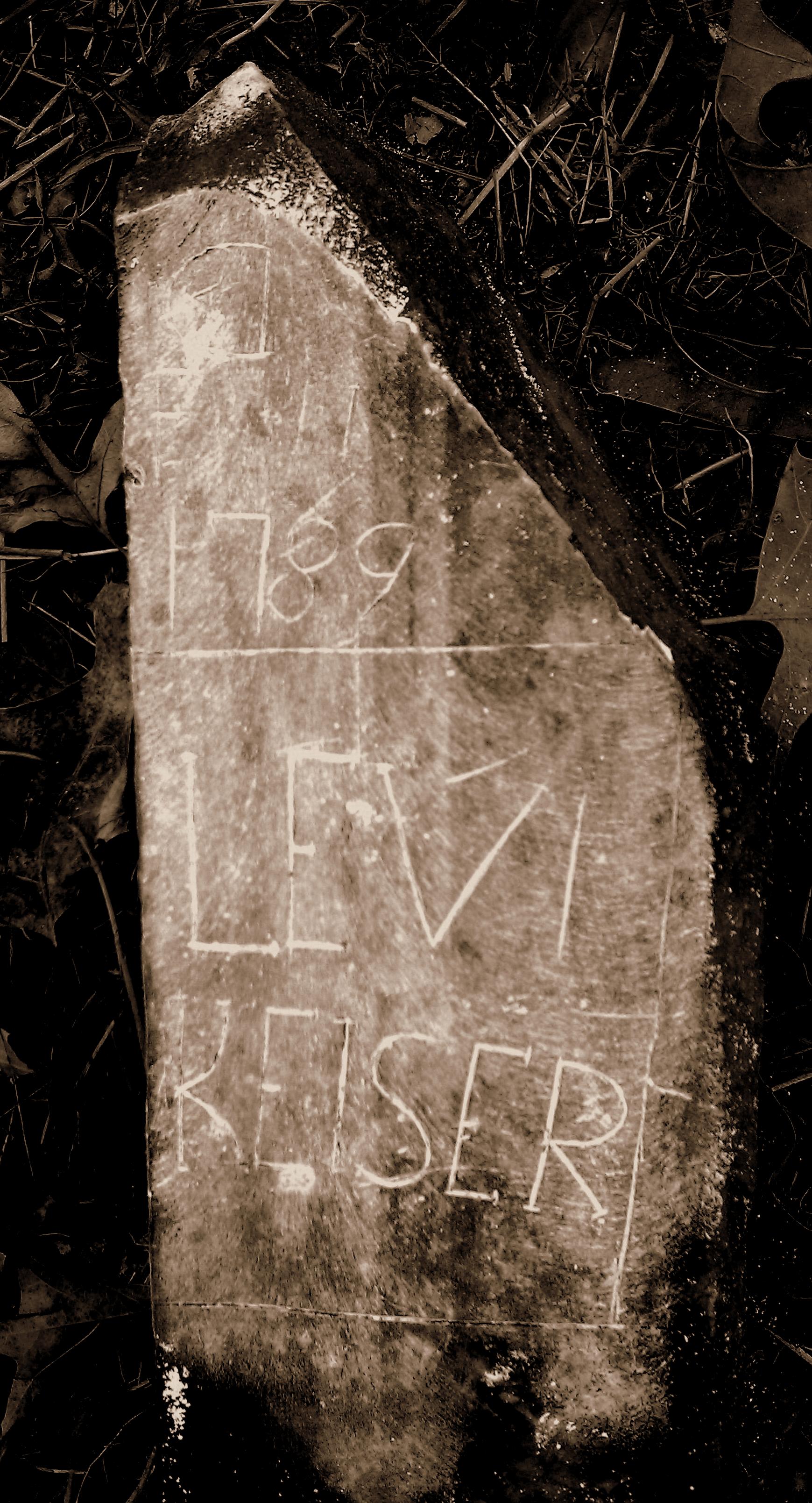
IMAG0240Frequently visiting the site in search of things possibly missed, on one such trip, the door of discovery opened once more. Partially buried under leaves and debris, a small stake of a rock identified the resting place of Levi Keiser. From the works of Marie Evans Davis-McQueen, I learned that Levi was born Feb 16, 1783. The son of George Alexander and Mary Dove Kiser (Kiser – as tradition spells it in NC legal records), we now know the little fellow died Feb 11, 1789. Not long after the death of little Levi Keiser, his brother named Thomas Dove Keiser was born November 20, 1793. And since Levi’s mother and father lived out their lives in the area surrounding the graveyard, it seems they would’ve wanted to be buried there, near their son. I couldn’t help but imagine that they and others in the family were buried nearby.

After learning of the amazing life journey of Thomas Dove Keiser/Keizur, I decided to revisit the old unreadable stone with an open mind to variations in naming. Amazed at what I now see, I’m almost certain the stone marks the resting place of T.D.’s and little Levi’s father.

When I visit that hallowed ground off of Hwy 601 in Midland NC, I think of journeys and of how all things are possible. There was of course the trip to Oregon and the Gurley family’s earlier migration from Johnston County NC. It’s wonderful getting to know the wealth in community and how it was served by this little church named Haynes. Though he never got to meet his younger brother Thomas, I’m sure little Levi would have been proud of his life’s journey.

James Allison Love and Grandsire Jimmy

family
My maternal ancestor is James Love, born in the early-mid 1700’s possibly in the area of Brunswick County VA. The son of James and Elizabeth Love, he did in fact live in Brunswick County prior to moving westward through the south side of Virginia before crossing the border into old Surry County, now Stokes County NC. He moved deeper into the foothills of Wilkes County NC where his son John served in his stead during the revolutionary war. John remained in Wilkes County as his father James and family moved east to Mecklenburg, now Cabarrus County NC. Our James Love, fondly known by us as Grandsire Jimmy, is well recorded in the annals of time. Though I’ve seen him listed as James Jr. and James Sr., his purported middle name Allison has never been recorded to my knowledge. That being said, where does the name come from and how did its use come to be?

adamAll evidence goes back to information provided to my great uncle James Adam Love, son of John Ephraim and Frances Isabelle Hinson Love. The author of The Rocky River Love Family, Adam frequently read his story during the Love family reunion at Love’s Chapel UMC in Stanfield NC. I remember so many times my mother telling of him standing before the congregation reading from the history. Old Mump Love leaned forward with ear horn in hand listening carefully to every word said. Following the program, the gathering adjourned to the grounds where a great spread of food awaited. Just a little girl then, my mother remembers large barrels of ice tea and the pleasures of family and fellowship. It’s almost as if I were there.

James Adam Love died 6 Apr 1939 and is buried at Love’s Chapel. A letter from his collection was given to his sister (my Grandmother), Minnie Ann Love. It’s a correspondence Uncle Adam had received from a distant cousin in Pope County AR whose ancestors had left Stanly County back in the mid 1800’s. Mrs. Robert Bigham Henry wrote of her grandfather Darling Love and of her family’s rich history. From a visit to Helen Tucker Obermeier in Stanly County NC, I learned of the existence of Adam’s response to the letter written by Mrs. Henry. From a typed copy obtained from Myra Norwood, Helen allowed me to copy James Adam Love’s letter of reply. Written in August 1932, he announced success in what was the first ever Love Family Reunion. He writes of a day of reading and singing and confirms the spirited event just as has been passed down to me by my mother.

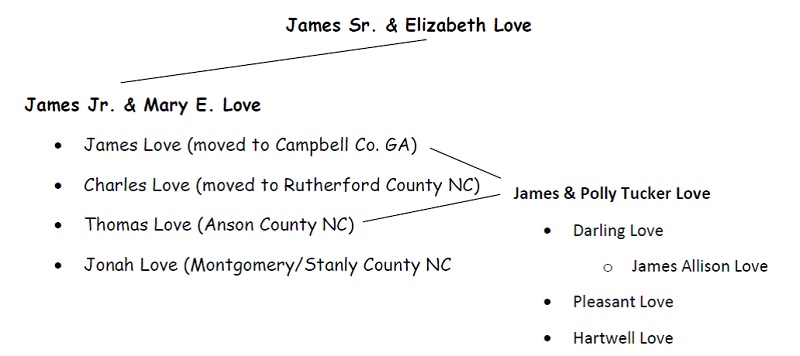
Listen up as this upcoming sentence is important. From family in Arkansas, we know Darling Love had a son James Allison Love whose daughter passed on that he, James Allison Love, was named for his grandfather. Court records here in NC opened the door, allowing this prevailing thought from Arkansas to be mistakenly associated with the life record of old Grandsire Jimmy. At that day and time it was believed against all likelihood that Darling Love was the son of old Grandsire Jimmy. Darling was born ca. 1815 and Grandsire Jimmy was born ca. 1745. Read the letters closely and you can sense the miscommunication in the correspondences between my great uncle and Ms. Henry from Arkansas.

petition7Since the days of Adam Love, two discoveries offer new possibilities. Most recently found, DNA from descendants of a James Love born ca. 1764, who died ca. 1824 in Campbell County GA, matches that from descendants of our Grandsire Jimmy. And, a petition in support of constructing public buildings ca 1794 in the newly formed Cabarrus County names James Love Sr. and James Love Jr. More than likely, James Love, who died in Campbell County GA is “Jr,” being the son of Grandsire Jimmy. There’s no mention of Allison in records of either James Love Sr. or Jr.

During the War of 1812, a person named James Love served in a unit raised in Cabarrus County. This could not be old Grandsire Jimmy nor James Love who later died in GA. They‘re simply too old. Per the unit roster, Private James Love served under Captain Evan S. Wiley who served under Lt. Col. Richard Allison. Could this James Love be the father of Darling Love and could Darling have named a son for a leader of the unit in which his dad served? And when Darling Love’s granddaughter said that her father James Allison Love was named for his grandfather, could the namesake have been this private who served in the War of 1812? You bet, but what ever happened to this James Love?

Helen Tucker Obermeier introduced me to a record that few others had seen. Dated 3 Sep 1858, the 62 year-old “Mary Brooks” applied for bounty land she believed due her on behalf of military services rendered by her deceased husband James Love in the War of 1812. In the two-page affidavit, Mary states she and James Love married 10 Aug 1813. And “…her name before said marriage was Mary [Polly] Tucker.” James and Mary were married by Isaiah Spiers, Justice of Peace of Cabarrus County. Two years later James Love enlisted about 10 Aug 1815 in Concord, Cabarrus County NC. James Love served for fifteen days until being honorably discharged 2 Mar 1815 at Wadesboro in Anson County. The unit returned home due to ratification of peace with Great Britain. Mary states that her husband James Love “died on Rocky River [at his residence] on the 8th day of April 1825.” Mary Tucker Love married 16 Sep 1828 David Brooks in Montgomery County. They were married by John Little, Justice of the Peace. Mary goes on to state that said husband David Brooks died about 1 Aug 1842. G. H. Honneycutt and Jonah Love witnessed the affidavit.

More on this James Love can be found on my site at: http://www.angelfire.com/nc/benjthomasofansonnc/lovetucker.html

Traditional family history had it that late in life, old Grandsire Jimmy had four children named Darling, Pleasant, Hartwell, and Nica Love. And after his death, the children were raised by George Tucker and wife. We now see this younger, previously unknown James with wife of maiden name Tucker. Was she George’s sister? Even if not, the record gives a hint at why George raised the kids after the death and remarriage of Polly.

In bringing this post to close, there was no Allison in VA tied to the family in such a way to be the namesake of our Grandsire Jimmy. However, there were plenty of that name in the area surrounding Cabarrus. I believe it’s wrong and a mistake that we refer to old Grandsire as James Allison Love. The records instead point to the younger James who married Polly Tucker. This James could be the son of the James who moved to GA. He could also be the son of Thomas Love who also lived along Rocky River. He could also be a son of a son of Grandsire Jimmy who died young and has not been found in record?

Bessie and the Beef Shoot


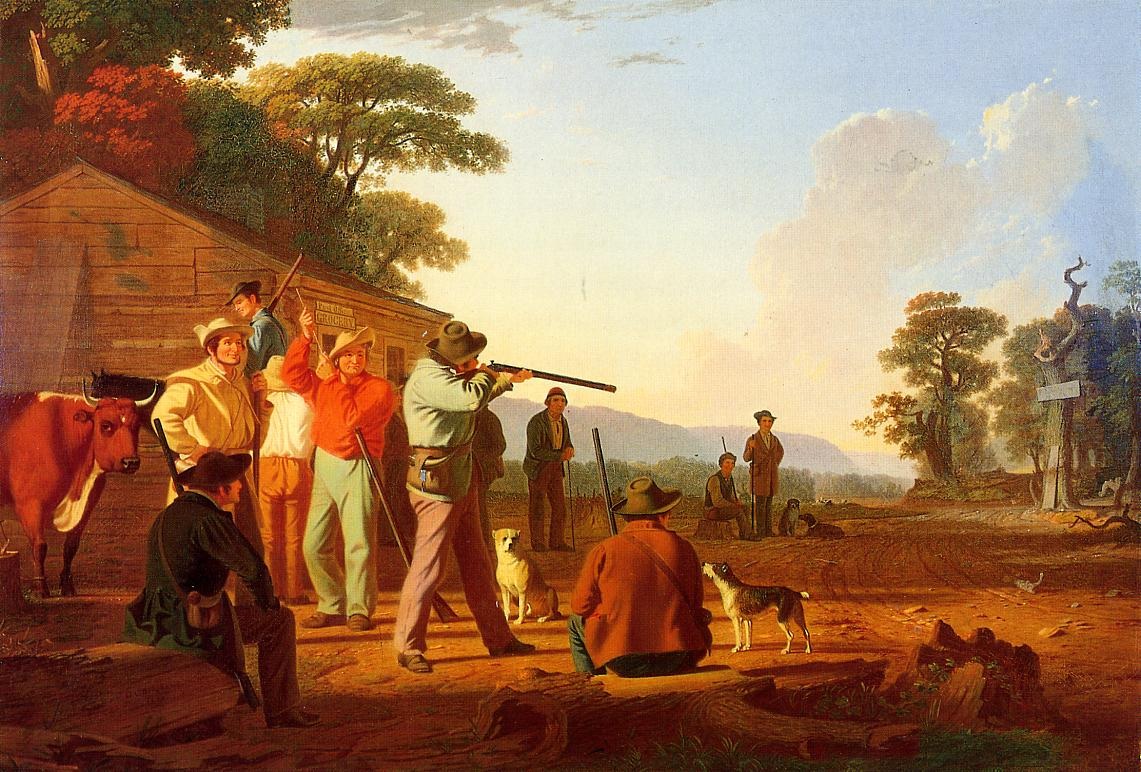
Shooting for the Beef - George Caleb Bingham

Shooting for the Beef – George Caleb Bingham

I remember as a little kid struggling to peer over my dad’s arms while he whittled us kids flutes made from the hollow stems of squash leaves. Though the instruments more or less squawked, you could truthfully say they worked …at least for a minute or two before turning to mush.

One day at around age eight, I just happened to observe something going on that was not meant for my young eyes. My dad and older brother were seated at the kitchen table where my dad had a knife and wood in hand. Working on a scouting requirement, my dad’s attention was rightfully on my brother, not me. By and by, and not wanting to be left out, I made it to the tool shed where a chisel and piece of 2×4 caught my attention. It didn’t take long for the chisel to find its way off the wood, severely splitting the end of my finger. Scared to death and having to show the dripping wound to my dad, he pulled out the doctoring stuff and went to work. As always, his last move was to give me a smile, give the bandage a squeeze and then gave me the warning not to do that again. To this day my unhealed scar and split nail are always there reminding me of the good memories of youth. The accident also drove me on a journey that has defined my adult life. For many years I’d rather be carving wood than eating a good meal.

Though I knew little of art as a kid, I did know what I liked. And for me, classical American landscapes have always pulled me to another day and time. From images of animals grazing, people at work, the glow of early morning light, and maybe a ray of sun glistening on a faraway hill, the 1800’s luminst style of painting in particular speaks to my heart.

One of my favorite paintings was “Shooting for the Beef” by Caleb Bingham. Even though I was a city kid, I got the message that the painting was of a scene like a turkey shoot with the prize being a beef cow. I loved how the image captured real life in rural Americana.

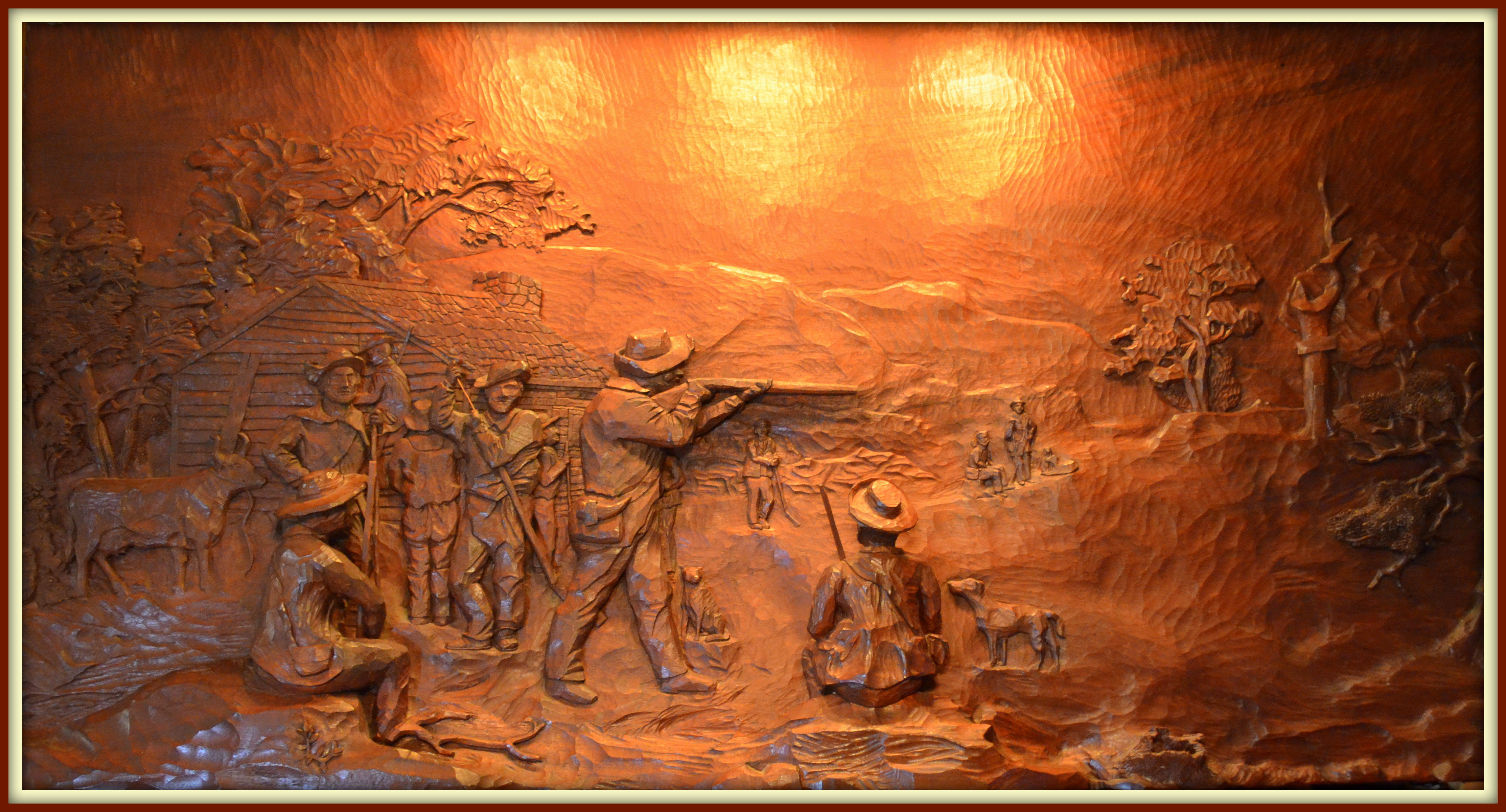
Acting on my desire to recreate the image in wood, my dad carried me to a lumber yard where he bought me a huge piece of mahogany that I cut, glued up and carved on for years. Since the wood turned out to be longer in scale than the painting, it was necessary to be creative by exploring my own ideas to lengthen the carving. As the painting showed only the front end of the cow, I decided to include all of the animal for which a wonderful photo was found in the family set of Encyclopedia Britannica.

After countless hours of work, my carving was complete and I was truly proud. Giving it to my parents to go over their mantel, my dad helped to make brackets and bought a special light. It made me happy to see my parent’s pride in sharing my work with friends and neighbors.

And then one day, late in my grandmother’s life, dad brought her to the house for a weekend visit. My grandmother lived to 98 and was a person who actually lived the kind of days and life portrayed in my work. She grew up in hard times and was yet the warmest soul I will ever be privileged to know. Not being able to say enough good about my grandmother, I’ll never forget her remark after seeing my carving. With chin in hand, she gazed the people and landscape until her eyes reached the cow. She shook her head, smiled, and said “why child, you’d eat Bessie?”

Failing to acknowledge the importance of the working ends of beef cattle vs. a dairy cow, all the time and effort I had spent boiled down to whether an animal had teats or not. And my grandmother was right on. You’d never take the life of such a prized Jersey cow to fill a plate with meat! For me, this was a valuable lesson. There’s so much that you need to get right in life and there’s plenty of opportunity for mistake. Know your subject and do your best to get the story right. Composition is more than the image, it’s also the resulting story that’s being told.

Shooting for the Beef -1982

Shooting for the Beef -1982

Regulators and the Blackened Face

I thoroughly enjoyed my days at NC Archives reading through state level petitions and court records from the opening days of our country. The time spent was not only about organizing my own understanding of history, there was also the raw pleasure in finding the occasional deposition or petition having all the elements of a good a novel. Some cases were deadly serious while others were beyond funny.
__________________________________

In 1771, General Hugh Waddell was heading north from Salisbury to Hillsborough to quell a rebellion of regulators. Intended as support for Waddell, a convoy of munitions from Charleston camped in now Cabarrus County was attacked during the night by locals who hid behind blackened faces. Known today as the “Cabarrus Black Boys,” I wonder if there were other such attacks or similar acts by Regulators in the southern piedmont of North Carolina?

A year prior to the attack on Waddell’s munitions, the Anson county surveyor named Robert Jarman was robbed as he headed east from the Peedee river. He too was attacked at night and by men with blackened faces. And just a year earlier than the robbery, regulators of Anson County signed a petition.

Robert Jarman provided a deposition of the attack to the Governor’s Council in 1770. Though it could have been all about a robbery, one line screams that the crime might be the doings of the Regulators. Can you pick it out from Robert Jarman’s deposition below? Warning: this is a graphic read!

North Carolina                                                                     December 10, 1770
Craven County

The deposition of Robert Jarman of Anson County in the Province aforesaid, Deputy, Surveyor, aged about thirty eight years, who being sworn upon the Holy Evangelists, deposeth and saith, that about two hours after sunset in the evening of the twenty ninth day of November last past, as this deponent was riding the road from Blewit’s Ferry on the Peedee River to Cole’s Bridge on Drowning Creek near an old diserted cabbin on a branch of Hitchcock’s Creek commonly called the Chalk Fork, he this deponent was robbed of five or six shillings in small pieces of silver, forty six shillings in Proclamation Money, and fifteen Portugal Pieces of Gold commonly called half Joe’s, in the following manner, to wit, As this deponent had passed the said branch about twenty or thirty yards from the ford thereof, he this deponent saw three men all armed with guns, rush suddenly out of the said cabbin and run towards this deponent, whereupon this deponent put forward and spurred on his horse with all his might and the said three men advancing toward the road aforesaid to meet this deponent, some of them cried out repeatedly, Damn your soul, stop, or we will blow your brains out, whereupon this deponent immediately attempted to take a pistol out of his pocket, but hearing at the same instant two of them cock their guns as they came within about six or seven yards from this deponent, he desisted from making any defense, and stopped his horse under the greatest shock and surprise, and thereupon one of the men immediately stopped, and presented his gun at this deponent, another of them seized this deponents horse by the bridle, and the third man seized hold of this deponent, pulling and shriving to get him off his horse, and at the same time cursing this deponent in the most shocking manner, and ordering him to deliver up his money, or they would instantly kill him, but he who held the deponents horse by the bridle, said damn him, leave off pulling him, and get his money, whereupon the others desisted in pulling this deponent, and began to search his pockets on the side he then stood, but finding no money there, he went round to the other side of this deponent, and took out of this deponent’s fob, about five or six shillings in small silver, and then took hold of this deponent’s saddle bags and began to search them, and from thence took out one parcel of this deponent’s proclamation money, and at the same time cursed this deponent, and said, I have got some of your money, and I’ll be damned if we don’t kill you if you don’t tell us where your Gold is, whereupon this deponent told him he had none, but the other replied, I know you have some, and damn you, we will kill you if you don’t give us all you have; yes damn him, said the other who held this deponents horse by the bridle, and we will have his cloaths too, I do insist out. No damn him said he that was searching this deponent, we will take nothing but his money, and finding another parcel, here, said he, I have got other bundle of his proc and we will have all he has got, or damn him we will kill him, and then immediately finding the fifteen half Joe’s, took them out of this deponents saddle bags and swearing by his Maker, said, Boys, we have got it, and seemed then to be contented, and began to return and put up into the saddle bags some of this deponents cloaths and things which had been taken out in the search, and takin up a bottle of rum belonging to this deponent, held it up between himself and the moon (which at this time shone very bright) and swore that if they did not take the bottle they would have the rum, and then drank to him who held this deponents horse by the bridle, and taking the bottle again, carried it to him who had stood with his gun presented at the distance aforesaid, and after drinking two drams a piece, the same person who had been searching this deponent, drinking to him that held this deponents horse by the bridle, said damn me boys, we have done it; No, said he that held this deponents horse, I want his cloaths too; No said he that searched this deponent, we have got what we wanted, and I’ll be damned if we will have any of his cloaths and then put the said bottle again into the deponents saddle bags, and then upon the said two persons who had seized hold of this deponent and his horse, left this deponent and went to the other person who had stood with his gun presented at a distance of about five or six yards from this deponent as aforesaid, and then all three of the said persons advanced about four or five step further from this deponent, and there stood talking together, whereupon this deponent pleaded with them not to leave him destitute of any money to ______________ his _____________, and in answer thereto, one of them said damn your blood, go off this instant or we will take everything you have, for I will be damned, continued he, if there shall ever go as much money again out of Anson to the damned sons of bitches below, as there has gone, if we can help it, and thereupon this deponent left them and proceeded as fast as he could to John Cole’s at the bridge on Drowning Creek aforesaid, then being in such concern, terror and confusion, that he scarce knew what course to take, And this deponent further saith that the said three men who robbed this deponent aforesaid are all unknown to this deponent, their faces being all blackened and disguised, and that those two who had seized him and his horse in the manner aforesaid, were smallish or rather under a middle size, and that he who stood off some distance with his gun presented at the time of the robbery committed as aforesaid, appeared to be a tall stout man, who never spoke during the whole action, to this deponents knowledge; that all three had in hunting shirts, and all wore their hair, the two former had their hair hid, the latter had his hair short and loose about his neck. And this deponent further saith that at the time when this deponent desired and intended to have lit out on his journey from home with company, his wife was in labour, and in such circumstances as humanity forbade him to leave her in, that that the day after she was brought to bed, he set out on his journey and rode late at night at the time he was robed as aforesaid, in order to overtake the company which were on the road before him, and further this deponent saith not.

Rob’ Jarman

Sworn the tenth day of December, 1770 before R. Cogdill

Where the Indians Walked

wnorthwestweb

During the late 1990’s, I began a project to map land records in southern Cabarrus County NC in hopes of building a better understanding of the surrounding community. Granted lands were located and conveyances documented several transactions out from their origin. Every new piece added to the growing puzzle opened new possibilities and raised new questions. Much of my blogging effort is based on discoveries made during this effort.

Looking at the above map of land grants, the following descriptions are important to understanding one such discovery:

7. Grant # 3119, Mecklenburg NC, ent. 1 Jun 1779, sur. 10 Mar 1780, iss: 22 Oct 1782. Issued to Charles McCammon, being 195 acres on the south side of Rocky River “opposite the mouth of Coldwater Creek.” The metes and bounds are: from a b. o. on Thomas Watson’s line near the Indian Path, running with the line) north 41 east 14 to hic. grub (said Watson’s corner), (with his other line) north 88 east 42 to two pines (Watson’s other corner), with another line of his) south 88 east 61 to a w. o. sapling (another corner of said Watson), (with another line of his) north 69 east 64 to b. o. (another corner of said Watson), north 10 west 64 to w. o. sapling (on bank of river), up said river to r. o. on bank, west 57 to b. o. sapling, north 24 west 48 to ash (on bank of river), up the river to w. o. and ash (on bank of river), south 16 west 100 to hic. grub, then to begin. CC: Charles Dorton, John Love
8. Grant # , Mecklenburg NC, ent. _____, sur. 18 Aug 1780, iss. ____. Issued to Thomas Watson, being 135 acres on the waters of Horse Branch. he metes and bounds are from two pines (his own and Charles McCammon’s corner, running then with McCammon’s line) south 88 west 42 to hic. grub (his other corner near the old Indian path), (with his other line) south 41 west 103 to b. o. (near said path near John Love) south 34 to b. o. sapling, south 54 east 100 to stake (near Charles McKindley), north 83 east 47 to large hic., south 60 east 86 (crossing two branches of the horse branch to a corner of the place he lives on) to a stake, (with his own line) north 108 to stake (his other corner, (with his other line) west 92 to stake (another corner of his), (with his own line) north 103 to begin. CC: John Love, Charles Dorton.
12. Grant # 3052, Mecklenburg NC, ent. 2 Aug 1779, sur. 3 Mar 1780, iss. 22 Oct 1782. Issued to William McAnulty, being 156 acres on the waters of Reedy Creek. The metes and bounds are: from two b. j. (on the Indian path, running thence with Charles McKindley’s entry) south 30 west 132 to b. o., (with said McKindley’s entry) south 22 west 33 to b. o. (David McKindley’s corner), (with this line) north 58 west 66 to b. j. (near said McKindley’s other corner), north 45 west 127 to w. o. sapling, north 16 east 101 to hic. (near Robert Davis & James Love’s entries), south 61 east 106 to stake, then to begin. CC: Charles McKindley.
26. Grant # 3174, Mecklenburg NC, ent. _______, sur. 10 Apr 1780, iss. _______. Issued to David McKindley, being 228 acres on the head waters of Anderson Creek. The metes and bounds are: frpm a b. o. north 58 west 60 ( with William McAnulty’s entry) to small w. o., south 65 west 55 to pine, south 47 west 108 to r. o. (on the Indian path, south 58 west 83 to hic. , south 46 east 84 (with Hugh Campbell & Joseph Bigger’s entry) to s. o., east 126 to long b. o. , north 62 east 109 to w. o., north 18 east 60 to small b. o. (by a pond), with Charles McKindley’s entry) to begin. CC: Samuel White, Charles McKindley.

In 1782, Charles McCammon received a North Carolina Secretary of State land grant (#7 above) for 195 acres on the south side of Rocky River opposite the mouth of Cold Water creek. Unlike any tract of land I had seen before, this grant effectively excluded a triangle of land along the river bank that would have normally been included (see the green triangle in the above plat map).

The excluded triangle of land had no meaning what so ever until, having sufficiently platted enough surrounding tracts, an awesome ah-hah moment revealed itself.

Notice the little black triangles in several of the above tracts (tracts 4, 7, 8 13, 26). The surveyor noted in his plats that these were points where the granted parcels of land joined or neared the “Indian Path.” Connecting the triangles, it’s easy to follow the path to its river crossing somewhere in the green triangle at the mouth of Cold Water creek.

Raising as many questions as answers, the discovery gave me a unique opportunity to stop and look closely at how the crossing and records fit into the greater scheme of things. Zeroing in on the green triangle located in tract #7 above, the first question raised was “what was so important that led the surveyor to exclude the land around the crossing?” Could there be a burial ground near the crossing? Was the land excluded in order to allow passing Indians a place to camp?

I made several trips to what is now a relatively new housing development along the river. There, I was met by a group of boys who led me on a hike along the river bank. A small drain and hill angled into the river from the bank. It’s said that Indians paths run the high ground and cross running water in shallow points. If that is true, then the site perfectly fits the Indian need. Though I did not find any hint of a burial ground, I suspect the area would make for great archeological project to be undertaken by a local college.

It’s also said that Indian paths were first and that the Dutch Wagon Road simply improved on the path already in place. Though using wheeled wagons, the incoming settlers required a more gentle approach down and crossing the steep river banks. Not shown in the map above, and moving away from the river on its northern bank, tracts on the north side of the river are identified as joining the “Dutch Road.” The wagon road actually left the Indian path and turned east as it neared the river on the north bank. This was because of steepness in the area and also because of a dam built just downstream by Peter Kizer. The best place for wagons to ford the river was in the shallow water below the dam.

Looking back to the green triangle of land, it remained vacant land for nearly 50 years when John H. Bost received a grant for acreage on both sides of Rocky river that included the little triangle. I’m sure this land had a history before the days of John Bost and even before the days of the first white settlers. I’d love to be able to walk the land more, to look for arrow heads and other signs of a culture that predates our own.

The general run of the Indian path is along and near present day Flowes Store road and further south along the Camden road. More on the above map and legal descriptions can be found on my site at:
http://www.angelfire.com/nc/benjthomasofansonnc/northwestmap.html
http://www.angelfire.com/nc/benjthomasofansonnc/northwestword.html

I Send You a Fue Punken Sead

  November the 15, 1863 camp nere Kenansville, N. C.

Deare and loving companion I seate my Self this morning to Drop you a fue lines to let you noe how I am. I am not well at this time nor havent bin for two or three Days  Bin puten Some Blood thru me for a Day or twoe thoe I feal thankful to God that hit is as well with me at this time as what hit is.  Deare loving companion I hope these fue lines mae goe Safe to yo kind loving hands and find you and all the childrons well and harty and Doing well.  Deare wife I have Bin Locken for a leter frome you all this weak thoe I have received nare letter frome you since the one that I got when Capt.

I begin to want to here frome you. I dreame of seaen you twist last nite and being with you and Bothe times you Seamed to Be mad which makes me feal uneasy a Bout you. I am a friad Sompthing is the mater with you or some of the family. Deare loving wife I want to sea you and the childrons the wrest that I ever did thoe I cant sae when I will be permited to Sea you. Thoe if we are not permited to sea each other in this life let us trie to live soe as to doe the will of our havonal fathers will soe that we mae meat in heaven where wares and trobles never comes and whare husbands and wives and parients and childrons can meat to part noe more Soe turne over and Read

Page Two

Deare loving companion I want you to Send me Some to Bucoe and make me a pare of legens and Send them by Mr. John D. Taylor if you plse and you will oblige me by Soe Doing.  I think that we will Draw our money Be for J. D. Taylor Starte home and if I doe I will Send you Som by Mr. Taylor.  I have noe nuse of eney importance to write to you at this time. Brother Jonah A. Love is well at this time and my mes is as well as thae are for comon the company is in tolerable helth at this time weare faren tolerable well at this time for sompthing to eat thoe I think that _______ Rashens will Sune give out.  Deare wife I wish that this civil ware wod stope soe that we all cold come home to live with our famles a gain as we Did Be for this ware tuck plase and I am in hopes that we all will be at home til Spring – hit is thought that N. C. will go back in the Union and I hope that she will and that Be fore Spring for I cant help but think that we are on the rong side. Deare wife I will send you a fue punken sead in this letter my Mr. Taylor.  Plant them in a gwod spot – thae come out of a fine punken.  I want you to write to me forth with and let me noe how you are and give me all the nuse you can soe I will bring my fue lines to a close By saing I ever Remain your true and loving husban as long as life shall last. Soe kis my Sweat babe for me – tel the childrons all that I send them all loving and that I want them all to trie ad Doe rite.  Soe noe more at the presnt Soe fare you well until I here frome you

frome Mr. M. G. Love to Mrs. P. F. Love and family

_________________

Phebe Love

Phebe Love

Born 23 February 1823, Michael Garmon Love is the son of Jonah and Mary Garmon Love. Michael married 10 Aug 1843 Phebe Love. Thomas P. Reed is listed as bondsman with the marriage bond being witnessed by Kiah P. Harris. Being his first cousin, Phebe Love was born 11 Oct 1827, the daughter of Thomas and Susannah Love. In 1849, Michael’s father donated the land for Love’s Chapel Methodist Episcopal Church. In the deed (2-255, Stanly NC), Phebe’s father was named as a member of the Board of Trustees who received the donated land.

Michael G. Love enlisted in Stanly County at rank of Corporal in CSA Co. H, 42nd Reg. In the summer of 1862, he wrote a letter to his wife from Lynchburg VA. Michael was promoted to rank of Sergeant on 20 Mar 1863. Dated 15 Nov 1863, he wrote the above letter to his wife and family. Physically sick or wounded and uneasy about his life, he now questioned the war and dreamed only of seeing home and family.

The writing of letters like that of Michael’s was repeated many times during the civil war. Soldiers often questioned the morality of war as the certainty of the truths they fought for wavered. Learning that life was short and precious, they wrote more clearly and clung tighter to those things that mattered. For Michael, stains on his letter indicate his pumpkin seeds likely made the journey home.

Michael Garmon Love was accounted for until wounded in an unspecified action on 15 Jul 1864. On 14 Dec 1864, he was furloughed from the Richmond VA hospital for sixty days. Returning home, he died on 29 Dec 1864. Michael Garmon Love is buried beside his father at Love’s Chapel United Methodist Church.

Dated 24 Nov 1869, Phebe F. Love donated five and a quarter acres (8-270, Stanly NC) for “the use of the Methodist Protestant Church at Love’s Grove.” She applied for a civil war pension in 1901 and died on 29 Oct 1901. She’s buried near her husband at Love’s Chapel United Methodist Church.

Love's Grove United Methodist Church

Love’s Grove United Methodist Church – built on land donated by Phebe Love

Seeking Religion

Christmas doesn’t begin until the candles have been extinguished and the congregation ups their collective voice in singing “Joy to the World.” Every year, a high point for my wife and I is in joining my mother and her church family at the 11:00 pm Christmas Eve service held in Terry Chapel at Dilworth UMC. There’s no better medicine for the heart than holding to the ones you love while rejoicing the birth of Christ.

This Christmas was no different. Coming in from the cold, the small chapel slowly warmed by the gathering crowd. Greetings were extended and the chatter of spirited conversation grew as the worshipers took seat. We sat in front of a mother and her son. She told of him just coming from the Moravian church and shared his excitement in experiencing his first Moravian Christmas service. I so wanted to hear more and to tell stories about my family’s connections to Wachovia and the Moravian Church. But this was Christ’s night and the service was about to begin.

We all come to Christ in our own way and time. Sometimes I wonder how God feels that his people worship in so many traditions. I’ve also wondered about church in the olden days and what the journey to Christ might have looked like in early America.
_____________________________
In the late 1990’s, my mother and I made a trip to Pope County Arkansas to a place where much of her family from Cabarrus County NC relocated in the late 1830’s. Though we had read the stories and knew most of the records, there’s nothing like being there to experience the land and communities of family so far away.

- Silas Monroe Shinn

– Silas Monroe Shinn

While going through the local library, I came across a really interesting memoir written by a homeboy from Cabarrus County who made the trip to Arkansas and then even further to California. Silas Monroe Shinn along with three others joined a wagon train to the gold fields in 1850. Reading like an action movie, Silas’s story tells of an escape from Geronimo, the loss of their wagon and horses, the crossing of the desert, and the trek through the Sierra Nevada’s. The story really was exciting, though a chapter titled “Religious Experiences” offers a rare glimpse into the young man’s search for true religion. The chapter reads:

My children all married. We have only three children but we have twenty-one grandchildren living and twenty-five great grandchildren and three great-great grandchildren.

Wife died October 18 1908, since which time I have been living with my youngest daughter, Fredonia, until January 14, 1910, when I came to Healdsburg where I am now living with my second daughter, Mary.

I have written the foregoing scenes and reminiscences of my life for the satisfaction of the children and grandchildren and great grandchildren. I greatly miss her love and companionship. I have hurriedly written these sketches. There are perhaps other items omitted which if written would be interesting. But I might follow this with another side of my life’s history-my religious thoughts and experiences beginning back at my birth and early life.

I was born November 18, 1821, in Montgomery County [now Stanly], North Carolina. I was the seventh son of Silas B. Shinn and Elizabeth B. Shinn. Father died before my earliest recollections. Mother was left with ten children to feed, clothe and school. She was left unprovided for, and, under the circumstances, she had a hard time of it. She could not spare the children to go to school after they were large enough to work. So they were kept at home to run errands and to help earn a living. At that time in that country, there were no public schools, only now and then a subscription school. If mother subscribed she had to pay whether the children were able to go or not. If they started to school and an opportunity of earning something presented itself, she took them out of school. Of course they picked up a little learning here and there. They all learned to work and all got along fairly well. All had a natural ability and stood well in the several communities in which they lived.

Brother Ransom, the oldest, had a good farm and several negroes. When the war came up he lost everything. He was elected “Just of the Peace.” Brother Jackson was killed as he was growing to manhood. Brother Thomas J., the third son, also did well. He too, owned several negroes, but lost all in the war. He was elected to the state senate legislature from Stanly County, N. C. Brother Madison, fourth son, was also elected to the legislature from Pope County, Arkansas, in 1948. He also lost everything in the war. He was a Methodist preacher when he died. Brother Littleton, fifth son, was also in good circumstances. He was elected Justice of the Peace. Brother Nathaniel Duncan, sixth son, was also in good circumstances, and was also elected Justice of the Peace, County Judge and later to the legislature. He died in 182.

And now myself, Silas Monroe, who came from North Carolina to Arkansas in the year 1839, married there November 18, 1841, to Letitia L. Maddux, with who I lived in love, peace and harmony for nearly sixty-seven years.
My brothers were all religious men, as were my three sisters. When I was about eight or nine years old, I went with mother to a camp meeting. There was quite a demonstration of spiritual power. I was convinced of the truth of what many called heart felt religion and thought when I was old enough I would keep that kind of religion. Time passed on. I tried to be honest and truthful. When I was about fourteen or fifteen years old, I attended a school conducted by a Lutheran minister. At its conclusion, I joined the church, thinking I would yet seek the heart-felt religion. Time went on, yet I frequently had the thought of seeking that religion, but putting it off from time to time. I don’t remember that I mentioned my intention to anyone.

Then we left North Carolina and moved to Arkansas, I was in my eighteenth year. There were no Lutherans in Arkansas at the time. One day I was by myself, and the thought of my purpose came over me. I felt that I had already put it off too long, and I then determined to attend to the matter at once. I went out and hid myself in the top of a bushy tree that had fallen and knelt down and tried to pray. The tears gushed from my eyes and I could not pray much. I felt afraid that someone would see me. However, I told the Lord that I had now made a start for the true religion and asked Him to keep me from being deceived. I wanted the genuine religion and no “fox-fire.” I outlined a plan to follow my seeking. I would go off to myself every day and pray. I would read the Bible and other good books. I would try to keep myself to my purpose of seeking until I had obtained that which I was seeking. I would not tell anyone of my purpose, but would keep it strictly to myself-yet if I had the opportunity of talking with devoted en on the subject, I would avail myself of doing so.

Well I believe I followed out my plan without a break for about three or four months, but it seemed that I was no nearer the goal than when I first started. That thought was discouraging, but I determined to persevere. I decided to change my plan in one particular; that was, I would let my purpose be known under certain conditions. There was a two-days Methodist meeting to come off only a mile from where I lived. I decided to go to that meeting and if there was a call made for those who wished to seek God and the forgiveness of sins, that I would go forward and ask the prayers of God’s people. That night service was held in my brother’s house as there was not at that time any church building. I went and found the house was crowded so I took a back seat, almost behind the door. I leaned on my elbow. In that position I went to sleep, but was awakened by the congregation singing. I did not know if the seekers had been invited until I saw the young girl, whom I had been paying attention to (who afterwards became my wife) go forward to the seat indicated for the seekers.

Well I just concluded not to go forward at that time, lest the people would say that I went forward because my girl did. But it soon came to my mind that I had promised the Lord I would go forward if there was a call made; the call had been made, and I had lied to the Lord. I wept sorely over not keeping my promise to God, but it was now too late. There were no more “Calls” during the remainder of the services, but I promised myself and the Lord that if I ever had another opportunity I would not again be caught asleep, nor would I follow another, but would be the first to go forward.

Now I think that it was two or three months later that there was another camp-meeting within about four miles of my home, and I promised the Lord that I would attend that meeting and go forward to each and every “call” for seekers. Well, I did go, and went forward at every call until the meeting was out and I had not yet found any religion. I felt very bad about it. Many declared to have been converted, and some were among my particular friends. There was another camp-meeting two weeks later, twenty miles away. I determined to avail myself of that, as the last opportunity, and would do all that I possibly could to obtain salvation. I attended and followed out my plan to be thorough on seeking, until I should find the blessing. I kept up until Sunday evening. When I was off to myself I concluded I had failed in my purpose, the meeting would soon break up, and I would just have to go back home without religion.

The question came to me: “Then what will you do? Will you give up?” I said “No.” I would go home, but would continue to seek all the days of my allotted life; even if I lost I would be on the line seeking. Then something seemed to ask me if I thought that if I followed out this plan of seeking, would I be blest. I said “No” then I felt safe. I laughed. Some of my friends were near me. I was unaware of their presences and they seeing me laugh, laughed also, and told me to get up and acknowledge it, for they knew that I had religion, that they could see it in my face. But I did not think THAT was religion I had been seeking and told them so, but they only laughed the more. They asked me: “Now where is that heavy burden you have been carrying so long?” I said I did not know. Then they continued laughing, saying: Oh, we can see it in your face. You cannot hide it. Do you feel the burden anymore?” I said “No,” and they praised and thanked God for my deliverance, but seemed amused at my seeming unwillingness to acknowledge it.

We went to the stand for the evening service. They called for seekers as usual but I did not go. I did not feel the least bit like going. I felt like singing and making melody in my heart to God. Yet still I would sometimes doubt that I had religion. The meeting was nearing a close. Some of my friends had already started home, but I stayed until the meeting was all over. Then I started home. I knew that word had preceded me home, and I expected mother to be looking for me, and likely she would be wrought up over the news that she might do a little shouting, and after all it might be a mistake. Yes, I felt that it might be a mistake, and I was sorry now that the news had gone out. They all seemed to be very sure of my being converted, but I was fearful about it.

When I rode up to the little gate, and got down, mother met me. She just put her arms around me and praised God and thanked Him. By and by she loosened her hold, and walked around the house, slapping her hands and uttering aloud many words of thankfulness. Then, it seemed to settle upon me for a certainty that I had no religion. Just then I think that if ever a man felt miserable I was the man. I had fooled my dear old mother. I had fooled my friends, who seemed to have so much confidence in my honesty, and lastly I had fooled myself. It was now in the gloom of evening. I asked a friend to go out with me. I told him all. I said: “You all told me that I had religion, but now I know it was a mistake, and I want you to kneel down here and pray for me.” We bowed down, but I got no relief. We returned to the house and mother had supper waiting. We sat down to the table, and I ate a few mouthfulls, got up from the table and went out. It was then quite dark. I was glad of the darkness. I withdrew a short distance from the house. I fell prostrate on the ground with my face down. I lost consciousness. I did not know how long, but when I come to myself I was as happy as man can ever be in this world. God’s visible presence in the form or a white halo was all around me. I felt it all around me. I felt it all through me, and for the first time in my life I said, “Glory! Glory! Glory!” Oh, it just gushed out of me: “Glory to God.” I then knew that I could never doubt any more, nor have I from that day. That was in October, 1841. I joined the Methodist church then, and have remained in the body ever since. Of course that was before the division between North and South. I remember that I regretted very much the division at the time it occurred and I still regret it. Even now I indulge in the hope of living to see the two bodies together again. I was in the South where slavery existed, but I was always opposed to it. I could never think it right to compel involuntary service from any living man, as I would not like to have any living man to compel it from me.

Well now I have been trying to live the life of a Christian for over sixty-eight years. My life has been faulty. I have not been as consistent as I should have been, but have continued to cling to the faith, although in muen weakness. I have no room for boasting of my Christian effort, but to humble me. I may say that I am ashamed of my lack of the ideal Christian life. Notwithstanding all my defects and shortcomings, and my many faults, and imperfections, I am still clinging to the Christian faith. I often feel the blessings of God –feel the soothings of His Spirit, and at this writing I still feel like holding on to the faith of Jesus.

I could relate some things in my personal experiences, somewhat wonderful, but I forbear lest people might think of me, above that, that they should. There has been enough weakness in my Christian life in the past, to keep me humble. But I think today I have great reason to be thankful to God that it is all well as it is with me. I might further add that my faith still clings to the promise of God. I feel more and more resigned to His will in all things, trusting in the merits of Jesus not my own righteousness. I have full and strong hope of Heaven and immortal life beyond the grave. Amen and amen. There seems to be much more unbelief and disregard of the doctrines of religion today than there was in my early life. When I was a boy it seemed to me that almost everybody had a proper regard for the due forms of divine worship. All would bow down on their knees in time of prayer. Nearly everybody attended church services whether they were members of a church or not. I am sorry that it seems greatly different to the claims of the Christian religion. There is much more infidelity, much more opposition and sneering at Christianity. Wickedness is exalted and is now found in high place. But I feel sure that there is a God.

The heavens declare the glory of God and the firmament showeth His handiwork. The truth of God’s word is established in my heart and soul, and remains the same forever. The principles of righteousness and unchangeable and eternal, and sooner or later all will have to bow the head and acknowledge God.

Many years ago, probably forty or more, I commenced to daily write something of my reflections and feelings on matters religious. This I kept up until it became monotonous, because of so much repetition. I dropped the matter, but today I could write about the same as I did then.

In the summer of 1890, the Shinn family held a family reunion in Pope County Arkansas. Silas Monroe Shinn traveled from his home on the west coast and his brother Thomas Jeffferon Shinn Sr did likwise from Cabarrus County NC. While on a train returning to North Carolina, Thomas fell weak and suffered a major stroke. He made it to Charlotte where he remained in hospital a short while before his death. Thomas J. Shinn is buried at Tucker Cemetery located on the south side of Rocky River: http://www.findagrave.com/cgi-bin/fg.cgi?page=gr&GSln=Shinn&GSiman=1&GScid=2197670&GRid=16750159&