Author Archives: geothos

JOHN THOMAS: A STARTING POINT IN VIRGINIA (PT. 5)

house

Floor plan of extant Porto Bello house prior to 1915 fire (Campbell 1961: 467.

From John Thomas’ 1651 patent for 450 acres on Poropotank Creek, we are introduced to Kath. Thomas and James Thomas who were among nine others transported as headrights by John to America. More than ten years later, the relationship between these people named Thomas becomes clear as is found in an entry of the Bruton [& Middleton] Parish Register:

Burials in 1663 – March 14, Robert Thomas sonne of John & Katherine Thomas  

A few years later John Thomas himself died as is recorded in his last will and testament. Opening a whole new chapter in the life of John Thomas on Queen’s Creek, let’s take a look at paragraph three from the History of Porto Bello Plantation (courtesy of the James River Archeology Institute}.

John Thomas died in October 1665. According to the terms of his will, his wife Katherine was to share the Queens Creek property with their sons, James, Stephen, and Edward as long as she remained a widow. Katherine subsequently married Benjamin Lillingston, and James died prematurely, leaving Stephen and Edward the sole owners. Although the division of their inheritance was not formalized until 1690, it is likely that the two brothers had reached an accommodation some time earlier, with Stephen settling on their father’s Poropotank River property in what is now King and Queen County, and Edward living on the Queens Creek plantation, which by that time had been reduced by sale to 223 acres (York County Deeds, Orders, Wills [YCDOW] 4: 63; Barbar 1923: 71; YCDOW 1: 308, 332; YCDOW 9: 153).

Let’s look at supporting records:

-p. 55 Will of John Thomas 3 April 166_married My houses and 250 acres at Queen’s Creek, where I live, to my three sons James, Stephen and Edward Thomas, equally divided between them and my wife for widowhood. All my land at Portupotamcke, 490 acres, to them above, also my household goods. Wit: William Gibbes, John (O) Lewis. Signed: John (IT) Thomas Recorded 26 Feb 1665.

-By court order of 26 Feb. 1665 we have divided estate of John Thomas dec’d:

To James Thomas, L31/4/20 and 1432 ½ lbs tob., with same to Edward Thomas, and Stephen Thomas, children of dec’d. to the relict: L46/17/3 and 2239 lbs tob. To each of them livestock 12 March 1665 Signed: Richard Croshaw, Ralph Graves*, Henry (H) white*, Ashell Batten.

*brother in laws of Richard Croshaw, son of Joseph Croshaw.

-p. 57 Bod of Benjamin Lillington & Ralph Graves of Maston Parishm, Yock Co. 13 March 1665 for Lillington’s administration of the estate of John Thomas dec’d. Wit: Richard Croshaw, Jno. Baskervyle. Signed: P Efford Recorded 13 April 1665.

24 January 1666. It appearing on report of Mrs. Katherine Lillington that James Thomas is 21; and it is ordered he be possessed of his estate by Mr. Benjamin Lillington, his guardian and father in law.

25 January 1666. On petition of Stephen Thomas his brother James Thomas is appointed his guardian.

I, Thomas London, testify that it is 19 years ago and as much as since 9th day October last, since Katherine Thomas, the mother of James Thomas, brought him forth out of England. 23 Jan 1666. Thomas (x) London.

20 April 1666. John Baskervyle, for his trouble in Inventory of John Thomas. Dec’d to be paid 1000 lbs. tob.

On petition of James Thomas, son of John Thomas, dec’d, Richard Roberts is appointed his guardian, and he is to have benefit of his own labor, being over 17 years of age.

James Thomas desired me to acquaint you that I have nothing to say in contradiction to his age. I thought good to write you, otherwise my not coming there might, as he suggests, do him injury. I would have waited upon the court myself, but am already troubled with a cold and this weather might a caused more. March 24, 1666 Signed Ben Lilllington.

-p. 63 Inventory of John Thomas, dec’d, (whole page), valued at L140/11/09 1665, by Richard Croshaw, Ralph Graves, Henry (H) White and Aschell Batten. Signed: Katherine (K) Lillington, relict of John Thomas 24 April 1666.

Henry White, age 34, says he was to seale the upper rooms with riven boards and make wainscote partitions between the two rooms and a wainscotte portal on the stair head and put banisters on the stairs, and Bourne was to pay him 606 lbs tob. Signed Henery (H) White, wit: Jno. Baskervyle.

-p. 64. Bond of Benjamin Lillington, Daniel Wyld and Richard Roberts for Lillington, 24 April 1666, that as he married Katherine, a relict of John Thomas, dec’d, he will cause to be paid to James, Edward and Stephen Thomas, sons of John, their shares of estate. James is eldest son. Signed: Ben Lillington, Daniel Wyld, Richard Roberts. Recorded 24 April 1666.

19 Sep 1672. Edward Thomas, having attained the age of 21, is ordered to be possessed of his estate by Ben Lillingston, his father in Law and gaurdian, Mary Hawthorne having made oath he is of age to Mr. Vaulx, in court.

I, Thomas Davis of York Co. and Maston Parish, sold to James Vaulx, land in the above parish, between Capt. William Corker and Edward Thomas, 150 acres as by patent, and 1—acres more, purchased by my father, John Davis, from John Thomas, being bounded by this 150 acres 29 Oct. 1672. [In 1674, Marston Parish was combined with Middletown to form the present Bruton Parish. Bruton Parish church still stands in Williamsburg, Virginia. Bishop Meade, an early Episcopalian minister of Virginia, says in his book, Old Churches, Ministers, and Families of Virginia, that James Vaulx was a vestryman of Bruton Parish church.] Wit: Elizabeth Wall, William (I) Showall. Recorded 21 Nov. 1672.

24 Jan 1675. Edward Thomas was appointed surveyor of highways in upper precinct of Bruton Parish, in place of Mr. Thomas Taylor.

From estate related records, we learn that Katherine is indeed the wife of John Thomas whose last will and testament was probated in 1665 York County VA. In testimony from Thomas London, Katherine brought her oldest son James out of England around 1646. This record and date agrees with John Thomas’s 1651 Poropotank Creek patent naming Katherine and James. And, we know that John’s son Edward came to leagal age of 21 in 1672. This means he was born ca. 1651 about the time John patented land on Poropotank Creek.

The legal attorney Benjamin Lillington was administrator of John Thomas’ estate. Benjamin soon after married Katherine, John Thomas’ widow. And, it appears Katherine’s son James married Benjamin Lillington’s daughter.

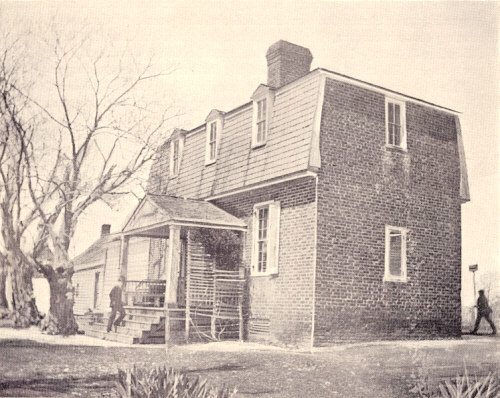
I find it interesting the size and scope of John Thomas’ estate. He appears not to be the mild mannered indentured servant our family has made him out to be. He was evidently prosperous, mixing in circles of the famed and powerful. And in preparing the estate, neighbor Joseph Crowshaw’s son-in-law Henry White documented structural repairs giving us a glimpse into what John Thomas’ home was like. Two stories, wainscotte and a portal at the stairhead; looking at the ca. 1900 photo of Porto Bello, I have to ask if the house or at least a knock-down rebuilt version of it was built upon the foundation of John Thomas’ homeplace? Or, as building technology advanced, could the archeological remains of an old barn or other outbuilding be the home place of John Thomas?

John Thomas in mention of his lands will appear in records into the 1700’s. His land will be visited by a notable Quaker and will later become home away from home being the Governor’s retreat. We do not exactly know John Thomas’s religion or beliefs. However, upcoming posts will shed light upon the lives and beliefs embraced by his children.

JOHN THOMAS: A STARTING POINT IN VIRGINIA (PT. 4)

poro

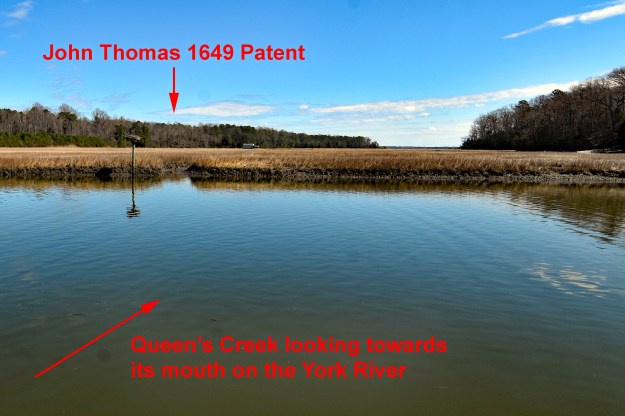
Before moving forward, let’s take a bit of time to place locations previously mentioned:

A. John Thomas’ 1649 patent – Located on the north side of Queen’s Creek. This patent names “wife Dorothy.”

B. Ware Creek – About 15 miles up-river being the location of John Broach’s Patent with headright for Anthony Parkhurst. John Broach would soon sell land on Queen’s Creek to said Parkhurst from whom it passed to John Thomas per 1649 patent. Also, just a year before John Thomas’ patent on Queens Creek, William Hoccaday patented land on Ware Creek with headright for John Thomas.

C. Skimino Creek – Location of dissenting Quaker activity, second stop (after with Edward Thomas) of Quaker Thomas Story, and place where “John Thomas of Queen’s Creek purchased a horse.

D. Poropotank Creek – Not yet mentioned, and as will soon become perfectly clear, John Thomas of Queen’s Creek received a land patent in on this creek. Situated on the north side and about three miles upstream from its mouth on the York River, the land was in then Gloucester County on the county line in what became King and Queen County Virginia in the 1650’s. Note there are very few records surviving for early Gloucester and King And Queen County. John Thomas must have had a keen business sense with the ability to make it as one of Virginia’s early farmers. He hedged his options through the diversification of land holdings. We traditionally see him as cloistered on the banks of Queen’s Creek. That’s not so.

The following are but a few records I found for John Thomas and his land on Poropotank:

JOHN THOMAS, 450 acs. Gloster Co., 6 Nov. 1651, p. 343. Upon W. N. W. side of Poropotank Cr., about 3 mi. up the same, along the Cr. Side opposite to land of Mr. Nicho. Jernew. Trans, of 9 pers: Edward Hide, Kath. Thomas, James Thomas, John Richards, George Locke, Wm. Peale, Abigale Longdale, John Brocas, Grace Musgrove.

JOHN LEVISTONE, 400 acs. Gloster Co., 16 Dec. 1653, p. 227. On the W. side of Poropotank Cr., behind land of John Thomas, etc. Trans, of 8 pers: Anne Silke, Jno. Backster, Barbery Scott, Ralph Bottock, James Joane, Rose Allen, Wm. Lamb.

RICHARD WILCHIN, 300 acs. Gloster Co., 30 Sept. 1654, p. 289. On N. E. side of Poropotank Cr., adj. land of John Thomas &c, to a Cr. dividing this & land of Mr. Canho & Mr. Vaus. 200 acs. by vertue of the rights of a bill of sale for so much from Mrs. Eliz. Vaus, the Atty. of Robt. Vaus, & confirmed by Mr. Hump. Vaus & Mr. Joseph Croshaw; & 100 acs. for trans, of 2 pers: Richard Wilchin & his wife Rachell.

JOHN LEVISTON, 453 acs. New Kent Co., 30 Aug. 1664, p. 348, (363). N.W. side of Poropotanke Cr., adj. John Thomas’ land, running S.W. by S. &c. to Timothy Landells land, thence W. by N. &c. 400 acs. ranted him the 16 Dec. 1653 & 53 acs. for trans, of 2 pers: Joane Browne, Henry Pratt.

JOHN LEVISTON, 453 acs. New Kent Co., 30 Aug. 1664, p. 348, (363). N.W. side of Poropotanke Cr., adj. John Thomas’ land, running S.W. by S. &c. to Timothy Landells land, thence W. by N. &c. 400 acs. ranted him the 16 Dec. 1653 & 53 acs. for trans, of 2 pers: Joane Browne, Henry Pratt.

Note that neighbors from Queen’s Creek such as Joseph Croshaw and Nicholas Jernew owned land near John Thomas on Poropotank. And most interesting is the 450 acre patent by John Thomas. Just two years after patenting land on Queen’s Creek, and maybe being just three years after a John Thomas came to the area by headright for William Hockaday, now John Thomas is himself transporting nine persons to America. Among them are persons named Katherine Thomas and James Thomas. Who are they? How do they play into our story?

Sorry for the sidebar but this is much needed before moving on. And now, as prior said, let’s look at information gleaned from the death of John Thomas and let’s start to view him from what we’ve learned of the family thereafter.

JOHN THOMAS: A STARTING POINT IN VIRGINIA (PT. 3)

john'sThe report titled “History of Porto Bello Plantation” is brief, placing emphasis on the methodology used in creating a historical timeline. The Thomas family is included in the report only because the plantation traces nicely back to John Thomas, subject of our own family study. It’s not at all meant nor written to be a Thomas family history. Therefore, I’ll not confuse our story by merely copying verbatim the entire study. Instead, one or two pertinent paragraphs (quoted in brown type) will be offered along with the addition of a more complete account of Thomas family records. So, and by courtesy of the James River Archeology Institute, on to paragraph two:
The subject of the Porto Bellow study known as Site 44YO1084 was encompassed by the Queen’s Creek plantation of the Thomas family, a York County clan with strong ties to Virginia’s Quaker Community. In October 1649, John Thomas patented a 300-acre tract on the north side of Queen’s Creek. This prime waterfront property was bounded by the land of Joseph Crowshaw to the northwest, the land of Nicholas Jernew to the northeast, the creek to the southeast, and to the southwest by “a Little creek and swamp leading to the Indian Cabin.” The patent indicated that 300 acres of the property had originally been granted to John Broach [variously spelled Brocke, Broche]. In fact, in November 1637 Brocke had patented two tracts in this vicinity; one of 400 acres and at the point of land where Queen’s Creek empties into the York River, and the 300-acre parcel immediately to the east. According to Thomas’ patent, Brocke subsequently sold the 300-acre parcel to Anthony Barkhurst, who in turn deeded it to Thomas (Nugent 1992: 76, 185-86).

The above mentioned 1649 patent to John Thomas may not refer to Anthony Barkhurst but rather should read Anthony Parkhust. And note from records that follow, the above mentioned John Broach also received 1,000 acres on Ware Creek. That land was acquired in part as headright for transporting Anthony Parkhurst to York County. John Broach was a French Huguenot, a surgeon, and it is believed his descendants evolved to be among today’s Brooks families out of Orange and Chatham Counties NC.

It also happens that William Hoccaday (shown below) received a headright a year earlier (1648) than the above John Thomas’ 1649 patent. Located on Ware Creek in now New Kent County, a person named John Thomas was among those being transported by William Hoccaday. Ware Creek enters the York River about 14 miles upstream with Skimino creek entering about midway. Having ties to Anthony Parkhurst on Queen’s Creek, is it possible that John Thomas who connects with William Hoccaday is the same as he who lived on Queen’s Creek? And note that Skimino is an area where settled a dissident group or meeting of Quakers.

The following records relate to and provide background for the above discussed time period:

-JOHN BROACH, 1,000 acs. Chas. River Co., Aug. 18, 1642, Page 788. Upon Chas. River & Ware Cr. Trans, of 20 pers.: Sarah Symons, Edward Watkins, Tho. Griffin, John Hickes, Nicholas Bannister, John Sheppard, 5 Negroes, & Antho. Packhurst (or Parkhurst) 3 times. 300 acs. by order of June 5, 1640 assigned unto him by Mr. Rosier.

Apr 1638 John Brocke, Surgeon, freely bestowed upon my godson John Major, son of Richard Major of Queens Cr., boate right, age 3 3/4 yrs, one cow one heifer and one yearling, etc., to be delivered when he is 18 yrs.” In May 1638, he assigned his 400 acres in Charles River Co. to Nicholas Jarnes.

-NICHOLAS JARNEW (Jernew), 400 acs. Chas. Riv. Co., 6 May 1638, p. 545. E. upon sd. river, bounded S. E. with Queens Cr., running parallel to same until cut off by a Cr. called Jarnew’s Journey. Due by assignment from John Brocke.

-JOHN DAVIS, 150 acs. Yorke Co., Oct. 29, 1647, Page 133. Upon the upper side of Queens Cr., adj. Mr. Jernew, along John Judson & Joseph Croshaw. Trans, of 3 pers.*

-WILLIAM HOCCADAY, 1346 acs., whereof 246 acs. of marsh lying near the narrow of York river, N. E. by N. upon the river, S. & by W. & E. & by S. upon the Ware Cr. & N. W. by N E upon Warreny [Warronny Creek] Cr. 500 acs. granted him by patent 6 Aug. 1646 & 846 acs. for trans, of 17 pers: Thomas Seawell, Hugh Smister, Hugh Jones, Junr., Edward Wood, Hugh Arther, Hugh (?), John Limicar (?), William Jones, Senr., Nicho. Smith, Edward Wood, Hen. James, Jno. Williams, Mary Gardner, Peeter Green, John Arthur, William Richards, John Thomas. 10 Dec. 1648, p. 168

-ROBERT VAULX, 330 acs. York Co., 10 Apr. 1657, p. 87, (126). On S. side of York Riv. & N. side of Queens Cr. 225 acs. part granted unto Jno. Judson 21 Nov. 1637, assigned unto Arthur Price 4 Mar. 1639, who assigned unto Anthony Parckhurst 29 Aug. 1640, who assigned unto William Burwell 26 May 1643, assigned unto Jno. Davis 17 Dec. 1644, assigned unto Mr. James Stone 2 Apr. 1646 & unto sd. Vaulx as Admr. of sd. Stone; 105 acs. for trans, of 3 pers: Mr. Charles Woodington, Ann Michell, Jno. Clarke.

-17 Nov 1659 York VA. “In difference between Matthew Page , it is ordered that a servant’s indenture sold to Mr. Page be assigned him for the full time and also John Thomas is to pay Page a good of cotton and convers suit, a good sea bed, 2 pr. Shoes, 2 pr. Stockings, 2 good canvas shirts, a monmouth cap, a rug and pillow and also clothing and necessaries which belonged to said servant and not already delivered.”

2-4 May 1660 York VA. “It appears that Samuel Straney took a boat of Mr. Patrick Napier’s from the landing at John Thomas’. And it is ordered he pay Napier 350 lbs tob., in regard to great prejudice done to Napier for want of same, being then visiting his sick patient and forced to wait for his boat for a long time by reason of said Straney’s carrying same away.”

-Arthur Price of Skimino Gutt, sell to John Thomas of Queen’s Creek, Planter, one chestnut horse about 8 years old, called Rouse. 22 Jun 1660 York. Wit: Tho. Wharton, Ricahrd Roberts. Approved by Maj. Joseph Crowshaw.

-Deposition by James Stainsby, age 28, examined 1 May 1661, says that in difference between John David and John Thomas, by the devilish instigation, vile and cruel persuasions of William Pettipoole and Anne his now wife did suborne your deponent to swear falsely concerning his master John Thomas, that he should give your deponent a certain sum of tobacco to swear that John Davis had killed a steer, which now I do here pronounce under oath, that my said master Thomas, nor his wife, nor none belonging to them never offered me no such thing, nor never desired nor persuaded me to swear for or against anyone in any matter, knowing my master Thomas behaving himself civil and honest to all persons; and that William Pettipoole and Nann his wife swore concerning him to false, and proceeded out of silence and envy, because my master Thomas checked them from stealing several bags of tobacco from John Davis and called them “thieves”, and forbad them his house. Further saith that what tobacco and other things Pettipoole and his wife stole from John Davis, they sold aboard sloops in Queen’s Creek and converted it to their own use, and sold a case of drams to the negro Emanuel Anvill. Said Pettipoole often persuaded me to accept stolen tobacco at my master’s house but I denied the, thereupon they hid it in hollow trees about the plantation, and so by night would carry it aboard sloops. James (S) Stainsby sworn before me, Wm Barbar.

Not only do the above records give us a glimpse into the character of John Thomas, they also tell us a little about the neighborhood in which he lived. Note that John Thomas had a legal issue with Matthew Page. Matthew may be the brother of Colonel John Page, prominent merchant, supporter of the first Bruton Parish Church and chief proponent of the village now known as Williamsburg becoming the Virginia State Capital. There’s also the purchase of a horse on Skimino Creek that loosely connects John Thomas of Queen’s Creek to the area of Ware’s Creek.

We now know that John Thomas of Queen’s Creek had a boat landing, a dock whereupon early surgeon Patrick Napier’s boat had been taken without permission. Patrick Napier apprenticed under the surgeon general  of the Scottish army during its defeat by Cromwell in 1650. And, remember that John Thomas’ own land had earlier been the property of a French surgeon named John Broach.

John Thomas’ land was close to the mouth of Queen’s Creek and having seen the area with my own eyes, I can imagine the sloop cruisers and long boats anchored and docked along the shoreline. I can imagine John Thomas’ indentured servant and the pressure put upon him by William Pettipoole to steal and resale tobacco to those aboard the boats. Tobacco, early livelihood, and other records so real you can almost smell it!

But then there are the families of Jernew, Vaulx, Davis and other neighbors along Queen’s Creek. From the records, you can see and imagine how the families interacted. As you’ll learn in later posts, such familial interactions continued into the early 1700’s.

One thing omitted in the Porto Bello Report is the naming of Dorothy, wife of John Thomas as appears in his 1649 patent. The patent reads: and fifty acres the residue being deed unto ye sd John Thomas by and for the transportation of one person into the Colony whose name is in records mentioned under this patent … dated ye 4th 8ber 1649 –  Dorothy WifeThe standard for headrights was 50 acres per person transported along with 50 acres for taking a wife. It appears that John Thomas received 50 acres for transporting his wife to America.

In 1665 the life and story of John Thomas comes to an end …or does it?  In later posts you’ll see that his last will and testament mentions a wife having a name other than Dorothy. The disagreement with what we’d like to believe true will surely be important in further discussion. But, as will be shown, the lands of John Thomas who died in 1665 can be traced both to the present and back to the 1649 patent naming wife Dorothy. There’s no further information on the life of John Thomas as related to paragraph two of the Porto Bellow report. The report’s next paragraph opens with the death of John Thomas, so let’s move the timeline forward a bit.

JOHN THOMAS: A STARTING POINT IN VIRGINIA (PT. 2)

Porto_Bello_lodge

Porto Bello, photograph taken approximately 1900

A recent post introduced the lands of John Thomas on Queen’s Creek in York County VA. It was described in a 1649 patent as being adjoined

“on the north by west upon the land of Joseph Croshaw, south by east upon Queen’s creek, west by south upon a little creek and swamp leading to the Indian cabin and east upon the by north land of M. Jernew, three hundred acres of the said land being granted formerly unto John Broach and by the said Broach assigned to Anthony Barckhurst and purchased of the said Barkurst by the said John Thomas and fifty acres the residue being deed unto ye sd John Thomas by and for the transportation of one person into the Colony”.

Without substantiated proof, this has been considered by many to be the earliest known lands upon which lived John Thomas who is believed to be my family’s emigrant ancestor. This belief may or may not be true as new finds are leading us down a path to a much greater understanding of this piece of land and what it means to our family.

Remember from an earlier post that our family has traditionally located John Thomas’ 1649 patent to be on the north side of Hwy 132 near Williamsburg. Wrong. Remember that Mark Kostro, Project Archaeologist for Colonial Williamsburg, stated that “John Thomas’ land is highly unlikely to be the location previously portrayed. However, [he firmly stated], it does lie somewhere along the north side of the short run of Queen’s Creek. And from a previous study aimed at connecting original land holdings, it’s highly likely that John Thomas’ 350 acres does indeed lie on the grounds of the secretive base known as Camp Peary” [a CIA training camp which immediately made us exclaim …. we’ll never step foot on that land!]. Mark Kostro was clear in that he had no certain information other than knowing the land could not be where we thought. He did though, give us an idea of where land may be located based on a past project carried out by a trusted intern.


Just as I was about to roll out this stuff, we received word from Mark that he had contacted other researchers who both validated his beliefs while offering significant changes. Instead of being where the intern’s study had placed it, the 1649 patent is closer to the mouth of Queen’s Creek near the York River. It’s now seen as adjoining Queen’s Creek near the present-day docks of Camp Peary.

So, what’s the scoop on this new angle of information? As it turns out, Camp Peary, like many government installations, is keenly interested in its own history. And to that end, the highly-respected James River Institute for Archeology was contracted to research the history of a site on Camp Peary known as Porto Bello. Traced back to John Thomas’ 1649 patent, the lands upon which Porto Bello stood are historically significant.

The next few posts will connect Porto Bello with the land of John Thomas while giving us the opportunity to take a little side-trip into John’s day and time. Courtesy of the James River Institute for Archeology, pertinent information abstracted from their report will be offered (with discussion) in hopes that we’ll understand more clearly the title history for the land of John Thomas. Wanting to be as thorough as able and realizing my own limitations, future posts will delve into the report one or two paragraphs at a time.

As we move forward it’s important for you to know that there is nothing yet known connecting this land on Queen’s Creek to our North Carolina descendancy as is traditionally believed. And, just as with the prior post, now, new information from noted York County historian Martha McCartney leads us to believe that there were at least three early arrivals with the name John Thomas. Their lives are distinguished in Martha’s book of biographical sketches titled Virginia Immigrants and Adventurers 1607-1635.

As originally stated, our goal is to establish a clear starting point for our family history. It’s all we want for now. Many others have offered their take on the lands of John Thomas. And, once again, let’s take a close look at yet another “new research” in hopes of establishing a starting point from which to study our Thomas family. Let’s begin with paragraph two of the “History of Porto Bello Plantation.” (See next post)

GRANDSIRE JIMMY HAD A SON NAMED JAMES

We have believed for many years that James Love who left a last will and testament in Campbell County Georgia is the son of Grandsire James Love who settled in early Cabarrus County NC. Proof of this is found in an undated petition to construct public buildings in Concord, the county seat of the newly formed Cabarrus County. The petition dated roughly 1794 was signed by both James Love Senr and James Love Junior. Beyond this proof, naming patterns for James Love Junior’s family includes a son Ingraham Love in honor of his mother, Mary Ingram Love. There are other hints including the documentation of neighbors in Georgia who had also been neighbors in North Carolina.

Having just turned a new page in my life, I’ve spent the afternoon enjoying a subscription to newspapers.com, a retirement gift from my wife Christina. My very first discovery using this new tool can be found in the following legal advertisement.

clipping_9467392 11 Oct 1825 western carolinian


BANGOR-HOUSE ON QUEEN’S

thomas story.jpg

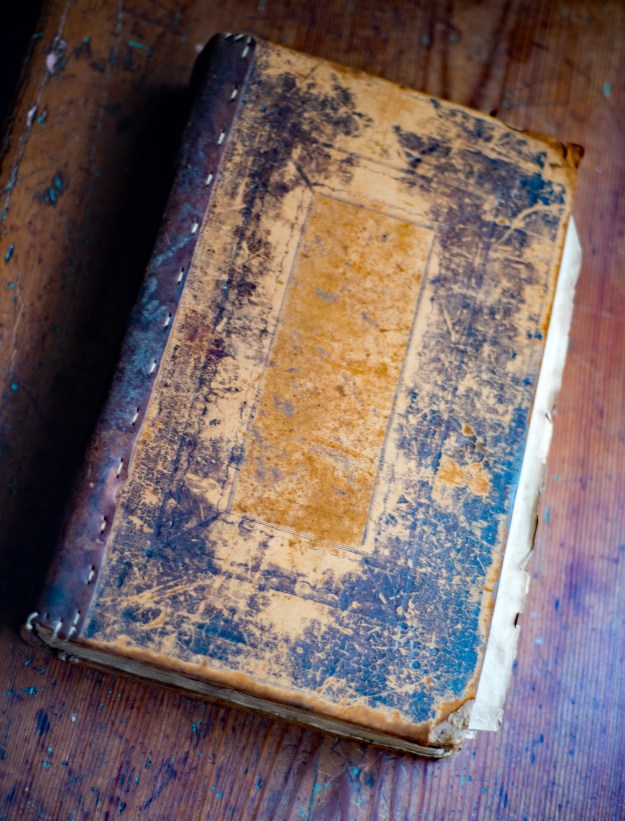
It was just months ago, when I posted about a Quaker named Thomas Story. I have a copy of his 1st edition autobiography in my possession. Little did I know then, that our family’s starting point, believed to be the lands of John Thomas in York County Virginia, is documented to be Thomas Story’s first stop and the location of his first sermon in America. Information on Thomas Story from Wikipedia: “In November 1698 Story sailed for Pennsylvania, where, at the request of Penn, …was chosen the first recorder of Philadelphia by a charter of 25 Oct. 1701, was a member of the council of state, keeper of the great seal, master of the rolls, and in 1706 elected mayor of Philadelphia, but paid a fine of £20 for declining to serve.”

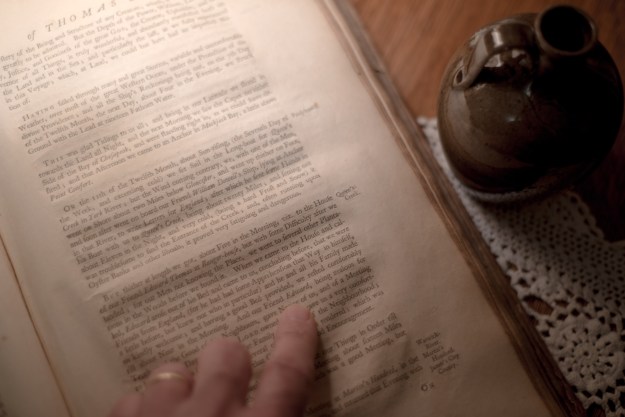
The following passages are from A Journal of the Life of Thomas Story:

Page 152. HAVING sailed through many and great Storms, variable and uncomfortable Weather, over most of the great Western Ocean, under the Protection of the divine Providence; and all the Ship’s Reckonings being out, on the 7th Day of the Twelfth Month, the next Day, about Four in the Evening, we Struck Ground with the Lead at nineteen Fathom Water.

THIS was glad Tidings to us all: and being in our Latitude we stood in towards the Land all Night, and the next Morning we saw the Capes on either Side of the Bay of Chesapeak, and were standing right in as could have desired; and that Afternoon we came to Anchor in Mockjack Bay, a little above Point Comfort.

ON the 11th of the Twelfth Month, about Sunrising, (the Seventh Day of the Week, and exceeding cold) we set sail in the Long-boat for Queen’s Creek in York River; but the Wind coming contrary, we, with one of the Men, went on Shore about two Miles below Gloucester, and went up thither on Foot, and Soon after went on board our Friend William Dowell’s Ship, lying at Anchor in that River, to write Letters for England; after which he sent some Hands in his Boat with us to Queen’s Creek, being about twenty Miles; and setting out about Eleven in the Night, and very cold, (being a hard Frost and Snow) it was troublesome to find the Entrance of the Creek; and, often running upon Oyster Banks and other Shoals, it proved very fatiguing and dangerous.

BUT thither at length we got, about Five in the Morning, vz. To the House of our Friend Edward Thomas at Bangor-house, but with some Difficulty after we landed; for our Men not knowing the Place, we went to Several other Plantations in the Woods before we found it. When we came to the House and called, Edward arose out of his Bed and came to us, concluding before, that we were Friends from England, (for he had had some Apprehension that Way in himself, a little before, but knew not who in particular) and he and all his Family made us kindly welcome; and having a good Bed provided, we rested comfortably till about Nine in the Morning. And our Friend Edward, being zealous for Truth, and the Good of his Neighbors, gave Notice of us, and of a Meeting to there that Day; where the Lord owned us, and gave us very comfortable Season of his Goodness with the Family and a few of the Neighborhood; who, though not Friends, were, Several of them, much tendered: which was the first Fruits of our Ministry in that County, and good Encouragement.

HERE we remained to refresh ourselves, and put out Things in Order till the 15th Day of the Month, and then had a Meeting about sixteen Miles off, at Daniel Akeburst’s, at Warwick River; which was a good Meeting, but small.

Page 164. THAT Evening we arrived at the Dock where the Ship was building, and lodged that Night with Captain Clayborn; and, next Day, had a Meeting at the Dock, near the Place; which was small, but comfortable; And, being weary with hard Travel, (but especially our Horses, for want of Food, or Forage) we determined to stay there till the First Day; and, intending another Meeting at the Dock, we gave notice of it to the Country.

WE had a Meeting accordingly, which was large and well; the People being generally sober, and several tendered, and after the Meeting, expressed their satisfaction; and some of Note among them said, “That since we had so good Things to publish, they were in hopes we would not finally leave those Parts “without more Meetings thereaway”; several of them adding, “That we should be welcome to their Houses, and the best Entertainment they had, though we had laid open their Priests to the lowest Capacities, and especially their Pseudo Baptism.

THE next Day, accompanied by Edward Thomas of Bangor-House, on Queen’s Creek, and his son, and some other Friends, who had come up, and given us their Company Some Days, we set forward for Queen’s Creek; but, in our Way, had much Thunder and Rain; and, though it was very dark in the Night in the Woods through the good Providence of God, we got well to that Journey’s End.

Edward was son of John Thomas who left a last will and testament in 1665 York County Virginia. From Thomas Story’s memoir, we know that John’s son, Edward Thomas, was prominently Quaker.

This took place at a time when there were very few Quaker ministers and meeting houses. Filling the void, Quakers met at the homes of respected elders where meetings were led by those called by God to do so.

The land owned by Edward Thomas can be traced back to John Thomas and his 1649 patent for 350 acres. This realization is credited to research contracted by Camp Peary. Expect much more in future posts.

book1

Journal of the Life of Thomas Story


JOHN THOMAS: A STARTING POINT IN VIRGINIA (PT. 1)

There’s a HUGE amount of research pertaining to the lands of John Thomas 1649 which now can be seen as not true. Ancestry , Geni, and other genealogy sites  are nothing more than thoughtless compilations of  what’s been wrongly said from the past. Furthermore, you may even see reference to following 8 pages of my research notes which in truth counters must of what’s been written.

Before using any of the following 8 pages of my working notes, please set aside time to read all sections in entirety.  If you have questions or concerns, feel free to contact me personally at geothos@bellsouth.net

_______________________________

We could start writing about John Thomas and his arrival in Virginia from any of many perspectives. But, as good fortune would have it, my first venture into this cause was initiated by David Queen whose knowledge and determination enabled a visit with Mark Kostro, Project Archaeologist for Colonial Williamsburg. Mark is likely the best qualified person in the region to address one of the top Thomas family mysteries.

But before moving forward, it should be pointed out that many questions can be asked about John Thomas ….when was he born, when did he arrive in the new world, and on board what ship did he sail? Was he one person, two different people, a father and son, man and cousin or nephew? And when did he marry and what was his life like following his sail to the new world? Did he make the trip once or many times? There is also question of his land holdings. Where did he first live and what later transactions are related to our ancestor versus the possibility of being confused with others of same name. And ultimately, what was the route of our ancestor out of Virginia into North Carolina where more modern records are increasingly available to search. Despite what anyone may say, the records on John Thomas do not collectively paint a clear picture. Much of what we know will be revisited in years to come and with that said, let’s now look at what’s traditionally believed to be the starting point for John Thomas in America.

Arriving sometime in the early years of the 17th century, it wasn’t until 1649 that a person by name of John Thomas is recorded as being granted land. A general location for the tract has been suggested for years by various family historians. Seeking clarity, and wanting to lay our eyes and hands on something tangible, arrangements were made for David and myself to meet with Mark who was well prepared. You’ll hear from Mark in a bit, but first look at the grant and transcription:

MicroFiche

To all & c. whereas & c. Now know ye that I, the said Sir William Berkely do with the consent of the council of State – accordingly give and grant unto John Thomas three hundred and fifty acres of land lying on the north side of Queen’s Creek and in the County of Yorke bounded vizt: north by west upon the land of Joseph Croshaw south by east upon Queen’s creek, west by south upon a little creek and swamp leading to the Indian cabin and east upon the by north land of M. Jernew, three hundred acres of the said land being granted formerly unto John Broach and by the said Broach assigned to Anthony Barckhurst and purchased of the said Barkurst by the said John Thomas and fifty acres the residue being deed unto ye sd John Thomas by and for the transportation of one person into the Colony whose name is in records mentioned under this patent to have and to hold & c yielding of which payment is to be made seven years after ye first ex. grant or sealing of the same & dated ye 4th 8ber 1649                                                    Dorothy Wife

 _____________________________________________

I cannot begin to write in detail about methodology and of how the above land was physically located. But, Edison H Thomas himself offers the following rationale and photo in his book “The Thomas and Bridges Story 1540-1840”:

“John Thomas and wife Dorothy settled on his 350 acres of land which was located near what is now the city of Williamsburg, Virginia. Today, it is a part of a military reservation and not accessible to the public. However, the general area can be plainly seen from a concrete bridge that carries State Road No. 132 across Queen’s Creek. The area lies on the east or right side of the creek as one looks upstream.”Thomas-Bridges story-59

This site is easily located on today’s landscape using an updated photo, a Google based map and Google interactive street view. And one note, of all the places on Queen’s creek to take a photo, the bridge crossing Hwy 132 offers the most representative view with the least amount of modern visual obstruction. As pointed out by David Queen, from any other vantage point, the appearance of a bridge upstream or down would detract from the image’s background.

Did Edison Thomas choose the photo location because he wanted readers to imagine the creek in John Thomas’ day and time …in the 1600’s? Was it a simple mistake or was there some other reason he located land in the secretive governmental base as being north of Hwy. 132?

Williamsburg archaeologist Mark Kostro, offered the following that both confirms and yet diverges from Edison Thomas’ take on the land. His assistance was very helpful in providing both historical context along with specific information pointing to another physical location. The impromptu presentation is in two parts, Make sure to see both!

So, as Mark Kostro clearly points out, archaeological research supported by historic record locates an early poor house on the land in question north and east of the Hwy 132 bridge. As Mark put it, John Thomas’ land is highly likely to not be the location previously portrayed. However, it does lie somewhere along the north side of the short run of Queen’s Creek. And from a previous study aimed at connecting original land holdings, it’s highly likely that John Thomas’s 350 acres does indeed lie on the grounds of the secretive base known as “The Farm” or officially, Camp Peary.

As offered in the presentation, and as based upon independent research from the past, John Thomas’ ca. 1649 grant of 350 acres is located within or near the green shaded area on the image below. Following the meeting at the Colonial Williamsburg Department of Archaeological Research, David Queen did not waste time and drove us to a public marina on W. Queen’s Drive. That location offered the best view north across Queen’s Creek towards Camp Peary and the lands once owned by John Thomas.

camp peary


DSC_2423

(top) Google image locating the John Thomas lands (in green) on Camp Peary along with location of marina and direction of viewpoint of the (bottom) photo looking across Queen’s Creek towards Camp Peary and the John Thomas lands.


In closing, I’d like to again express admiration and a sincere thanks to the efforts of both David Queen and Mark Kostro. I’d also like to express admiration for researchers such as Edison Thomas who made so much happen in a time when records were much more difficult to access. The takeaway for me is to tell the whole story. The background of how a story comes together is often as valuable and appreciated as much as the story itself. And with the same critical eye, we’ll need to move from this point to ask more questions. And for each one, we’ll need to base the answers from a large circle of possibilities, making sure to tell it all.

As for John Thomas’ land, was this the starting point for our many generations in America? Or, was this but a point along his journey south. Was this the land of our John Thomas or could it be the makings of history for someone else’s family? Our goal was to establish a clear starting point which we now have. It’s time to move forward and know that these are the challenges we will face. And please realize that new information will likely change your perspective of what you’ve just read.   Stay tuned!

GOING BACK TO OLD VIRGINIA

Filled with a curious hunger to fully understand our Thomas family, once again we come together to review and build upon prior efforts of telling our story. Some of us have seemingly clear paths through northern tier counties of North Carolina back to Virginia where records become fewer and therefore more difficult to link. There are others, like myself, whose only connection lies in DNA and the educated guess that somehow, we will someday clear a more perfect path into this family.

For us all, there is John Thomas who appears in 1620’s ship lists, a census/muster list, and a later land record near Jamestown VA. And, then there’s the story of Sea Venture, a storm, and Shakespeare’s “The Tempest.” Of all the possibilities, the connection to this place and time is nothing less than magical. It’s a great challenge! We’re talking John Rolfe and Pocahontas, the formative years prior to Colonial Williamsburg, the opening chapter of our American story.

Much has been written about this earliest of American Thomas families. Published 1984, there’s Edison H. Thomas and his “Thomas and Bridges Story 1540 –1840.” And in 1977, Robert E Thomas wrote “The Thomas family in 300 years of American history.” There’s the writings of notable researchers like historian Hugh Buckner Johnston whose mother was Ruth Thomas born in Wilson County NC. And, there’s also indispensable research materials such as “Cavaliers and Pioneers. Abstracts of Virginia Land Patents and Grants” dealing specifically with records sourced in early Virginia.

As we move forward, we’ll need to work with others in the family who have differing viewpoints. There will be differences with what was believed and written in the past. There will be disagreements both with the traditionally accepted story as well as among ourselves in deciphering the meaning of new finds. Yes, there will be new finds and new stories to tell. Some will merely add to the story while others may figuratively shake the ground from where we believed our beloved ancestors once lived.

For many years I’ve looked towards Virginia with fear and an anxious internalized kicking and screaming of Noooooo….. don’t drag me there!!! It’s a big leap going back through records I have little knowledge. It expands the tree exponentially and with that is a much larger circle of information that’ll need to be verified. There’s much written on this stuff and until now (ha-ha), I was not part of the history. But things have changed, like myself, there is a growing crop of cousins who’ll be paying us a visit in the years to come. We’ll learn of each other through DNA and by improved understanding of the records. We’ll know each other and the story of each other’s family. So, if any THOMAS finds a kinship and is interested in learning more, please don’t be shy. Join us, share, and most importantly, participate in the painless Y DNA testing. We need more participants across the far-reaching spectrum of our Thomas family.

A LOVE IN COMMON: Pt. 3


pump


For much of my formative years, the centerpiece in my family’s home was a wonderfully ornate pump organ that had belonged to my mother’s grandmother. Having been professionally refinished, it was a fabulous piece of furniture though at times it worked while other times not so well. It served as the safekeep for everything from photographs to all our birth certificates. It held two oil lamps and always, a pair of binoculars hung over the top corner finial.

As time passed, the quality of sound lessoned until one day my brother and I dug into the working end of the instrument. We repaired a hole in the bellows made by mice and even sacrificed our scout belts to replace the linkage connecting the peddles and bellows. It worked, but not perfectly so.

Even as a young kid, I was always amazed by the craftsmanship; the gingerbread and acanthus leaf scroll work. Though my mom always spoke in the most loving way about her grandmother, all I knew of her was this piece of furniture and hence I envisioned some stuffy old house immaculately furnished. But, I was wrong.

_____________________________________________

Enjoying the many trips “to the country” and even more so, the times I get to spend with my mom; it’s always good to see her fellowship with those of her own generation, those who she knew in childhood and those whose experience is the same as hers.

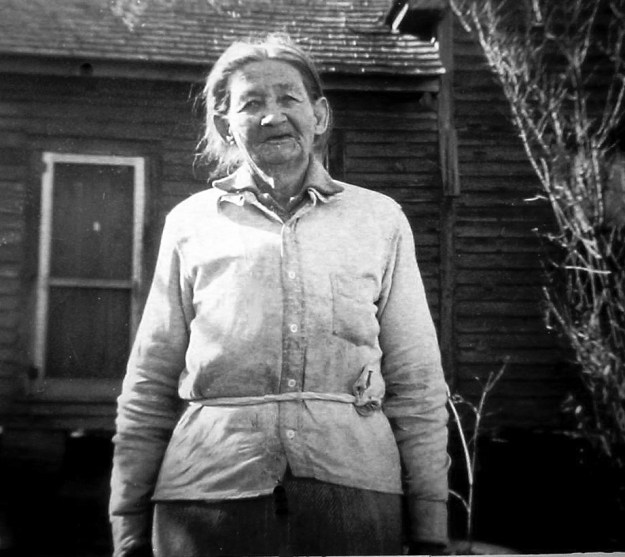
On a most recent trip, we visited the granddaughter of my mother’s uncle Rush Love. From the newspaper article, you’ll remember that Rush is the son of James Daniel and Florence Geretta Sossamon Love. To give you a little background, a trip to Stanfield has never been made without my mom pointing out uncle Rush’s barn and telling of his granary. Anyhow, on this trip I not only learned what Uncle Rush looked like, I was also given a photo of grandpa Dan and granny Florence with their organ. It’s a fabulous photo and one I’ll always cherish. These were good and simple folks and like in our house, the organ was obviously a centerpiece.

On other trips to the country we visited my mom’s uncle Coyle Love, another son of grandpa Dan and Granny Florence. I remember the house on the lower side of the road and of my mom showing me her grandpa Dan’s home place just up the road. On one trip I was introduced to Coyle’s granddaughter JoAnne who graciously shared the following testimony of times spent with her Granny Florence.

geretaGRANDMA FLORENCE – MEMORIES

My Grandma Florence lived on Coyle Road in Stanfield, about 2 blocks from our home place on the same road.  I can recall only a few, but precious memories about Grandma Florence.  When I was very young, before school age, I would get to stay with Grandma Florence for short periods of time, never overnight.

During those short visits when it was warm outside, Grandma Florence would get the metal trays out of the ice box.  She would mix up some special ingredients to make vanilla ice cream.  She would pour the mixture in the metal ice trays, and put them in the old ice box.  We then would go to the front part of the little house, and play the organ, while waiting patiently, for the ice cream to freeze. When I say play the organ, Grandma would allow me to pull a knob or two out, and peck at the keys to make music, while she pressed the pedals below.  You see I was much too short do both. I would sit on her lap while we did this, and sing Jesus Loves Me.  Then after we’d finish playing the organ, we would go back to the ice box.   She would take those metal trays and get one ice cream block for each of us.  She put each piece in a little saucer, along with a spoon. 

We would go to the back steps on the back of the house, and have a seat.  While we picked away at that ice cream cube, we would talk, and laugh. It seemed like a long time, because my little cube would usually melt, and I would end up turning the saucer up to drink mine.  I do not remember what we talked about, but I remember her laughing a lot at what I would say.  When she laughed, her little belly would shake like a small bowl of jelly.

I ask her one time, why her belly shook so when she laughed?  She only laughed harder than ever, and said I would know one day.  Well the day has arrived, and I do know and understand the answer to that question!

Some days while we were sitting on the back steps, she would tell me to close my little eyes, and then she would tell me to open them.  She would step away from me, and then I would hear a jingle, and she would walk back to me, and tell me I could open my eyes. She would have enough change in her hand to buy a can of snuff, which she enjoyed dipping. When my Mom came to pick me up, Grandma would ask her to pick her up a can of snuff at the grocery store. When Grandma Florence passed away, I was still too young to understand.  My Dad held me up so I could touch her as she lay in the casket. She was so cold.  I did not like the way she felt.  I kept speaking to her, not understanding why she would not speak back to me.  I remember crying, but Grandma Florence still would not offer to let me play her organ, or make me some block ice cream, so we could talk, laugh, and I could watch her little belly shake.   

It is strange how we may be very young, yet keep such vivid memories of the special people in our lives that meant a lot to us. I still love to eat ice cream, talk, laugh, and when I feel my belly shake a little, I just smile and think of Grandma Florence.  Both of us, sitting on the back steps of her little house in Stanfield.  She was a very sweet, kind, and good lady to a very young little girl.  She made a big impression on me, as to how to treat others, and to create memories to live by.                                                                                                                   Joanne Love Yow

_____________________________________________

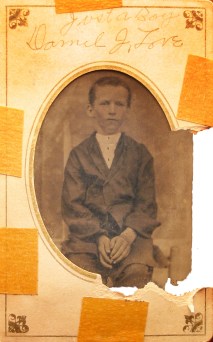
jdan2Just a boy, James Daniel Love was raised in his father William James Love’s house located north of Love’s Chapel on the west side of Love’s Chapel Rd. I’ve been told a certain old tree in a field behind the present-day houses lining the road was the spot where the old home place once stood. And further back in time, I’ve heard this was also been the home of William James Love’s father, Jonah Askew Love. I’ve always wondered about that.

Dan, as folks would call him, married and left a legacy I’m proud to be a part. He and Florence Sossamon were blessed with a good start in life. However, the years following the stock market crash paid a toll on everyone, and this couple was not immune.

During the past 20 years, our country has passed through a similar time though by no means of the same degree of severity. Called the “New Norm,” growth has been slow or nonexistent. We’ve become creative with money making schemes and life’s just a bit different. But, if times really got bad, I’d reflect on, and find strength in, the lives of people like my great grandparents.   I’m sure they worked hard to make ends meet. And, I can imagine the couple with their pioneer spirit. I’m sure a garden was kept and it was a way of life where daily sustenance grew from much more than a paycheck. You didn’t need to bring home the bacon because it was safe in its pen outback.

In closing, I’d like to share a few remaining photos that I hope you’ll enjoy. Also, please note that I’m looking for and would love to talk to anyone who’d like to share the stories of their members of this greater LOVE family.


A LOVE IN COMMON: Part 2

conrad_tonemappedIt was in 1799 when the young Conrad Reed’s discovery on Little Meadow Creek changed America. The son of a German Hessian, he was the first to discover gold in the new country. A few short years later, ca. 1805, Conrad married Martha, the daughter of James Love, a neighbor and founder of a nearby Methodist church known as Love’s or Mount Moriah. Conrad and Martha raised a family on a large tract of land on the banks of Rocky River just south of the present-day intersection of Pine Bluff and Nance roads. And remember, keep in mind this post will all lead back to my great grandfather James Daniel Love and his wife Florence Geretta Sossamon. Note that Conrad’s Martha is the sister of James Daniel Love’s great grandfather Jonah Love.

Conrad and Martha’s first born was James L. Reed who was likely named for Martha’s father, James Love. Court records indicate Conrad Reed died in 1834 at a time when the Reed family was racked by greed over control of their prosperous mine. It was James L Reed who penned an agreement hoping to bring order to the family venture.

On 10 Jun 1836, James L Reed married Susan Love, the daughter of Thomas and Susannah Polk Love. Thomas was a brother to Jonah and therefore offers another Love connection to my story. Thomas Love owned land near Reason’s Branch along the river in now Union County. He also supported the church and is listed among the early trustees of Bethel United Methodist in Midland. James L Reed died young and on 4 Sep 1845, a committee met at his house to lay off a widow’s allotment. James Reed’s grave survives and it is located in a small cemetery on a hill crest amongst a small trailer park near the intersection of Pine Bluff and Nance Roads. His resting place is likely near that of his father, Conrad’s.

lucy-hartsal

Lucy Hartsell, wife of Columbus P Sossamon

On 2 Dec 1847, David Green Sossamon married Susan Love, the widow of James L. Reed. Hmmm…..Sossamon! Note that David is the son of Christian and Susan Kiser Sossamon who are buried at Flat Rock Lutheran Church cemetery. And on 6 May 1849, Columbus P Sossamon was born to Susan Love Reed and David G. Sossamon. Dated 21 Sep 1867, the young Columbus P Sossamon married Lucy Hartsell, the daughter of Joshua and Hester Love Hartsell. And yes, you’ve got that right! Hester Love is the daughter of Jonah Love and is therefore the sister of James Daniel Love’s grandfather. And, though not a direct blood line in this case, Joshua Hartsell’s father was Andrew Hartsell who married Conrad Reed’s sister, Catherine. Following the death of Catherine, on 9 Nov 1833, Andrew married Sally Love, again, a daughter of Jonah Love. She was 26 years younger than Andrew. And following the break-up or Reed’s mine, Andrew purchased the mine and hundreds of surrounding acres.

So here we are, and I hope your patience has held out. Conrad Reed married Martha Love, and their son James L Reed married Susan Love who after the death of her husband James married second to David G Sossamon and had son Columbus P Sossamon who married Lucy Hartsell whose mother was a Love and who’s the mother of Florence Geretta Sossamon born 20 Sep 1871. And, Florence Sossamon, my mother’s grandmother, married 2 Nov 1890 to James Daniel Love.

Packed full of Love, Granny Florence came by it naturally as is clearly reflected in both her heritage and as you’ll see, the words of her legacy.