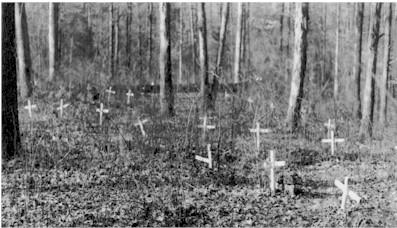
Category Archives: Uncategorized

THE WORST OF US ALL (PT 3)

Following his near-death experience in January of 1871, Henderson Judd was reminded of his own physical mortality. A month later, in February of the same year, he gave to Macklin C. Thomas, son of Tillman Thomas and wife Harriet Judd Thomas a $60 promissory note dating to the early 1860’s. Macklin was to use it to cover one of Henderson’s liabilities. And then unrelated and on 29 Mar 1871 , at the request of Henderson Judd, Col. A. A. F. Seawell wrote and executed a deed of trust for the said Judd. Registered in Chatham County and recorded in deed book and page AP-59, Col. A. A. F. Seawell and Jefferson Thomas acted as trustees for Archibald Judd and the other children of Henderson Judd. The deed of trust reads:

“…in consideration of the sum of one dollar to the said Henderson Judd paid by the aforesaid Jefferson Thomas and Aaron A. Seawell together with the further consideration of my affection for Archibald Judd, Adelar Judd, John D. Judd, James Judd, Nancy Judd, William H. Judd, Jonna Judd, Mary H. Judd and Lula Judd of whom I the said Henderson Judd are the reputed father which reputation is admitted to be true.”

In this instrument, three tracts of land along the Cape Fear River totaling 174 acres were placed in trust for the benefit of Henderson’s children. Other property conveyed in trust is also described after naming and including all the land:

“ …also all the stock of horses, mules, cattle. And hogs and all the personal property of every description which I the said Henderson Judd now own or may hereafter become the owner of up to the day and time of my death.”

The subject of Henderson Judd has been well written about from the perspective of the family descendants of which in one article can be found the following:

“On July 27, 1871, Henderson Judd was dead.

The family tells that on that day, Henderson was paid another visit by the Klan, and in retaliation for his testimony against them, Henderson was dragged out of his house, tied to the old oak tree, castrated, and left to bleed to death.”

So, in Mar 1871, Henderson Judd deeded land for the use of his five children who were also his former slaves and who were now free. And then on 27 Jul 1871, he was dragged out of his house, tied to a tree, castrated, and was left to bleed to death. But his story did not end at the base of a tree. On the very same day, “some hours prior to his death, [Henderson Judd] called us to his bedside.” In what’s known as a nuncupative or oral will, Henderson Judd did not die without his final wishes being spoken and recorded.

On the same day, 27 Mar 1871, Henderson Judd was indeed visited at his bedside as his last will and testament reads:

henderson Judd

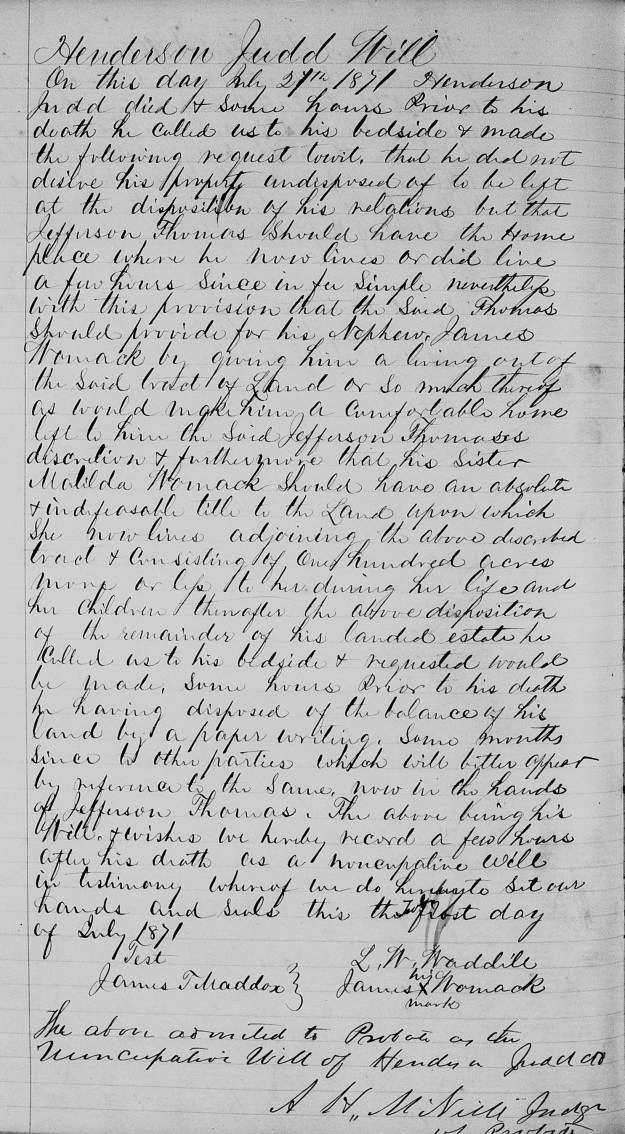
On this day Jul 27th, 1871, Henderson Judd died & some hours prior to his death he called us to his bedside & made the following request towit that he did not devise his property undisposed of to be left at the disposition of his relations but that Jefferson Thomas should have the home place where he now lives or did live a few hours since in fee simple nevertheless with this provision that the said Thomas should provide for his nephew James Womack by giving him a living out of the said tract of land or so much thereof as would make him a comfortable home left to him the said Jefferson Thomas’ discretion & furthermore that his sister Matilda Womack should have an absolute & indisposable title to the land upon which she now lives adjoining the above described tract & consisting of one hundred acres more or less to her during her live and her children thereafter the above disposition of the remainder of his landed estate he called us to his bedside & requested would be made some hours prior to his death he having disposed of the balance of his land by a paper writing some months since to other parties which will better appear by reference to the same, now in the hands of Jefferson Thomas. The above being his will & wishes we hereby record a few hours after his death as a nuncupative will in testimony whereof we do hereunto set our hands and seals this 27 of July 1871. L. W. Waddill Test: James T. Maddox James (X) Womack The above admitted to Probate as the Noncupative Will of Henderson Judd A. H. McNeill, Judge

So, the old man Henderson Judd has died and at that point life in the neighborhood began to reset its clock accordingly. I’m not sure where Henderson is buried and if that information is even known. As for Yearby Thomas, he lived until 1880 and is buried in Lee County.

By way of the nuncupative will, undevised portions of Henderson Judd’s estate lands had been bequeathed to a select few nephews and a niece. And back in March of the year of his death, the black children of Henderson Judd had received a sizeable portion of his estate lands which was held in the hands of trustees. However, in a last hour oral statement taken on his death bed, the trustees were given the right to sell any of the lands as was needed. And as you can guess, selling they did. Within a year or two, much of Henderson Judd’s land along the banks of the Cape Fear was sold to Mr. Rosser of Chatham County. I can’t morally judge this action as I have no idea whether or not the land was sold for good reason.

juggland

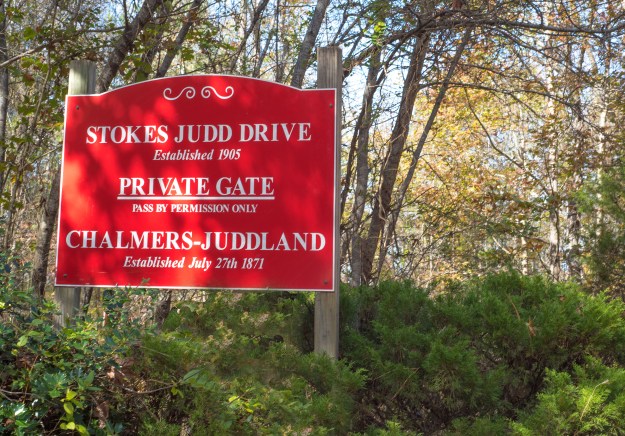
This all is probably one of those things no one wanted to remember, but you’re wrong if you think it’s been forgotten. At the back end of Buckhorn Road stands a sign identifying “JUDDLAND.” Notice the establishment date on the sign. This is the place where Stokes Judd lived and was beaten. It’s the land that passed down from Henderson Judd to Stokes Judd and on and on through his family. It’s not far from where the old school or church once stood. And family descendants return annually to celebrate the memory and the struggles Stokes endured. The story of Stokes Judd can be found at The Curious Case of Stokes Maddox Judd, Former Slave and Confederate Pensioner. There’s also an article written about Henderson Judd and the Outrage on the Cape Fear River. And lastly, the Congressional Report providing detailed background can be found at Congressional Series of United States Public Documents, 1872, Volume 1530


THE WORST OF US ALL (PT. 2)

churchBorn ca. 1761 possibly in Northampton County, in 1802 Thomas Dickey (Dickens) received a land grant in Chatham County for 50 acres adjoining the Moore County line. Thomas Dickens’ land was close to the Cape Fear River adjoining that of John Womack. It was east of Joseph Thomas’ who later sold his land to Ishmael Roberts, who was a person of color.

Trying to connect the dots and not finding any information documenting whose son he was and exactly where he lived, it is known at some point a person by name of Anderson Dickens gave an acre of land for what was later listed in a Federal case as being a church. However, depositions indicate the land may have actually been used for a school. Either way, located near the original 50 acre grant issued to Thomas Dickens, the church/school was for the use of the community of African Americans who lived in the neighborhood.

Also of importance, Henderson Judd lived near Anderson Dickens. A prosperous white farmer, prior to the close of the civil war, Henderson had fathered at least five mulatto children born to his slave/housekeeper named Mary. And following the close of the war, Henderson Judd and Mary had an additional five children. It was in 1871 that the aging Henderson Judd conveyed land to his freed black children. It’s at this time starting in the winter of 1871 that things went horribly wrong.

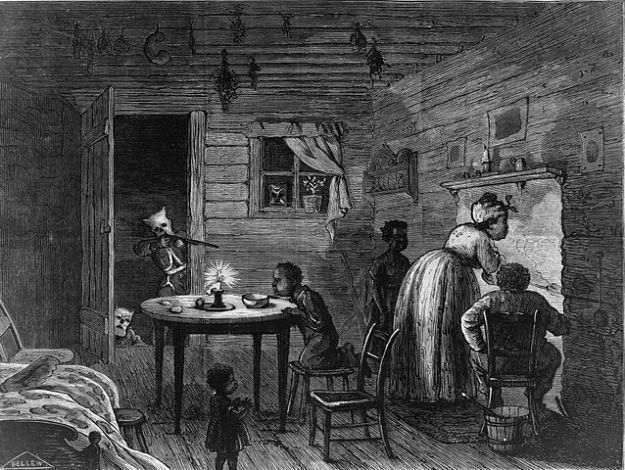
On two separate occasions occurring in short succession, five disguised clansmen swept into the community. When apprehended and asked of their rationale, the five men gave the following answer: “they were going to drive the negroes out of the county; that they were not going to allow them to be there.” Of the five, only one was seen and recognized, and his name was John Yerby Thomas.

The events are well documented with a sworn examination taking place in Washington DC. Deputy US Marshall Joseph G. Hester operating out of Raleigh handled the cases and he gave testimony of events beginning in January 1871. In the first event, Joseph Hester was sent to a place called Big Poplar, at the corner of Harnett, Moore and Chatham Counties with a warrant to arrest parties going in disguise upon the public highways. They were also trespassing upon the premises of William Judd, Stokes Judd, and Anderson Dickens and of “burning a church on the land of Anderson Dickens.” A white man, Anderson Dickens had given the small black community ground near Judd’s to build a church/school. Soon after it was built, the group of disguised men came to Dickens’ house in the dark of night. Using fence rails to break down the door, Dickens and his wife were compelled to take fire from their own place and to carry it to the little church. Dickens was forced to take benches from the church and he was commanded to pile them into the middle of the floor. His wife was compelled to gather brush and sticks from the woods. A fire was kindled and soon the church was in flames.  Afterward, Dickens and his wife were told to go home and to never speak of the evening. The men then went to William Judd’s and whipped his son and then to Stokes Judd and whipped him too. Both victims were people of color with Stokes possibly being Cherokee.

The five men were arrested and carried to Raleigh; however all gave bond and returned home. Two or three days afterward, William Judd, whose son had been previously whipped, came to Raleigh and made a second complaint. Upon his return, the Ku-Klux attacked him a second time. Somehow William was able to make it to the woods with his family where they were able to hide until danger had passed. They all made their escape except for a woman named Bella Douglass who was not very well. Captured in the house, the attackers cut limbs from a cherry tree and whipped her severely.

Henderson Judd loaned US Marshall Hester horses and guided him to the road leading to where the KKK men lived. Henderson told Hester that upon the men’s return from their first arrest, the said Henderson had been pulled from his own home. Henderson’s guns were taken and his dogs shot. “They carried him five miles from his home and there dismounted him, and he was compelled to walk home in the night, over a very rough, rocky road.” Henderson was an old and decrepit man some 65-70 years old. While at the home of Henderson Judd and his nephew Rora Womack, US Marshall Hester was told that on the occasion old man Judd was carried off, they cut his clothes off and made him walk naked the five miles home. Again, this was the cold of winter. Also carried away were an old infirmed black lady and a fellow named Hance or Hanks who may have been working on the barn. Some say the old lady was Henderson Judd’s Housekeeper Mary. Neither Hance nor the old black lady survived the ordeal as they were both dead within a day or two.

Henderson Judd and his neighbors had been horribly abused. Still considered wealthy and owner of much land, his respect in the community plummeted following the civil war. It was considered okay  to do the things he had done while a slave master, but he had done nothing to change his ways following the war.  Out of step with the prevailing winds, and though still wealthy, Henderson was viewed by many as low class. He knew he was a marked man and the blood-letting was not yet ready to end. Let’s turn the page …


FROM THE WORST OF US ALL (PT 1)

kkkThere’s always good and bad. And, sometimes in our studies of family history we’ll uncover extreme examples of both. I’m not a believer that just because something is true it’s wise to tell. Sometimes things evil in nature are best left unsaid. But then again, even out of the worst of us can be found goodness or at least some rationale commanding us to do good. Lessons can be found in both good and bad.

In this three-part series of posts, I’ll write about John Yerby Thomas and of his despicable acts of hatred during the post-civil war period of reconstruction. I’ll also write about his family and what I know of their connection to ours. Does Yerby carry our blood and is he of our Thomas family? Ultimately that’s not as important as his crimes and the lessons we all must learn. And as for his doings, hopefully Yerby Thomas was condemned by the highest standard.

As has been outlined in prior posts, DNA shows that my Thomas family in Anson County NC somehow connects to a line out of early Wake County. We are family. That other part of our family first settled in Wake about 1772 and later moved across the county line into eastern Chatham into what’s now Lee County. Joseph Thomas [III] owned land along Bush Creek where at the turn of 1800 free people of color also settled. I hope the relations were good since we know there were numerous land transactions between our family and those  who were of color. The families of Ishmael Roberts and others even purchased from the 1819 estate of Joseph Thomas. All appeared well until in the 1830’s the families of color removed themselves to Indiana. A great wave in politics and the resulting change in social landscape drove them from their homes in North Carolina.

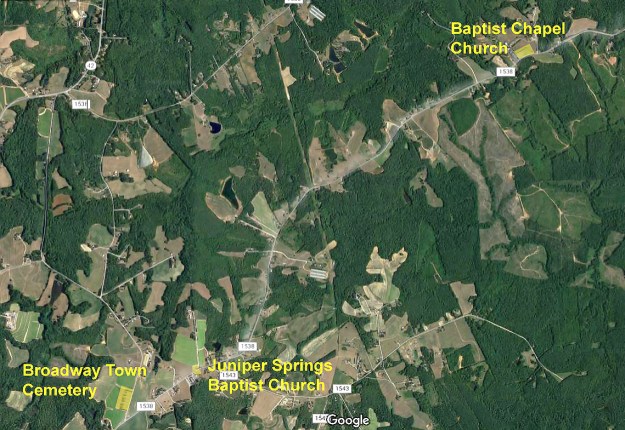
Much of Joseph Thomas’ children drifted a bit south out of Chatham across the old Moore County line and settled near the present day loop road known as Buckhorn Road. Circling out to near the Cape Fear River, land records in the area show that Joseph’s son John must have lived and died there. This belief is supported by the burial of John’s son Tillman Thomas at Baptist Chapel Church. And less than three miles west on Buckhorn Road is more of Tillman’s family buried at Juniper Springs Baptist Church. Along with members of Tillman’s family, descendants of Grisham Thomas can also be found at Juniper Springs. And less than a half mile further west off of Buckhorn Road is the Broadway Town Cemetery where Grisham Thomas is buried. You’d think for sure by location that Grisham Thomas would be blood kin to our family? However, according to the 1850 census, Grissom was born ca. 1783 in “Virginia.” At a time when Joseph Thomas was firmly in place in Wake County, Grisham Thomas was born much further north across the Virginia state line. From this it’s rightfully considered that Grisham Thomas is not related by blood to Joseph Thomas [III]. However, there’s still scenarios in which this assumption could be made wrong. It’s important that you learn there’s a great need for some direct line male descendant of Grisham Thomas to be Y DNA tested. Y tests are the best for proving patriarchal lineages.

Juniper spring

Lorenzo_DowGrisham Thomas had five male sons: John Yerby Thomas, Wesley Thomas, Anderson Thomas, Lorenzo Dow Thomas, and William Otis Thomas. I have no information on the meaning of William Otis’ naming though his older brother Lorenzo is quite different. Like many in his time, Lorenzo Thomas was named for the eccentric travelling Methodist evangelist Lorenzo Dow (1777-1834). It is said preacher Lorenzo Dow could quiet a turbulent camp meeting with “the sound of his voice or at the sight of his fragile but awe-inspiring presence.” Dow’s audiences often exhibited unusual physical manifestations under the influence of his impassioned preaching.

Grisham Thomas also had son Wesley Thomas whose naming further shows that Grisham Thomas was influenced by the Methodist church. There’s also son Anderson Thomas; his naming is of little noteworthy. However, and as relates to this this post, it must be said that census records indicate Anderson was the owner of slaves. This is important in that following the American Civil War, Anderson Thomas applied for Southern Loyalist Claim. He was both a slave owner and Union sympathizer.

The troops of William Tecumseh Sherman camped not far from Anderson Thomas’ neighborhood during their passage following the battle of Bentonville. Anderson sought compensation for damages in response to the troops stealing of his buggy, livestock, and crops. And within his case documentation is the following brief:

Claimant was 53 years in age in 1861 and was at his home in Moore Co. at the surrender and not say that he was there all the time and was there all during the war – farming – farm consisted of 174 acres – cultivated 40. Had nothing to do with the rebel army – had 5 sons conscripted – I did not furnish them with anything – was always opposed to the war and if he would have been younger he would have gone to the Yankees – always thought the Yankees would whip and tried to keep his sons out of the rebel army as long as possible. Belonged to the Red Strings and attended Union meetings mostly private – don’t think he ever received a pass – voted for Union men all the time – voted for Holden for governor against Vance and not change one bit during the war.

Elias Cox, 38 in 1861, farmer, Moore County N. C. lived within 3 miles of claimant during the war and saw him about once or twice a month – often heard him talk he always expressed himself against the war – said it would ruin the gov’t – the union men used to meet at the public school about once a month to hold meetings but the rebels threatened them and they had to stop – saw the claim’t there once or twice and he said he was ready for any union principles – never heard anybody say anything but that he was a religious man – he said it was a rich man’s war heard him talk this in public to 5 or 6 persons several times-

Absolum Kelly in 1861 was ——-old and lived 2 miles from claimant during the war – saw him once a week and heard each other’s resentments- he voted the union ticket all the time and have seen him do it- he was a Jackson Democrat but left them in 1861 as he said they made the war and he would not vote with them anymore- was punctual in attending union meetings at witness’ house- everybody in the neighborhood knew him as a union man- heard the —– curse him for a d-d union man- heard some of the neighbors cursing him for voting for Holden during the war instead of Vance.

Account
Mule $50, Mare $75, 25 Bus of Corn $25,
200 lb of Bacon $40, 100 lbs Fodder $5, Buggy $50
The clamant files two claims: the original amounts to $147.75 –the amended to $345-Claimant says that Sherman’s army at the surrender went into camp at the Cape Fear River 5 miles from his house and remained two weeks – two soldiers came to his house and asked him where his horses were- he told them in the stable and they put ropes around their necks and led them off towards camp …

And lastly there’s John Yerby Thomas, the subject of this post. Born ca. 1811, in 1840 Yerby was living in Cumberland County beside his brother Wesley. The 1850 and 1860 census enumerates Yerby, wife Delany and son John W. (Wesley?) as living first in Cumberland and then nearby in Harnett County. In 1870, the 66 year old Yerby Thomas and wife Delany are again listed as farmers living in Harnett County. At that time a black person named Green Judd is enumerated in the household as “farm hand.”

1850 moore judd

1850 Moore County Census


Another person who’s critically important in this post is named Henderson Judd. In 1850, Henderson Judd is listed as 44 years of age and living in Moore County. The only other person living with him is his 74 year old mother Elizabeth (Solomon) Judd. And for that year and enumerated on both sides of Henderson Judd are the families of Priscilla and Green Thomas. Living with Green Thomas is 50 year old Penelope Thomas, the widow of Martin Thomas who is the grandson of Joseph Thomas [III]. And, living with Priscilla (Brown) Thomas are William Brown and Elizabeth Dickens. These folk somehow relate to the family and story of Joseph Thomas [III] but there’s little connection to Grisham Thomas except through his son Yerby Thomas.

1870 henderson judd

1870 Moore County Census

In 1870, and being during the harsh reconstruction period following the civil war, the census reveals that Henderson Judd is enumerated as head of household of a biracial family. To the right you’ll see Henderson as being white, his wife/partner or housekeeper as being black, and his 9 children as being mulatto. Also living in the household is Henderson’s nephew James Womack.

As you can see, the family of Henderson Judd was different from others in the neighborhood. In protest of this family dynamic arose a response of hatred, intolerance, and retribution. Not long after 1870, the lives of Henderson and Mary Judd crossed paths with John Yerby Thomas who as a member of the Ku Klux Klan, also lived not far away. And, just as Henderson Judd had social views we might perceive as well ahead of his day, the family of Yerby Thomas was also socially divided. It sounds absurdly crazy, but on one hand there’s Yerby Thomas whose crimes and involvement in the Ku Klu Klan will be made  clear. And then there’s also Yerby’s brother Anderson Thomas who as a religious man, supported the Union during the civil war. I wonder what that family Thanksgiving dinner looked like? And with that, it’s all about to change. Let’s turn the page and begin to look closely at recorded events and testimony heard in 1871 by the United States Congress.


A GOOD DEED

Today I happened across a very interesting deed of sale while going through online records for Anson County. In book T and on page 359, Lee Yarborough conveys to George Carker/Kiker 75 acres on the south side of Rocky River located in the river fork and Richardson’s Creek. According to his revolutionary war pension request, George Karcher was “born in the County of Philadelphia and State of Pennsylvania on the 25th day of October 1852” (1752). At one point he lived in a section of Mecklenburg County that later became Cabarrus. I believe a grant for land located north of Rocky River and east of present day Hwy. 601 is where he first settled in our state of North Carolina. You can go to my land records site where this tract and its legal description are identified as map key tract #38.

northmap

38. Grant # 3561, Mecklenburg NC. Issued to George Carrigor (Carricker), being 200 acres on Plum Run. Beginning at a stone west 152 to pine, north 48 west 59 to wo (own and Orr’s corner), south 8 west 242 (on own line passing his old corner), to ro, north 50 east 73 to ro, east 94 to stone (six feet from John Finney), south 57 east 20 to bo, north 22 east 186 to begin.

andrewBefore moving forward, it’s important to point out that just a bit south and across the river from George Karaker’s granted land is located what’s known as the Tucker Cemetery.  It’s there where Andrew Cariker’s grave is located. Who was Andrew and how is he connected to the earlier George Karaker?  Are they family?

Also found in his revolutionary war pension request, “on August 31, 1835 in Pike County Georgia, the veteran (George Karcher) applied for the transfer of his pension benefit to the Georgia agency giving as his reasons for moving from North Carolina to Georgia.the veteran’s application for a transfer was supported by the affidavit of John D Lee who states that he has known the veteran from the affiant’s earliest recollection. …and on December 4, 1848 in Heard County Georgia, Daniel Kariker [sic] gave testimony that he was present when George Karcher alias George Kariker was married to Frances lay in Anson County North Carolina about the year 1806 and that Frances Kariker is the widow of George Kariker who died in Heard County in October 1836.” George’s wife’s name is spelled incorrectly; it’s supposed to be Lee. And of further interest, George and Frances’ son Phillip had son Edmond who married Elizabeth Brown Traywick who was first married to Benjamin Thomas Junior.

The above deeded land at the mouth of Richardson Creek is located in an area thick with those of name Lee, Gilbert, Culpepper, and Brooks. We’re not certain of earlier locations in which the Gilbert family lived, though evidence points most strongly toward the northeast to points from Wake County and to its east. We also know the Brooks family passed through Chatham County and also from points further east.

In the above deed dated 1804, note that the land in question included “50 acres left William Gilbert by his grandfather John Brooks.” This is rare, huge, and a wonderful inclusion in such a simple deed of sale. The implication is that William’s mother is a Brooks …and with that, who was William Gilbert’s father?

Dated 1789 and registered in Anson County deed book B2-344, Jesse Gilbert, Esquire sold to Jno. Brooks three tracts on Richardson Creek. Located within the geographical area of these these combined families’ lands, it’s interesting that this deed was witnessed by William Gilbert and Frances Yarborbough. It’s believed that Frances Lee first married into the Yarborough family before marrying George Karcher. And could William Gilbert be the son of Jesse or possibly others carrying the name? Is he the son of John or Thomas Gilbert?

From forums online it’s clear that others have spent many hours pondering this same question. And as for myself, I’m not at all certain as to the father of William Gilbert. I’m equally unsure who all has seen and studied this deed which names William Gilbert’s grandfather. As much as being given a detailed answer, I appreciate leaving any learning opportunity armed anew with questions driving me to some greater awareness yet unknown. Simply call them clues if you like, information like that found in this deed may possibly open new doors. If you’re a researcher of this family I’d like to hear from you. Is this new and does it add to your family possibilities.

GROWING UP ON PARK ROAD

Storm Troopers

Walking up the street with our dog Mister, I laid down on the pavement to get a peek through the little holes in the man-hole cover. I knew every inch of the storm drains as earlier that summer Jamie, the Allen boys and myself spent weeks crawling in from the creek to explore and map the underground system. What a life and looking back I’m really thankful we survived and were never caught down there at a time of flooding waters for which the tunnels were designed (warning: do not try this).

With burlap sack in hand and dog by my side, pecans were needed and we had a job to do. Making our way to the vacant corner lot on Park Road, the plan was to spend the afternoon gathering nuts from under two very large trees. Thanksgiving was behind us and my mom turned to preparing the family for Christmas. My job was to collect the pecans she used to make the best ice box fruit cake you’d ever want to taste …*really.*

Mister was the dog of all dogs. He was a champion several years in a row at the Freedom Park Pet Show and was eventually awarded a grand champion trophy. The special prize was given with the stipulation my sister would not enter the dog again with the idea being to give others a chance to win. And on at least one Sunday morning at nearby Park Road Baptist, a sermon offered up by the Reverend Milford told of Mister’s frequent “baptisms” in the church fountain. Numerous times I’d see Mister outside my classroom window at Park Road Elementary waiting to lead us home at the end of the school day. What a dog!

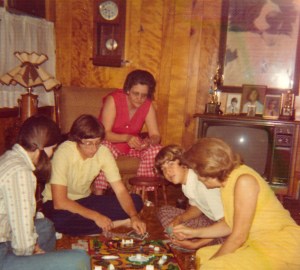
And then there was Ms. McDaniel, Mister’s good friend and our next door neighbor. I remember once her giving me a birthday cake with candles you couldn’t blow out …she made sure a place was set for Mister to join in. An older couple without kids, sometimes Ms. McDaniel and her husband would invite our dog Mister to join them on vacation. One day upon returning from a family outing, we were greeted by a huge poster sized portrait of Mister lighted and hanging in our front yard tree. A gift from Mrs. McDaniel, tor many years the framed poster hung over our console TV which was covered with all  of Mister’s trophies.


Mr's picture

Poster of Mister with trophies watching over during an evening of board games.

Back to the corner lot. On this particular fall afternoon everything was going well with our task of gathering nuts. That is, until two fellows on motorcycles turned the corner into our subdivision. It was the late sixties so imagine long hair, suede coats, and lots of fringe. And one of the bikes was the longest chopper you’d ever want to see. It was all happening so fast but I knew this couldn’t end well. You see, the one thing Mister Dog couldn’t resist was the opportunity to chase a motorcycle. Before I could even turn to him, the dog was making way at full spend trying to get to one of the biker’s feet. I’ll never forget seeing that long chopper trying best it could to swerve in hopes of avoiding our dog. It was then, all of a sudden, that there was a crash and the two bikes and their riders piled in a tangled heap. I remember heading to the scene but seeing the expressions on the biker’s faces, knew it’d be best to take my dog’s lead and run as fast as I could towards home.

The corner lot on Park Road went through a major transformation following the Thanksgiving holidays.  Strings of lights were hung, rows of stakes were driven into the ground, and Christmas trees were strapped to them creating a glorious sales display. The smell of balsam and cedar filled the air and lots of activity dominated our sub-division entrance until Christmas Day. After Christmas the display was taken down and all the unsold trees were piled up to be hauled off. It was at this time where some of us kids seized upon the opportunity at hand.

For several years, and usually during the work week following Christmas, we kids descended on the corner for what we knew was the greatest event of the holiday ….the Christmas Tree battlefield. To get the event underway, we’d chose up sides and divided all the left over trees. The trees were woven, stacked and trimmed into makeshift forts. There was the protective intersanction or keep and we even made portals from which warfare would soon visit. And after our forts of green were built, we kids pooled our money together before heading across the street for a buying spree.

Across from our corner lot was Park Road Shopping Center …the best thing going for kids. There was a movie theatre, barber shop, a pet store and even an ice cream shop. Oh, and ask me sometime about the time we kids spent several nights collecting lightning bugs which were released in mass during a Saturday morning summer children’s matinee. I digress but know that the shopping center was a great play ground. For tag or hide-and-go-seek, there’s no better place to hide than behind the coat racks in the ladies section of Ivey’s or Penny’s. And, then we discovered the back side of the shopping center. It was there, while exploring the contents of dumpsters, that we figured out you could reach the top of the building by climbing over one certain receptacle. And what a place up there; we were like kings of the world! Some of the best games of army were played on top of the shopping center and in the cold of winter the frozen lakes of water became the perfect sporting arenas for our band of mischievous kids.

Park Road Shopping Center also housed two grocery stores. Colonial was at the top of the crescent row of stores while A&P was at the lower end. It was there where we kids headed to buy as many cartons of eggs as our collective monies would allow. And so, the forts were readied and we were fully armed …it was now time for the battle to begin.

All wrapped up in protective layers of clothing, we duked it out among our little kingdoms at the corner of Park Road. Sometimes our forts worked as we had hoped but many an egg made it through the defensive fortifications. There’s nothing like the stinging smack of an egg on an icy cold winter day. There were raids and counter maneuvers and at some point the forts were abandoned for an all-out conflagration face to face …ooh!! Our annual game was repeated for several years until one certain battle ended with a chase passing through the ground floor of a newly opened office building. We had imposed badly upon the working class and knew at that point our good times were over. I think growing up is as much about endings as it is about new beginnings.

Anyhow, parcel by piece, the classy old houses and vacant lots along Park Road disappeared. For a while there was the trend of building 3-4 story office buildings. Nowadays construction has begun anew and a mix of housing is being built atop retail space. It’s the flavor of the day.

I loved my childhood in Ashcraft across from Park Road Shopping Center. We had plenty of adventures and we certainly tested the rules of norm. Yes there was neighborhood rivalry and a social pecking order, but nobody was ever hurt. We knew the limits and always watched out for each other. And in all of that, I know the neighborhood will continue to change as it always has and always will. But in all of it, I’m thankful for the memories and for my time growing up on Park Road.

HARK! HOW ALL THE WELKIN RINGS

hark

Huh??? …while working this afternoon on background for a new post, I came across an expression I’ve never heard before. Can you find it?

“In 1810 it was decided to found a church and call it Meadow Branch. The place selected was on the Concord-Camden road one mile north of Wingate. There on that sloping hillside covered with giant oaks that knew not the woodsman’s axe, and near a purling stream, Elders John Bennett and Joseph Williams and others who brought letters from Gourdvine established the ancient temple of God. Here your ancestors and mine one hundred years ago made the welkin ring. They, hardy frontiermen that they were, felled the trees and hewed the logs to make … the first structure.”

In the above passage, Professor E. C Sikes identifies the first location for what’s now Meadow Creek Baptist church on the campus of Wingate University. What’s so important about that? Well, read closely and you’ll see that the church was founded on letters brought from nearby Gourdvine. It’s there where my ggggrandfather Ananias Thomas  lived and is buried. Now called the Edmond Davis Cemetery, I can’t help but to think the ancient resting place once served the original Gourdvine Baptist Church. It must have stood nearby.

Found in the History of Wingate Baptist Church: 1810-2009, the writer continues with further details on the original Meadow Branch Church:

“This building standing on the Headley place was occupied by Meadow Branch Church from the time that it was constituted until the split in 1835. But much was to happen before that event. The church minutes faithfully recorded baptisms, excommunication of members, and restoration of membership to some of those same members after their repentance.”

What’s important here and especially to me, is the mentioning that in 1810, letters were brought from Gourdvine Creek Baptist Church in order to found a new church called Meadow Branch. And, on land outside of present day Wingate, the church was built on “the Headley Place.”

You see, my ancestor Ananias Thomas, a good name for a Baptist, had a son named Headley Thomas who was born ca. 1815 …about the same time as Meadow Branch was founded. I’ve always wondered about the name and why it became his. We no longer speak his name so the relevance is now lost.

I know a neighbor named Francis Coburn moved from Martin County ca. 1795. Earlier it is believed Francis married Lydia Headley/Hadley and that they had a son Headley Coburn born ca. 1772. And also nearby in Anson/Mecklenburg was Headley Polk, born ca. 1812 to Shelby and Winifred Coburn Polk. I’ll not go deeper as that’s saved for some other day. But, for now, know that I’ve always thought that that Headley Thomas was somehow named in honor and was even possibly related to Francis Coburn. That’s still possible, but who owned the “Headley Place” and how does he fit into the story? Note that I’ve found no mention of the Headley surname in early Anson County.

_____________________________________

Now, with all that off the table and out of the way, the real reason for this post lies in the season. Know that E. C. Sikes served as pastor of Meadow Branch for ten years starting in the mid 1840’s. And in his description of the original location of Meadow Branch Baptist Church, Sikes writes:

“Here your ancestors and mine one hundred years ago made the welkin ring.”

An expression I’ve never heard, I googled “Make the Welkin Ring” and found the following on a Colonial Williamsburg site on Christmas Hymns You Thought You Knew. About the Welkin Ring, Colonial Williamsburg musician John Turner explains:

Well, it’s the original title of what became “Hark! The Herald Angel Sings.” But when Charles Wesley first wrote the hymn, the title was, “Hark! How All the Welkin Rings.” And that was in the chorus. His brother John was in the habit of editing his hymns. Charles would often sit up late at night and write maybe 20 verses in a night to a hymn. And then John would come along – his older brother – and cut it down to six verses, or change one 20-verse hymn into three hymns, or four hymns. The two of them never quite really got along because of that.

But, “Hark! How All the Welkin Rings” was something that both John Wesley, and one of their good friends, George Whitfield, thought it was already an antiquated word. This was published in 1739, and they are using a word that some of them think is old-fashioned. “Welkin” is a word that means “the firmament of heaven.” But, Charles Wesley’s friends mostly seemed to think nobody knew that anymore, even in 1739. So George Whitfield actually changed the verse to, “Hark! The Herald Angel Sings,” and that becomes the one we know.

Words, like people, have meaning as long as their existence is relevant. Who was Headley and what is a Welkin? Is there no longer an urge to speak of these things? I have no idea who “Headley” was but wonder if he could have possibly played a role in my family history? Finding missing words and renewing the burning desire to speak them can open doors that would otherwise forever remain closed.

Hark the herald angels sing
“Glory to the newborn King!
Peace on earth and mercy mild
God and sinners reconciled”
Joyful, all ye nations rise
Join the triumph of the skies
With the angelic host proclaim:
“Christ is born in Bethlehem”
Hark! The herald angels sing
“Glory to the newborn King!”

Christ by highest heav’n adored
Christ the everlasting Lord!
Late in time behold Him come
Offspring of a Virgin’s womb
Veiled in flesh the Godhead see
Hail the incarnate Deity
Pleased as man with man to dwell
Jesus, our Emmanuel
Hark! The herald angels sing
“Glory to the newborn King!”

Hail the heav’n-born Prince of Peace!
Hail the Son of Righteousness!
Light and life to all He brings
Ris’n with healing in His wings
Mild He lays His glory by
Born that man no more may die
Born to raise the sons of earth
Born to give them second birth
Hark! The herald angels sing
“Glory to the newborn King!”

YOU CAN CALL ME PATSY, BUT MY NAME IS CATHERINE

You can call her Patsy or you can call her Martha, but it’d be really nice if she were kindly referred to by the name given at birth. It’d be the name routinely used by her husband and family. And, if she were living today, I’m sure Catherine Thomas would be puzzled at how badly we’ve mangled her identity. It’s just not right.

Online there are numerous sites proclaiming that Joseph Thomas [III] married a person named Martha or Patsy. It’s also believed that this Martha or Patsy was born a Godwin. I know she’s not Martha or Patsy and I wonder where the idea of Godwin came from. It may be true, but what is the source? What makes people think that Joseph’s wife was born into the Godwin family? And we’ll call her Martha? …no way!

Somewhere online I’ve seen where someone wrote that Joseph’s wife was Catherine. Sometimes Google eludes me as now I can’t locate the related online discussion. But please take a little time to look through your own notes on the children of Joseph Thomas [III] and you’ll see that the name Catherine was used numerous times in later generations. It was done so in honor of a good lady. And in the 1819 estate of Joseph Thomas [III], you’ll see the name Catherine as buying from the estate sale. At first I thought this may be the wife of Joseph [III] but in looking at the writings of others it seemed Catherine was commonly believed to be the daughter of John and Mary Oaks Thomas and therefore the granddaughter of Joseph Thomas [III]. This Catherine was buying household goods from the 1819 estate sale alongside a person named Micajah Bagget, or was she? As records clearly indicate, Catherine Thomas (*this Catherine?*) and Micajah Bagget moved to Georgia by 1840. Now raising my hand in recognition of an error, I acknowledge a mistake recently made. Looking at the ages, I made the egregious error of believing that Micajah’s Catherine was a daughter of Joseph Thomas [III] and not his granddaughter as is accepted by others. It just simply seemed to me that Catherine was too old to be a daughter of John and Mary Oaks. And why as a granddaughter would she be among the few people buying from her grandfather’s estate?

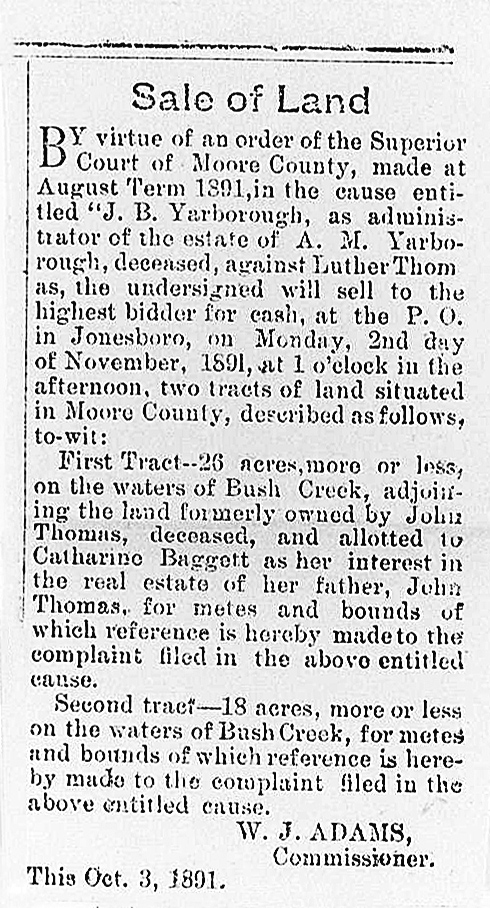
I was wrong in my thinking. In looking at the Moore County loose estate papers of A. M. Yarborough, I found a legal notice for sale of land arising from a suit against Luther Thomas. Note that Archibald Murphy Yarborough below owned land in Chatham County near Avent’s Ferry. And some of his land originated or at least had passed through the hands of Joseph Thomas [III] and Ishmael Roberts, a free person of color. The land in question lies on water of Bush Creek which is also near the estate lands of Allen Thomas and Ishmael Roberts. Bush Creek crosses the county line running from Chatham into old Moore County where it appears this land was located. And note that the said Allen Thomas of Chatham County died in the mid 1800’s leaving a division of land naming one of his heirs as being Luther Thomas. Did this suit grow from the estate of Allen Thomas as was passed down through his son Luther? I’m not sure.

AM Yarborough . Moore County

Looking at the above legal notice, note that it appeared in print on 3 Oct 1891. Being over one hundred years after the birth of John and Mary Oaks Thomas’ daughter Catherine, the 26 acres in question adjoined that “formerly owned by John Thomas deceased and allotted to Catherine Bagget as her interest in the real estate of her father, John Thomas.” Wow!! …in a burn county we now know roughly where John Thomas lived. And though there is no surviving deed or estate records spelling out what became of his land upon his death, this one parcel or share of his estate can be located if only we can locate the adjoining 26 acre tract that once belonged to Luther Thomas. About fifteen years following this legal notice, Lee County was cut from Chatham and Moore County. It might be possible through a title search to locate the John Thomas lands in either Moore County (after the courthouse fire) or early Lee County records.

Beyond this huge clue as to where John and Mary Oaks Thomas may have lived, this record clearly establishes Catherine Bagget to be their daughter. It also fits the timeline of Catherine and her husband’s removal to Georgia. It’s possible she never returned to Moore County to claim her share in her father’s estate.

So, ….back to the estate of Joseph Thomas [III]. Was Catherine who purchased from the estate the same person who was identified in later records as being the daughter of John Thomas? I’m not sure.

catherine page 469

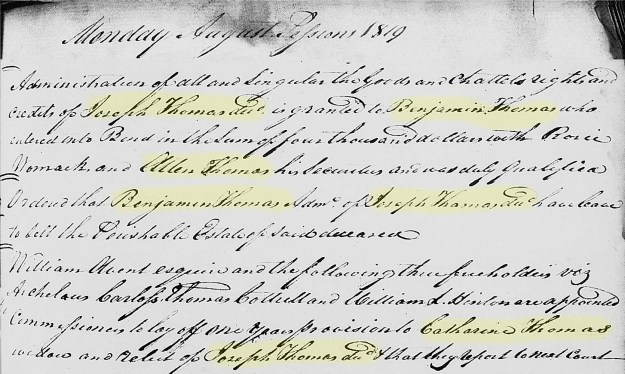
In the above court minutes dated Aug 1819, administration of the estate of Joseph Thomas [III] was granted to his son Benjamin Thomas with Rorie Womack and son Allen Thomas entering into bond in the amount of $4,000. Using an inflation calculator, $4,000 in 1819 is roughly equivalent to $75,000 dollars in 2017. So we know that Joseph Thomas [III] left a sizeable estate. We also know in later court minutes that the estate was ultimately settled by Joseph’s son Allen. I can only imagine what led to the change away from son Benjamin.

And, very important in this discussion, note that the last entry in the above court record reads:

William Avent esquire and the following three freeholders viz; Archelus Carloss, Thomas Cottrell, and William L. Hinton are appointed Commissioners to lay off one year’s provision to Catherine Thomas widow and relict of Joseph Thomas dec’d & that they report to next court.

Once again we’re at the end of a post and we’ve learned some really cool history. We now know that at his death, Joseph Thomas [III] was married to Catherine Thomas. So you can call her Martha, and you may call her Patsy, but I think she’d like to be known by her real name. And as for a question I can’t answer, who was Catherine named in the estate sale of Joseph Thomas [III]? Was it Joseph’s widow or was it his granddaughter? Were both there at the estate sale and were they both listed as making purchases? I think we’ll never know that answer.

LOST CREEK SETTLEMENT(S) (PT 4)

I’m accustomed to the old south as being the way I’ve always envisioned it. Females in early records are seldom mentioned. And likewise, there is little to no mention of blacks or “people of color.” This all changed for me when I began looking at the neighborhood of Joseph Thomas and of his neighbors including Ishmael Roberts. None of what you’re about to see will be an easy read but is very much necessary in understanding what may have happened. Let’s take a look.

Dated 6 Dec 1819, Joseph Thomas’ Chatham County estate sale included purchases by several people of color:Under Jonathan Lindley-8The above listed John C. Waldon, whose middle name was Chavis (a well-known and prominent African American surname) is first found in Virginia. The name later appears in records of Northampton, Warren, Wake, Randolph and then Chatham Counties North Carolina where members of the family are listed in census records as free people of color. John C Waldon purchased large amounts of land in both Chatham and Randolph Counties. On 12 Sep 1829, being ten years after the above recorded estate sale of Joseph Thomas, John Waldon wrote his last will and testament in Chatham County NC. His wife and thirteen children are named along with over 500 acres situated in both Chatham and Randolph Counties.
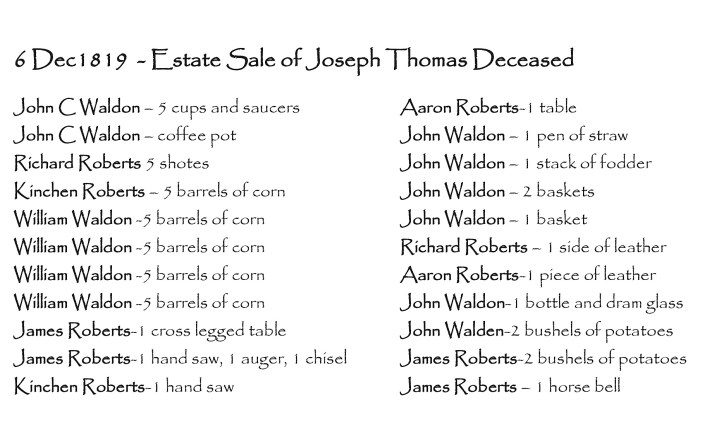
It is said that Allen Thomas, the son of elder Joseph Thomas [III]  married  Nancy Ann Weldon who is believed to be the daughter of John Weldon Esq later of Moore County. And yet, Allen Thomas owned a sizeable amount of land just to the west of the lands to be studied in this post. Curiously, the said Allen Thomas’ land adjoined that of the above mentioned John C Waldon who we know to be a person of color. There are also deeds to Bartley and James Walden and to “John Waldon” but none for John Weldon. In Aug 1821 a deed from Philip and Sally Johnson to Aaron Thomas was proved by oath of John Thomas and the private examination of the said Sarah was taken by David Reid and “John Welden” Justices of Peace for the County of Moore. Is it possible that John Waldon who buys from the estate of Joseph Thomas is the same as John Weldon who was later listed as Esquire in Moore County? If different, are we sure which family Allen Thomas married into?

And as for Ishmael Roberts in the above written estate sale, he was likely born ca. 1750 in Northampton County NC where on 6 June 1789 Ishmael was named in his mother Margaret Roberts’ last will and testament. Like others in the area, Ishmael is identified as “Free People of Color” or mulatto. He’s believed to be a mix of black and white with tribal roots of Iroquoian speaking Tuscaroran and Meherrin along with southeastern Siouan Indian. Following the conclusion of the Tuscaroran War of 1717, the culture of indigenous peoples was nearly lost through a slow mixing with other races. It was during this period when many migrated south to present day Duplin and Roberson Counties.
It’s in Roberson County where Ishmael Roberts first appears in land records. And in 1800 Robeson County, Ishmael Roberts is enumerated as head of household of 14 people of free color. As appears below, Ishmael Roberts removed again to Chatham County where he is  listed similarly in 1810. Note that Ishmael’s living beside James Waldon and not far from his son Kinchen Roberts. Also, you’ll see Allen Thomas nearby along with Thomas Archy being enumerated near the bottom. And, as there’s so very much to learn by looking at the Chatham County lands of Ishmael Roberts, let’s go there next.
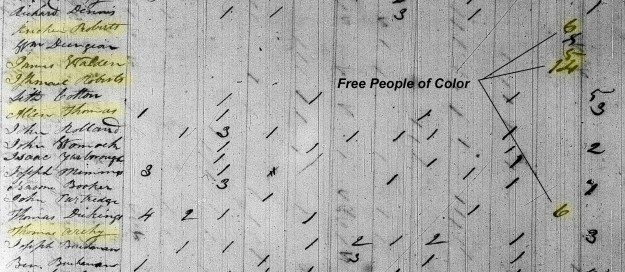
1810 census

Circa 1800, Joseph Thomas moved from Wake County across Avent Ferry to land along the Moore and Chatham County line where he received several land grants. By 1804, Joseph Thomas began selling and gifting his lands to his sons. At that time part of the land fell into the hands of Ishmael Roberts:

MAP KEY 1 [Land Grant 168 Chatham, ent. 3 May 1779, iss. 31 Mar 1780] Being 250 acres issued to Volentine Braswell crossing Bush Creek and joining his own lines and those of Drake and Yarborough.

[N-456 Chatham, 18 Feb 1804] Micajah Thomas of Moore County to Ishmael Roberts being 250 acres on the waters of Bear (should be Bush) Creek adjoining his own and Yarbro’s land. Wit: A Harper and P. Griffis

MAP KEY 2 [Land Grant 1514 Chatham, iss. 13 Dec 1798] Being 275 acres issued to Joseph Thomas adjoining the county line and lands of Thomas Partridge and Micajah Thomas]

[N-437 Chatham, 18 Feb 1804] Joseph Thomas of Chatham to Ishmael Roberts, being 100 acres on the Cape Fear joining Thomas Partridge and son Micajah Thomas. Wit: A Harper and P. Griffis. In pink below, this was a horizontal strip cut from the northern end of a tract originally granted to Volentine Braswell.

Starting in 1808, Ishmael lost part of the above 250 acres of land due to indebtedness. However, within three years the same land returned back to him. Take a look at how the following two conveyances illuminate that situation:

MAP KEY 1 [P-118 Chatham, 12 Feb 1808] George Gee Esq Sherriff to Abraham Harper “whereas by virtue of an execution issuing from the county court of Chatham against Ishmael Roberts for the sum of 16 pounds of which said sum was recovered by Thomas Stokes.” The 250 acres Ishmael had purchased from Micajah Thomas per deed [N-456 Chatham] was sold to pay the debt. Wit: B Lightfoot, Francis Jones.

MAP KEY 1 [S-26 Chatham, 14 Aug 1811] Thomas Ragland & Henry Branson Administrators of Abraham Harper deceased to Ishmael Roberts. Being a certain tract of 260 acres “sold by execution of the instance of Thomas Stokes on 9 Nov 1807 belonging to Ishmael Roberts and bought by the Abraham Harper deceased.” Wit: Zach Harmon.

Before continuing, let’s look at a few other surrounding tracts once owned by the Thomas family. You’ll notice deeds amongst brothers and possibly including Uncles and Nephews:

MAP KEY 3 [Land Grant 1511 Chatham, iss. 13 Dec 1798] Assigned to John Thomas from Jos Thomas being 95 acres on the county line and adjoining the lands of Micajah Thomas and Parham.

MAP KEY 3 [U-447 Chatham, 21 Apr 1817, Aug 1817] Frederick Thomas of Moore County to Aaron Thomas of Chatham being 95 acres. Wit: Wm. Avent, John Griffin.

And another Tract:

MAP KEY 4 [Land Grant 497 Chatham, ent 14 Aug 1779, iss 31 Mar 1780] Being 100 acres issued to Bird Braswell adjoining the Cumberland County line and lands of Joseph Yarborough. CC: Henry Braswell, Seth Cotton. Note that Bird Braswell was a Revolutionary War Soldier who had moved to Hancock County GA.

MAP KEY 4 [E-156 Chatham, 8 Oct 1790] Bird Braswell to William Parham. Wit: John Womack, Nicholas Hardin.

MAP KEY 4 [K-417 Chatham, 27 Apr 1799, William (x) Parham to Lewis Parham. Wit: Benjamin Spivey.

MAP KEY 4 [L-24 Chatham, 1800] Lewis Parham to Micajah Thomas. Wit: Frances Parham, Benjamin Pollard.

MAP KEY 4 [M-629 Chatham, 9 Jan 1805] Micajah Thomas to Frederick Thomas being the lower and smaller section adjoining the county line. Wit: James Stephens, Joseph Thomas.

MAP KEY 4 [ Chatham, 1 Apr 1817] Frederick Thomas to Aaron Thomas. Wit: Wm. Avent, John C. Griffin.

MAP KEY 4 [M-641 Chatham, 9 Jan 1805] Micajah (x) Thomas of Moore County to Ishmael Roberts being 57 acres and the larger pick shaded upper portion of the tract. Wit: Joseph Thomas, James Stephens.

Over eight years following Ishmael Robert’s first purchases in Chatham, Ishmael Roberts purchased another piece of land before his children appear in land records:

MAP KEY 5 [V-131 Chatham, 10 Apr 1818] Allen Thomas for 76 dollars to Ishmael Roberts, being 102 acres on the branch of Little Lick Creek it being part of two tracts granted to James Rains per # 1487 & 1742. This tract adjoins the said Roberts’ line, Elizabeth Rush’s line, and a stake on Little Lick Creek at the mouth of Little Lick Branch. Wit: Thos. Springfield.

The title history for the tract adjoining to the east is very interesting and ends with a larger deed for 527 acres likely including the following land:

MAP KEY 5 [Land Grant 493 Chatham, 23 Aug 1779, 31 Mar 1780] Listed as being 300 acres granted to Nicholas Partridge, later conveyances are for 154 acres. The tract adjoins lands of Drake, Henry Braswell, Abner Hill. It crosses Henry Branch and the Ferry Line near the road.

MAP KEY 5 [X-320 Chatham, 15 Aug 1821] James A. M Carroll and Cornelius and Eliz. Tyson to Kinchen Roberts being 154 acres and 2/3 part of a certain tract adjoining Drake’s corner, Braswell’s corner, Abner Hill’s line, across Henry Branch, and across the ferry road.

MAP KEY 5 and MORE [Z-1 Chatham, 23 Sep 1825] Ishmael Roberts to John H. Levin of Wake. For 1,000 dollars . The land whereon I now live and also the tracts whereon his sons James and Aaron lives meaning the land he purchased of Micajah Thomas, Joseph Thomas, and Allen Rains except 33 acres which he the said Ishmael Roberts sold to Frederick Thomas containing 527 acres on Bush Creek and Little Lick Creek adjoining the lands of Jerry Yarborough, Nathan Yarborough, Aaron Thomas, Allen Thomas, and the land whereon Mrs. Rush now lives and others …that the aforesaid tract is conveyed in trust viz; that whereas the aforesaid Ishmael Roberts is justly indebted to Joseph Hawkins in the sum of 136 dollars. Wit: Green Bobbitt.

MAP KEY 2 [A.BA-134 Chatham, 25 Dec 1828] Kinchen Roberts to Thomas Springfield being the 154 acres in deed [X-320 Chatham]. Wit: Edmund J Drake, William Sloan.

MAP KEY 5 [ AD1-354 Chatham, 4 Nov 1835] Thomas Springfield to Joseph Avent. Wit: Wm Avent, Nathan Clegg.

USGS GeoTIFF DRG 1:24000 Quad of Moncure. Product:615994

Beginning in 1825, and nearing his death, Ishmael Roberts began selling off lands to his sons.

MAP KEY 2 [A.AA Chatham, 12 Feb 1825] Ishmael Roberts to Aaron Roberts for 150 dollars being 100 acres formerly adjoining Thomas Partridge and Micajah Thomas. Being the top portion shaded in pink, this is a portion of a grant assigned to John Thomas by his father Joseph Thomas. Wit: Wm. Campbell, Lunceford Dickens.

MAP KEY 1 [A.BA-221 Chatham, 8 Feb 1825] Ishmael Roberts to Richard Roberts for $400 being a tract of 100 acres on the Bush Creek. This is the lower unshaded or green section of the tract beginning at a stake on south side of Bush Creek deemed in Nathaniel Yarborough’s line S1 E with Yarborough’s line 23.70 ch to dead pine then S 81 W with James Roberts’ line 18.34 to stake among pointers sd James’ corner S 2.50 to stake , the S 89 W31.68 ch to Bush Creek then down the creek to begin. Wit: Wm. Campbell, Aaron Thomas.

MAP KEY 6 [A.BA-330 Chatham, 12 Sep 1828] Pardon B Roberts to Isham Rosser for 75 dollars containing 102 acres it being part of two tracts granted to James Roberts and the same and as sold by Allen Thomas to Ishmael Roberts per [V-131 Chatham]. Wit. Wm. Avent, Micajah Rosser.

____________________________

Per the 1829 final estate settlement of Ishmael Roberts, the heirs sold a remaining 160 acre tract being the northern portion of the grant issued in 1780 to Thomas Springfield. As shown in the plat below, a year earlier Kinchen Roberts as representative of the heirs sold a small strip of the same land which originated with Voluntine Braswell. Not on any family histories, the plat below from Ishmael Roberts’ final estate names Thomas Springfield to be an heir. Huh?

[A.BA-186 Chatham, 3 Apr 1829] Kinchen Roberts to Thomas Springfield for 18 dollars all my interest of the undivided the lands of Ishmael Roberts deceased being a legatee of Ishmael Roberts deceased the lands being on Bush Creek adjoining the Rossers, Yarborough, Thomas and others supposed to be 150 acres. Wit: Edmund J Drake, Benja Springfield.

[A.BA-304 Chatham, 2 Feb 1830] Pardon B Roberts, Jonathan Roberts, Etheldred Roberts, James Roberts, Benjamin Roberts, Elias Roberts, Ishmael Roberts, Aaron Roberts, Richard Roberts, Zachariah Roberts, Elizabeth Archer, Mary Roberts, Margaret Lucas, Delphia Trevin, Rebecca Roberts, and Sylvia Roberts of Chatham to John W. Judd for total of $367 do sell 160 acres on Bush Creek beginning on the band of the sd creek in Nathan Yarborough’s line a horn beam corner then Ne 15.50 ch to a stake in Jeremiah Yarborough’s line, then with that line W 33.50 ch to Yarborough’s corner, then with his other line N 9 to Springfield’s line then with Springfields line W 24.75 to stake, S49.40 to stake in Aaron Thomas’ line then east with his line 7.50 to Bush Creek near below said Thomas’ mill, then down the sd creek to Richard Robert’s line it’s meanders to the beginning. Wit: Aaron Thomas, Yarborough.
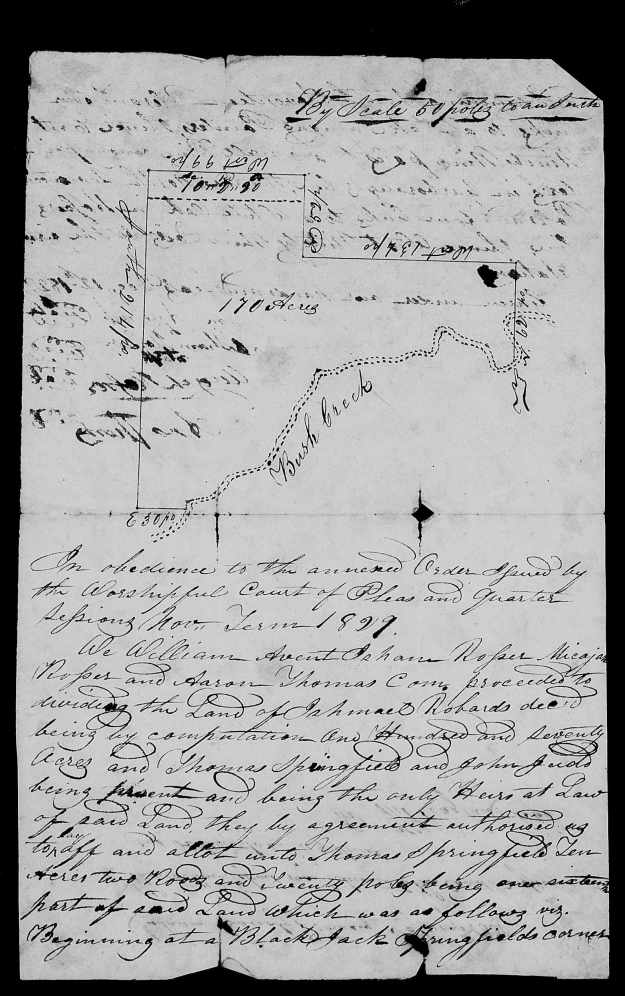
 

Ishmael Roberts

Distribution of the Estate of Ishmael Roberts. Locatable as being the top half of Map Key 1 with the land deeded to Thomas Springfield being the small strip cut out in this plat.


As I hope you can ascertain from the above, the family of Ishmael Roberts as free people removed from Robeson County and chose to live near Joseph Thomas in Chatham County. And there were others who did also. Why did they choose Chatham? And what was there about 1800 that made it necessary or desirable to move? These folks bought and sold from each other and they were there at the death of Joseph Thomas. They were neighbors and to the degree they were neighborly I’m yet to fully understand. But know that Ishmael was a revolutionary war soldier who served from 3 June 1777 to 3 June 1778 as a private in Colonel Abraham Shepherd’s Company. Colonel Shepherd gave him a certificate which stated that Ishmael was furloughed at Head Quarters Valley Forge to come home with “me” who was enlisted in my regiment for the term of three years …and returned home with me. A patriot serving under Abraham Sheppard. I find it curious that Ishmael Roberts chose to settle on lands along the county line nearby or once belonging to John and Andrew Sheppard. Is there anything to that? There are many remaining questions and it’s my hope that work will be done to bring further light to the North Carolina side of this wonderful story.


LICK CREEK SETTLEMENT(S) (PT 3)

As sure as the wind blows, something was in the air as without warning free families of color living in piedmont North Carolina began their trek north. Much like with the migratory plan of all God’s creatures, something untouchable and yet simultaneously gripping signaled the start of this mass exodus. Born of changes in society, new laws coinciding with the opening of a land of new possibilities cleared the way. Courtesy of a study of the Lick Creek Settlement https://www.fs.usda.gov/detail/hoosier/specialplaces/?cid=fsbdev3_017495  located within Indiana’s Hoosier National Forest, the following video created by Daion Morton offers a wonderful introduction of the movement and of the peoples’ journey from Chatham County, North Carolina:

We know Ishmael Roberts was the patriarch of a large family with children once spreading from Robeson to Chatham Counties in North Carolina. Penned in his own hand, on 12 Jul 1826 Ishmael “Robirds” wrote his last will and testament:

Ishmael Roberts – Last Will and Testament
To view larger images, click on one of the images and then in the bottom right side of the page click again on see full size image.  


A Chatham County court minute entry for William Avent (Executor of Ishmael Roberts vs. Heirs of Ishmael Roberts) reads: “find that the paper writing offered for probation to the last will and testament of Ishmael Roberts as regards to personal property but not his will as regards his real estate. William Avent Executor of the Last Will and Testament of Ishmael Roberts dec’d came into court and was qualified.” One month later another entry shows that any issues with the will must have been settled as the will was proved for probate by witness of Eli Yarborough.

Following his death in the late 1820’s, Ishmael’s family began selling off land in preparation of their removal to Indiana. Rather than me repeating good work that’s already been published, I recommend and hope that you’ll read the following two pages:

Ishmael Roberts at: http://lost-creek.org/genealogy/getperson.php?personID=i1723&tree=tree2

The Roberts Family at: http://lost-creek.org/genealogy/histories/feature7.php

Several of Ishmael Robert’s children removed to and lived at least for part of their lives  in Orange County Indiana. Note the intermarriages with members of the Archer family. It’ll later be shown that their father,  Thomas Archer, had lived nearby to Ishmael Roberts at time of the 1810 census:

  • Kinchen Roberts married Nancy Chavis and moved to Orange County IN prior to settling in Lost Creek, Vigo County IN.
  • Benjamin Roberts married Sally Archer in Orange County NC, moved to Orange County IN and appears late in life in Vigo IN.
  • Etheldred Roberts married Dicey Locklear of Robeson County NC and died in Orange County IN.
  • Elias Roberts married Nancy Archer and died in Orange County IN.
  • Mary Roberts married Moses Archer and moved to Vigo County IN.
  • Delphy Roberts married Henry Trevan and moved to Orange County IN prior to settling in Vigo County IN.
  • Zachariah Roberts married Mary Newsome.

In 1850, Elias Roberts is living next to Matthew Thomas in Orange County Indiana. Both Elias and Matthew are enumerated as black and their families are considered to be mulatto. They were both born in North Carolina while their children were all born in Indiana. And, notice that Matthew Thomas has a son named Joseph. Elias Roberts is quite well off in terms of worth as his holdings are enumerated to be valued at $1,000.

1850 orange

I’ve yet to find any record clearly connecting Matthew Thomas with the family of Joseph Thomas in Chatham County, North Carolina. That said, coincidences of location, naming and timing leads me to believe it remains a possibility. DNA testing and further studies may uncover the truth one way or the other.

Some of the children of Ishmael and Sylvia Archer Roberts migrated further west to what’s called the Lost Creek Settlement in Vigo County located near present day Terra Haute IN. More on Lost Creek can be found at: http://lost-creek.org/genealogy/histories/feature1.php

One of the strongest connections of this family to Chatham County NC is through the lands of Ishmael Roberts and his son Kinchen.  We know that Kinchen Roberts moved to Orange County IN before settling west in Lost Creek. Kinchen’s son Banister is believed to be the first of the immediate family to die in Vigo County and he’s buried in the Roberts Cemetery which is located on lands once belonging to Kinchen Roberts http://lost-creek.org/genealogy/showmap.php?cemeteryID=4. Others in tbe family whose paths led to Lost Creek Indiana include siblings Benjamin, James, and Delphy Roberts whose lives are outlined above.

And in another migratory move, some of Ishmael’s children moved to Owen County IN:

  • Pardon Bowen Roberts married and was among the earliest settlers in Spencer, Owen County IN.
  • Aaron Roberts married Jany Terry in Robeson County NC and removed to Owen County IN.
  • James Roberts married Polly Stewart in Owen County before moving further west to Lost Creek in Vigo County.

And in one other migratory move for the family, some of Ishmael’s children moved to Beech Settlement in Ripley, Rush County IN. They are:

  • Richard Roberts married Edith Newsome and moved to Ripley, Rush County IN.
  • Aaron Roberts who married Jany Terry in Roberson County.

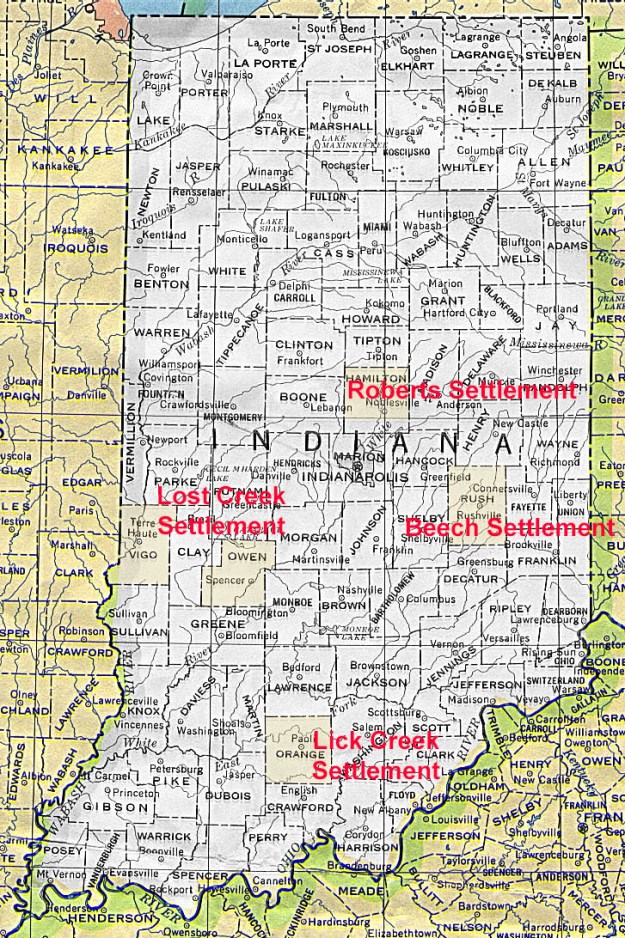
The map below locates settlements in Indiana whereupon lived the Roberts Family and others of earlier in North Carolina.

indiana_90

_____________________________________________

Remember that Ishmael Roberts was named in his mother’s last will and testament which was probated ca. 1785 in Northampton County NC? Also from Northampton, several other families of Roberts, Chavis and others made their way to Indiana to a place they called the Roberts Settlement. Located a bit to the north in Hamilton County, this is yet another significant stopping point for free families of color who had once lived in North Carolina. Please take a moment to read through an organizational site for the Roberts Settlement http://www.robertssettlement.org/  where is linked the following PBS program.

In closing, I have to point out that there is so very much on this family and yet it must be  so very personally strong for those whose families are descendants. With that in mind, I  feel that further discussion of life in Indiana should be told by those within the family. My purpose is merely to point out the possibility that here in North Carolina, the beginnings of the story being told may be similarly rich in context. And, somehow there’s a tie to the Thomas family both here in North Carolina and also in Indiana.  I have no proof that Matthew Thomas of Indiana is related to Joseph Thomas of Chatham County NC. However, maybe after reading this, some other person may provide the DNA evidence needed or find some other clue to make the case.

Seeing this broad, deliberate and spreading migration of family in Indiana, let’s turn back to Chatham County to look closer at records there.

LICK CREEK SETTLEMENT(S) (Pt 2)

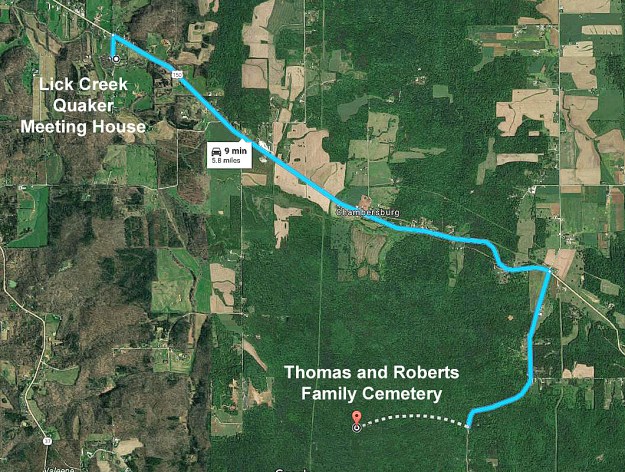
Hmm …while in Orange County Indiana, if only I had driven another mile or so down Hwy 150 before taking Greasy Gravy Road south? My perspective on the Lick Creek Quaker Meeting would have certainly changed in learning of another place now called the Lick Creek African Settlement. But maybe it wouldn’t have been a big deal back then as at that time I was totally unaware of the people who had lived there in Paddy’s Garden and of their connection to my own extended family in Chatham County NC. It’s amazing that I had travelled so very far to find a family who I now know not to be mine and yet drove so close to families whose story really was.

lick directions

Lick Creek Settlement is the historic home of free people of color who had removed from North Carolina in the early 1800’s. As the winds of slavery grew increasingly brutal, changes in law and culture made it impossible for free blacks and people of mixed race to remain in the state. From their settlement near the Lick Creek in Chatham County, North Carolina, these folks sought a better life in a new land along a creek of same name in Indiana.

Supported communally on both ends of their journey by the Quakers, an African American settlement was created in Indiana within two miles of the Quaker’s Lick Creek Meeting House. Both blacks and whites had made the trip from North Carolina. It was no different than were the actions Quakers had taken during the Revolutionary War. However, because the blacks settled among the Quakers in Orange County Indiana, it seems that contemporary belief has them as also living near each other in North Carolina. But, that’s not completely so. It’s my belief the free people of color removed from another location not far away along the Moore/County lines where they had lived peaceably. And equally important, I think it in error to refer to this migration of free people as being just black, colored, or African American. Beyond being black, records in North Carolina clearly trace the families as multi-racial, being rooted in peoples known as Saponi, Tuscarora, and Lumbee. We are all defined through our pride as people and for those who moved to Indiana, their heritage as part-Indian or indigenous people should not be underestimated. And, in degrees not fully recognized, these free people of color certainly mixed with the local white population.

Deep in the Hoosier National Forest along Indiana’s border with Kentucky, archeological evidence shows that life in the Lick Creek Settlement went well for a short period of time. That is, until the wrongs of the expanding slave taking society once again knocked at their back door. Starting in the 1820’s, the new state of Indiana forbid slavery and any prejudicial treatment of people based on race and belief. But by 1840, things were changing even in Indiana. No longer was it advertised as a safe haven, a refuge for African Americans escaping the southern culture.

There were raids across the Kentucky border along with accusations of criminal behavior. The wooded land in southern Indiana did not support the agrarian way of life. Once more, starting in the 1840’s, the people defined as colored or black began another move in search of better lands and a better way of life.

Thomas – Roberts Cemetery

Today, there’s little to remind us of the community of people who once lived along the Lick Creek in Indiana. There are the remains of an old cemetery once referred by some as Little African. However, that location is also fondly known to be Patty’s Garden by those whose ancestors lived upon the land. Today the cemetery is formally identified as being the Roberts and Thomas cemetery in honor of the community’s earliest leaders. Elias Roberts had once lived in North Carolina on lands his father Ishmael purchased of Joseph Thomas in Chatham County. In Indiana, Elias gave land for the early AME church and cemetery. The cemetery is also named in honor of Matthew Thomas who‘s recognized as the first settler at the Lick Creek Settlement.

My quest in this series of posts is to outline the journeys made by the Roberts family in hopes of shedding light on Matthew Thomas. I’m also in search of community and what life was like along the areas surrounding Lick Creek in Chatham County. Was Elias Roberts friends with my racially white Thomas family? Was Matthew Thomas named for or somehow related to the family of Joseph Thomas in Chatham County, North Carolina? Was he named for or somehow related to that other family …the Quaker family of Lewis Thomas who had made the trip from Piney Grove Meeting in southern North Carolina?

Much has been studied, written and televised on the migration north of the Roberts Family. The family was large and it quickly spread beyond one particular area of Indiana. So, before making connections to family records here in North Carolina, let’s look at the Roberts Family, where they lived and what’s out there linking them to my person of interest …Matthew Thomas.