
Courtesy of State Archives of North Carolina
It has been many years since the colonists began their separation from the control of Britain. Talk increasingly spread across the landscape as the voices of descent frequently heard during government assemblage grew more loudly. It was during this time of our becoming Americans that such calls for freedom took on the tone of war. In celebration, “in 2026, America will commemorate 250 years since the signing of the Declaration of Independence and the development of a new nation dedicated to “life, liberty, and the pursuit of happiness” . North Carolinians can be especially proud in that the regulator movement and other political skirmishes within our borders can be rightfully viewed as leading the effort. And not to be overlooked, in response to the tea act passed by the British Parliament in 1773, a group of 51 women gathered on October 25, 1774, to sign the “Edenton Resolve.” For what is known also as the Edenton Tea Party, numerous 250-year celebratory remembrances will reverberate across our state during the latter half of October and into early November (see AMERICA 250NC). And thinking about all my cousins and distant relations from long ago, I am amazed to have stumbled upon a connection to our Rocky River home. It’s there where Gideon Green once lived, and he is the one whose Aunt Elizabeth attended the famed down-east tea party. And if I have read the documents correctly, my Burris family also has a round-a-bout tie to the tea party. I hope to share more on that family later following a related presentation at this year’s Solomon and Judith Burris reunion taking place on October 12. So, when seeing the promos, and historical writings about things most people can only imagine, I ask the reader to realize that you too may have good reason to celebrate America 250.
Where do I begin? Before delving into any ancestral struggle for independence, a bit of corrective genealogy is in order. Firstly, Beaufort County History attempts to weave the life of Gideon Green’s son Leonard through a person named Farnifold Green who is credited as the first person to patent land in what is now Beaufort. A mistaken assumption and instead, I believe Gideon traces back to a person named Leonard whose grandfather, Richard Green Senior, received a 1667 patent near the Virginia line along the Chowan River. And about Gideon Green before arriving to the Rocky River, he is called upon in 1772 Wake County to witness a legal dispute per a civil action paper. Also named on the slip of paper is Joseph Thomas, whose yDNA perfectly matches my Benjamin Thomas family who settled next to and interacted with Gideon in the 1780s Anson County. Not only does Joseph Thomas have known ties to Leonard Green of Wake, in one fell swoop my Thomas family of Anson County is now genetically one with another Thomas family whose descendants spread across Wake, Chatham, Moore, and Lee Counties. Furthermore, my imagination of some preexisting link between the Green family and my Thomas family can now be proven as valid. At the heart of proving this connection is a slip of paper that clearly mentions Gideon Green. Thank-you Gideon for leaving this much-needed piece of evidence in Wake County:
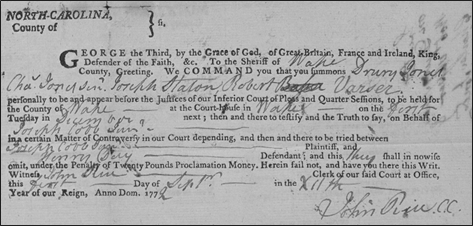
Courtesy of State Archives of North Carolina
Gideon certainly goes back to Leonard Green who appears both in old Montgomery County and in Wake County near the above-mentioned Joseph Thomas. It is said that Joseph Thomas hails from Bertie County, but hesitantly, I wonder if another path carried him alongside Leonard Green and others by way of a migratory stop in Edgecombe County. This is not the time for that discussion.
Back to the Green family, on 13 Sep 1742 in Edgecombe County, Richard Green penned a Last Will and Testament (LW&T) in which he claims Chowan County to be his home. Richard gives land individually to his sons before mentioning them collectively: “I also give to my five sons Richard Green, William Green, Thomas Green, Lonard Green, Jacob Green, my wife’s land for which their own need.” One would instantly think that Richard had five sons. And of this number, each is bequeathed land such that the descriptions provide helpful information for understanding the family movement back to the original 1660s patent. However, a son is missing as one other is called out separately:
“Item: I give and bequeath to my son John Green twenty shillings to be raised
out of my estate.”
While each son was given land, Richard Green bequeathed twenty shillings to his son John. Such is usually the case when out of fairness, an heir already held ownership or was somehow in possession of real property. And while most of the sons drifted west, we now know that John remained down east.
Much more could be said about the family of Gideon and his probable father Leonard Green though the subject of this post involves the lesser-mentioned John Green, who happens to be Gideon Green’s uncle. It’s a rare treat to be able to share information about down-east kinfolk as relates to the dirt farmers who settled along the Rocky River. Records indicate that John Green remained along the Chowan River where less than a month before appearing in his father’s LW&T, he purchased from William Bly [Blythe] a 150-acre piece of land on “Indian Branch beginning at the mouth of a branch running out of Catherine Creek pocoson [swamp].” Situated near land owned by the ailing Richard Green, the acquisition possibly precluded John’s need to receive land through his father’s LW&T. Furthermore, per the Native American Project, Roberta Estes shares the following narrative concerning the nearby Chowanoke Indians:
“The Chowan Reservation originally lay in what is now Gates County, on the banks of Catherine’s Creek and Bennet’s Creek. It seems to have consisted mainly of swamp land, roughly 17 square miles in 1729. The land was sold off steadily through the 1700’s until by 1790 the tribe had been reduced to nothing.”
John continued to own land along the Virginia road though he quickly moved a bit south along it to where he is found in the governmental town of Edenton. Moving forward to the 1760s, court and deed records identify John Green as purchasing numerous lots in Edenton. Identifying him as a carpenter, one such document calls out three houses 36’ x 18’ in size. And from North Carolina Architects and Builders, John was called upon to make repairs to the courthouse. And for the historic St Paul’s Episcopal Church, “John Green accomplished the joinery work of putting up the pulpit (since lost).”
It is believed John Green married Elizabeth Branch, the daughter of William and Elizabeth Branch. A widow, John’s wife married first to Edward Underhill, who died circa 1757. John’s Last Will and Testament (LW&T) was penned in Nov 1779 in which he identifies himself as “Inn Keeper.” His wife Elizabeth is given the liberty to choose from household items. And noteworthy, the will is witnessed by William Hoskins.
Charged with the task “to digitally publish exhibits on various special topics,” the North Carolina Office of Archives and History created MOSAICNC where can be found the following concerning John Green. He was “a staunch advocate for the Patriot cause during the American Revolution, Green served as a member of the Edenton Committee of Safety in 1775.” The bio includes his signing of “a bond promising that Thomas Hoskins would appear before the Edenton District Superior Court in May 1778.” A year before John Green’s LW&T was written, the said Thomas Hoskins came to court to declare and “bear faithful and true Allegiance to the State of North Carolina, and will truly Endeavour to Support, Maintain, and Defend the independent Government thereof, against George the third, King of Great Britain, and his Successor.” Note that Thomas Hoskins’ brother William witnessed John Green’s LW&T.
If the foregoing is not enough to raise the brows of Green family rooted along the Rocky River, note that Solomon Burris’ mother may be Thomas Hoskins’ sister. Not only did our Burris and Green kinfolk once know and likely spend time with each other back in Edenton, in round-a-bout ways, they also were there for the famed tea party. More on the Burris connection at the upcoming reunion. But, for now, four years before assuring that Thomas Hoskins would appear in court to declare his allegiance, Gideon’s aunt Elizabeth joined a group of women to voice their support for the American cause against unfair taxation. Considered the first such gathering of women in America, Mrs. Penelope Barker organized the meeting at the home of Mrs. Elizabeth King at which time resolves were drawn to boycott English tea and cloth.
Proudly referred by North Carolinians as the Edenton Tea Party, a message dated 16 Jan 1775 in the Morning Chronicle and London Advertiser provides the following account along with the only authentic list of signers.
Extract of a letter from North Carolina, Oct. 27:
The Provincial Deputies of North Carolina having resolvd not to drink any more tea, nor wear any more British cloth, &c. many ladies of this Province have determined to give a memorable proof of their patriotism, and have accordingly entered into the following honourable and spirited association. I send it to you, to shew your fair countrywomen, how zealously and faithfully American ladies follow the laudable example of their husbands, and what opposition your Ministers may expect to receive from a people thus firmly united against them.
RESOLVED
As we cannot be indifferent on any occasion that appears nearly to affect the peace and happiness of our country, and as it has thought necessary, for the public good, to enter into several particular resolves by a meeting of Members deputed from the whole Province, it is a duty which we owe, not only to our near and dear connections who have concurred in them, but to ourselves who are essentially interested in their welfare, to do everything as far as lies in our power to testify our sincere adherence to the same; and we do therefore accordingly subscribe this paper, as a witness of our fixed intention and solemn determination to do so.
Abagail Charlton Mary Blount
F. Johnstone Elizabeth Creacy
Margaret Cathcart Elizabeth Patterson
Anne Johnstone Jane Wellwood
Margaret Pearson Mary Woolard
Penelope Dawson Sarah Beasley
Jean Blair Susannah Vail
Grace Clayton Elizabeth Vail
Frances Hall Elizabeth Vail
Mary Jones Mary Creacy
Anne Hall Mary Creacy
Rebecca Bondfield Ruth Benbury
Sarah Littlejohn Sarah Howcott
Penelope Barker Sarah Hoskins
Elizabeth P. Ormond Mary Littledle
M. Payne Sarah Valentine
Elizabeth Johnston Elizabeth Crickett
Mary Bonner Elizabeth Green
Lydia Bonner Mary Ramsay
Sarah Howe Anne Horniblow
Lydia Bennet Mary Hunter
Marion Wells Tresia Cunningham
Anne Anderson Elizabeth Roberts
Sarah Mathews Elizabeth Roberts
Anne Haughton Elizabeth Roberts
Elizabeth Beasly
Of all the stories from which to anchor one’s heritage, I find it remarkable that my simple family of farmers from western North Carolina can be remotely connected to such people and such an event. Does one raise a cup of tea in memory, or instead, should we withhold? Never placed in the position to even consider best etiquette, there’s lots to consider as October turns to November.
 They Lived Along a Rocky River