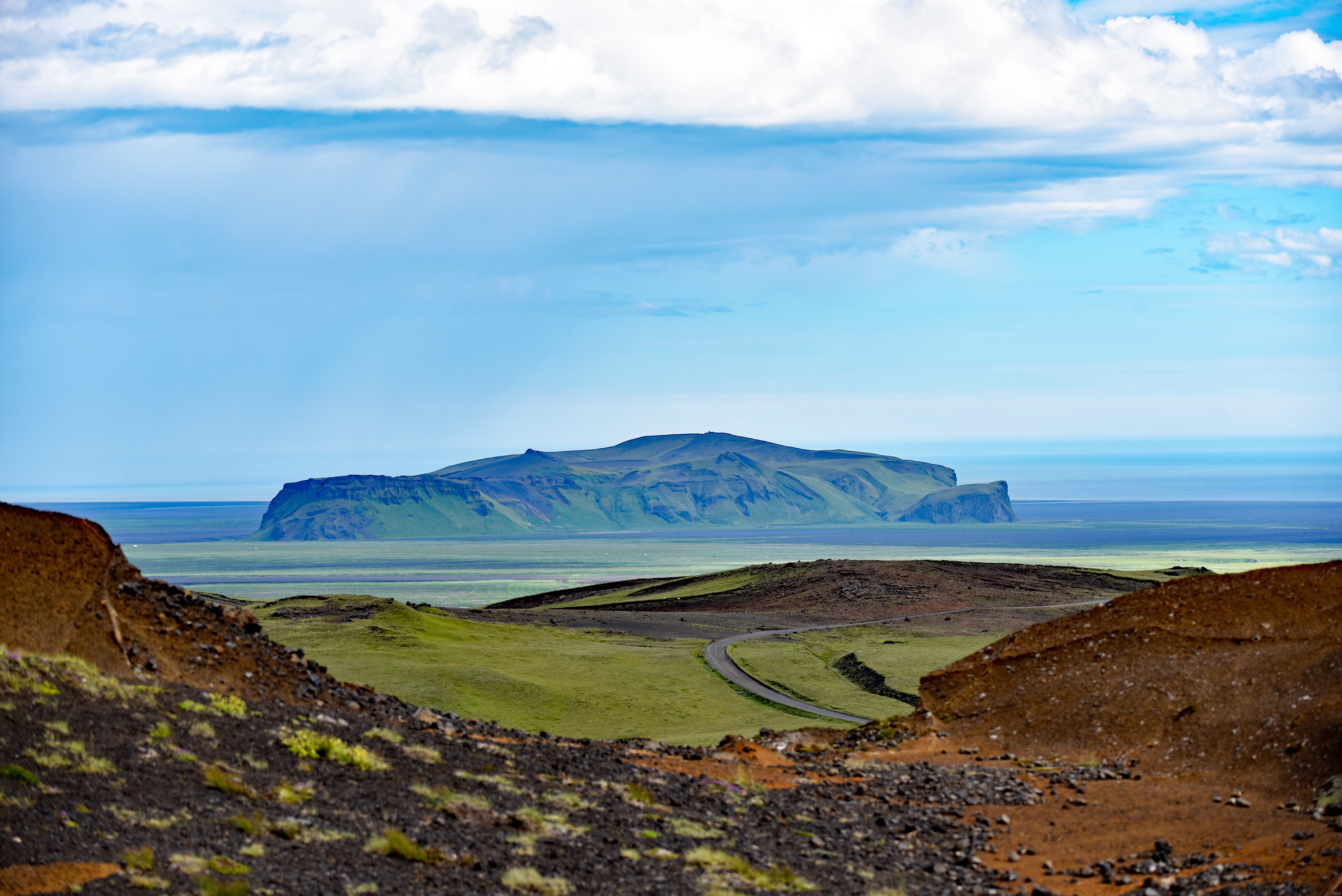
Hjörleifshöfði, Iceland
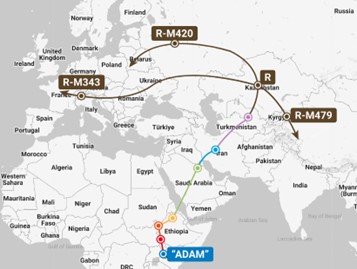 I grew up a happy towheaded young’un with hair indicative of some Northern European descent. My view concerning ethnicity began to change as my hair browned with age. Being a THOMAS with believed heritage originating in Wales, the advent of yDNA research through FamilytreeDNA.com led to beginnings much deeper in time (see Adam, right). Note that yDNA research traces son to father ancestry ever-so-deep into time without the dilemma of genetic halving encountered when using autosomal testing products such as can be purchased through Ancestry.com.
Chromosomally, yDNA traces a person’s direct paternal line deep into time while autosomal testing cannot accurately reach further than say 7-8 generations. Sadly, and unlike as would be the case with more recent points of entries in places like Galveston or Ellis Island, the tool begins to fail many of those of us rooted in early North Carolina roughly at the time our ancestors arrived in this new world. Hence, the tool fails many North Carolinians during a time beyond what can be rightfully studied through the simple autosomal tools purchased commercially. But autosomal testing is both a great tool for discovering more recent cousins along with finding clues as to the widespread origins of all the different genetic ethnicities making up who we are today. And while yDNA traces the paternal lineage deep into time, improved autosomal studies give us a greater understanding of communities and how people recently migrated together across the landscape. Again though, it’s sad for this family historian that such tools once again fail to pick up on the generations of family and friends as they entered our state from Virginia circa 1700. It’s a tough reality to imagine what atDNA could do for my family research if it were accurate for a mere two or three more generations back in time.
With tool talk now out of the way, I’d like to share a bit on a recent vacation along with how that experience has impacted the way I see my family. You see, the recent opening of a flight hub out of Raleigh-Durham in North Carolina has enabled me and family to explore the remote reaches of Iceland. Also, my sister-in-law, who is born Danish, has always been proud of her Viking heritage and has told me I needed to watch the TV show VIKINGS, which I have. I also read about the geology and history and what life is like in Iceland where each new day reveals changes in its physical landscape. Straddling the Mid-Atlantic Ridge, volcanic rising pushes new material both east and west, adding daily to the North American and Eurasian tectonic plates. Just as occurred when Greenland migrated over the same hotspot eons ago, Iceland is now being reshaped by our planet’s volatile core. More on that later, but for now, note that it turns out that my autosomal DNA (atDNA) report through Ancestry.com does impact the way I should perceive what I’ve learned on my vacation to Iceland.
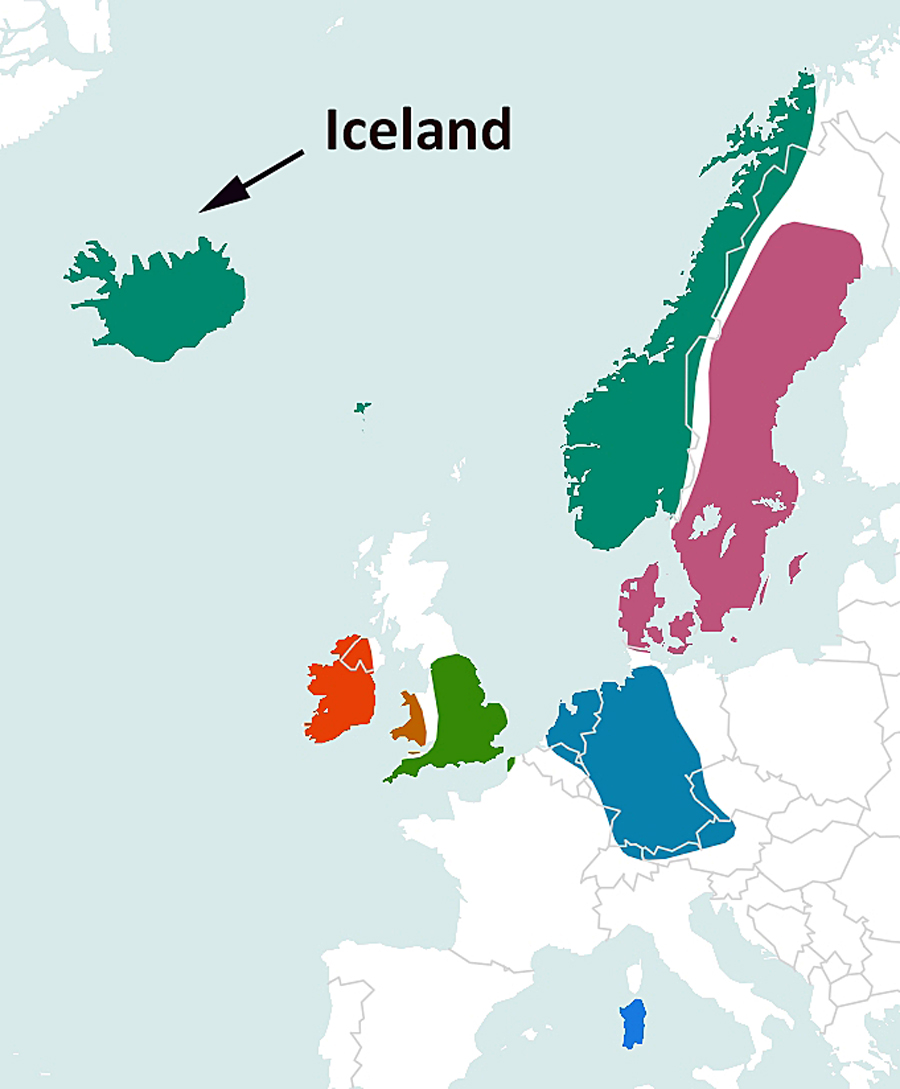 Testing with Ancestry provided the following map indicating the regions of the world where autosomal DNA looks most like mine. Of peculiarity, atDNA like mine is found in Iceland, Ireland, England, Norway and Sweden, but oddly not in Scotland ….drats! Note that the image (right) is a composite, combining results from both my father and mother. But which is which? Also included in the report is a breakdown of the places most matching my two parents, but again, which place matches which parent? To answer that question all I needed to do was to look separately at reports for known cousins on both my mother and father’s side of the family. Doing so allowed me to assign places representing atDNA reports most-closely matching each parent. Ancestry.com provided the following with the assignment of parentage determined by me.
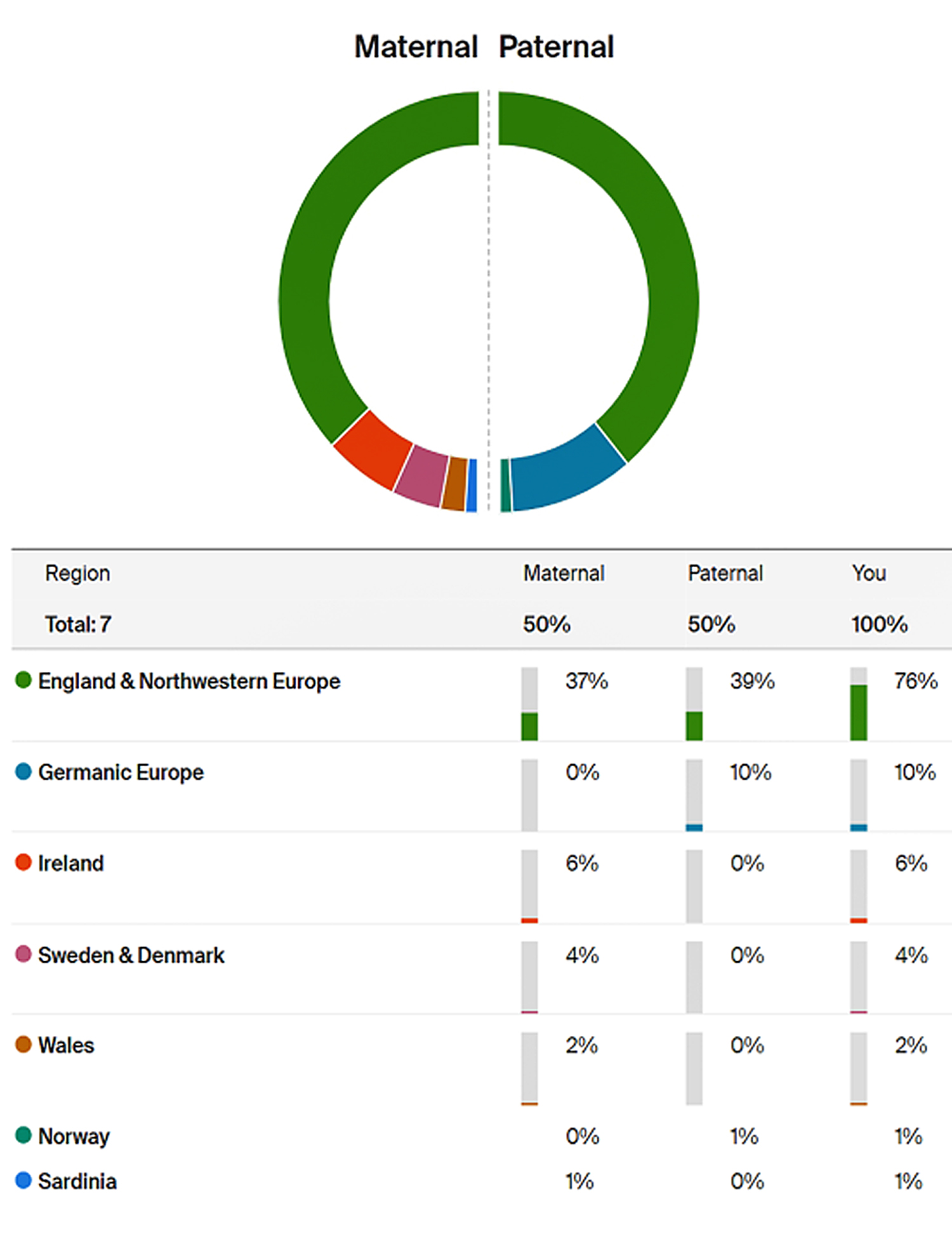
So somehow, I may be made up of a wee bit of Icelandic heritage apparently accounted within the 6% of the Norwegian/Sweden genetic make-up gifted to me by my mother. My mother is the daughter of William Love and Minnie Anne Love who both being distant cousins in the same Love lineage, share a heritage believed to be Scottish/Irish. As for any Viking admixture, it is known ca. 790 that the warrior people raided and lived in the northern reaches of both Ireland and Scotland from which it is believed women were enslaved for wives and in preparation for Viking ventures west to Iceland and beyond. Furthermore, I learned on our trip that Irish Monks may have preceded the Viking move as some say that Irish monks founded a monastery possibly utilizing lava tubes to protect them from the wicked weather. And finally, when enquired about in a genealogy-DNA Facebook Group, friend Tammie Rabon Hudson responded that her mitochondrial (mtDNA) test indicated that her direct matriarchal or female lineage leading to her existence in Stanly County is mapped out as passing from Sweden/Norway in part through Iceland. Like yDNA, mtDNA traces one’s direct maternal lineage deep into time; possibly reaching to a time before surnames were first used.
Believing numerous equally viable and unprovable possibilities exist from which to explain my genetic ties to Iceland, I’d like now to share just a bit on what I learned during my visit concerning Vikings and where they lived on the Island country.
Travelling Road 1, also known as Ring Road around the perimeter of Iceland.
Location names in the Icelandic language are long words, usually formed as composites of several words representing the place in totality. Driving Ring Road beyond the town of Vic (meaning Bay), we passed south of Katla, one of the largest and most explosive volcanos in Iceland. Katla is covered by the large glacier Mýrdalsjökull, meaning “Bog,” “Open Valley,” “Glacier.” We turned north onto F Road 214. Note that F roads legally require 4-wheel drive and in the case of 214, the road’s common name is Kerlinggardalsvegur which means “Old Lady,” “Shelter,” “Road.” Note that Google is a must for this sort of vacation. The road dead ends into a sheltered camping area suitable for deeper exploration. Nearing the top of the remote road, we came upon Katla Geopark, a grotesque volcanic landscape bringing to mind pterodactyls, tyrannosauruses, and other critters from long before man. And juxtapositioned against all that one may imagine, an overlook peers upon the greenest of green surrounding an enormous glacial flood plain filled with a record amount of black volcanic debris. Seen in the photo below is a dormant and wasting volcanic core rising above it all in the extreme far distance where the glacial wash meets the ocean. The little hill in the distance is a special place in history called Hjörleifshöfði. According to Wiki, the place received its name from the first legendary settlers who lived in Iceland.
 Accordingly,
“Hjörleifr Hróðmarsson was the brother-in-law of Ingólfur Arnarson, Iceland’s first official settler. He settled at Hjörleifshöfði towards the end of the ninth century. There, however, he was slain by his slaves. The slaves fled to Vestmannaeyjar, where Ingólfur took his revenge for his friend and slew them. On the top of the mountain is a mound called Hjörleifshaugur, where Hjörleifr is said to be buried.”
To learn more about this place I advise the reader to look at the following blog site with post written by Regína Hrönn Ragnarsdóttir:
Hmmm, could the slaves held at Hjörleifshöfði have been Irish, maybe some distant kin to folks I’d call my own? That’s a maybe, or were they possibly from a time of Norwegian Vikings? Were the Vikings themselves somehow my kin? So many possibilities and it is important to honestly state that absolution in truth lies far beyond what we can glean from history. Iceland is a land of lore, yet, several days after passing the volcanic plains leading south from the mighty Katla, news spread across Iceland and the world also of a great glacial melting in the spot we had recently visited. Our trip turned into serious business. Maybe from seismic heating underlying the glacier, but certainly enhanced by a wetter than normal summer, the routine and temporary thawing of glacier overran the Ring Road, washing out an important bridge. See: https://www.msn.com/en-us/video/weather/glacial-flood-waters-inundate-road-in-southern-iceland/vi-BB1qMAFQ?ocid=BingNewsSerp&t=8
Our adventure carried us to stops up the eastern fjords and east across the country’s North where we finally reached another stay at the farming community of Varmahlíð, which means “Warm,” “Hill.” Timing on such trips require one to cut some of the initially desired stops from the itinerary and in this case, if time had allowed, we could have driven an hour to the north coast where stands a monument to Hrafna-Flóki Vilgerðarsson, a Norseman and important character in The Vikings who intentionally sailed to Iceland in the year 868. During our stay at the Varmahlíð Hotel, prominently placed near the elevator was a poster identifying the various Vikings known to have resided in the region. Also, needing medicine and having to go to the nearby town of Sauðárkrókur, meaning “Sheep,” “River,” “Hook,” we stopped by a small Lutheran Church beside a wonderfully reconstructed Viking Village (below).
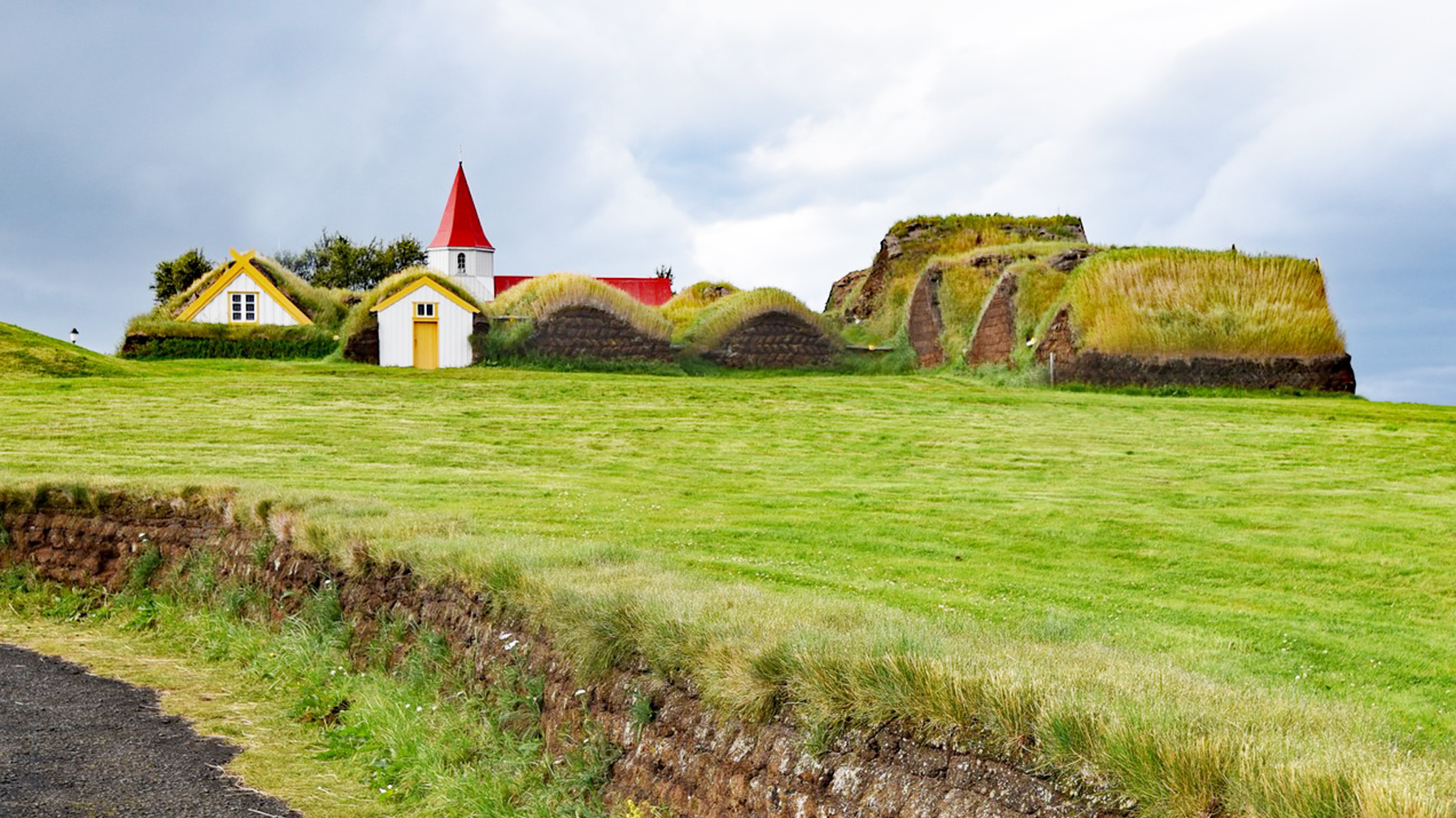
 The village was made entirely of sod, much like was constructed by Norwegians and others who settled the American West. And in front of the little church stood a small monument of a mother and child entitled the first mother in America.
At this point our trip turned south and west, towards the Western Fjords and the Snaefellsnes Peninsula where Jules Verne found inspiration to write his novel Journey to the Center of the Earth. But before reaching the peninsula and after passing the southern-most point of Hrútafjörðu, a northwest fjord meaning “Male,” “Sheep,” we chose to head to Snaefellsnes by way of another F road. This time driving on the rugged F 586, we forded a deep stream numerous times on what was the most rugged leg of our journey (see video: https://www.youtube.com/watch?v=IcXGmzYxV18&t=6s). We followed a valley floor where it is said Lief Erikson, the first European to walk on Continental American lands, was born. On F 586 we drove past a reconstructed Viking longhouse rightly called Eiríksstaðir, believed to be the homestead of a person known as Eiríkr Þorvaldsson, otherwise called Erik the Red. Erik had been banished from Norway and would also be exiled from Iceland during which time he explored Greenland where he settled and his life ended. From Wiki, a bio for Eiríkr Þorvaldsson tells of his land:
“a site thought to be that of the original farm has been investigated by archaeologists and remains of two buildings dating to the 9th–10th centuries have been identified. An open-air museum has been established nearby.”
It is believed Leif Eiríksson, Erik the Red’s son, was born in Iceland, possibly at this site. Every school kid has learned of Leif and his walk on the North American Continent before Columbus.

There is much more I want to explore and write about though Iceland is physically very far away and even more so in terms of any genetic path leading to its people. Yes, it’s possible my folks once walked the land, though it’s far more plausible that I touch ancestry with others who did in fact walk the land. The tools used for researching genetic heritage only improve as sampling broadens with every new person buying the commercially available products. And for yDNA, I hope someone, someday, will be tested whose data reveals new and undeniable branches of my THOMAS tree deep into time. What a fun trip for now and looking back across the road to Snæfellsjökull, I leave you with a final photo until we meet again …. Skål!

 They Lived Along a Rocky River